We Finally Know How Ancient Roman Concrete Was Able to Last Thousands of Years
The ancient Romans were masters of building and engineering, perhaps most famously represented by the aqueducts. And those still functional marvels rely on a unique construction material: pozzolanic concrete, a spectacularly durable concrete that gave Roman structures their incredible strength.
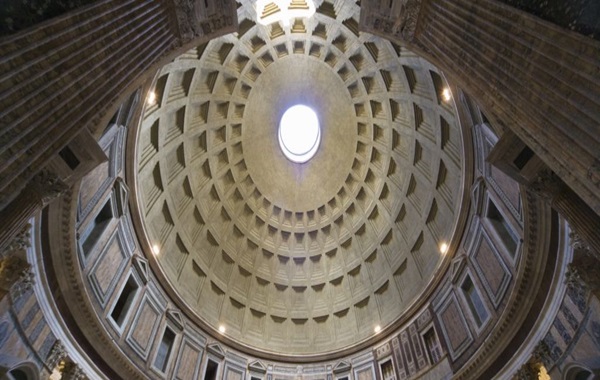
Even today, one of their structures – the Pantheon, still intact and nearly 2,000 years old – holds the record for the world’s largest dome of unreinforced concrete.
The properties of this concrete have generally been attributed to its ingredients: pozzolana, a mix of volcanic ash – named after the Italian city of Pozzuoli, where a significant deposit of it can be found – and lime. When mixed with water, the two materials can react to produce strong concrete.
But that, as it turns out, is not the whole story. In 2023, an international team of researchers led by the Massachusetts Institute of Technology (MIT) found that not only are the materials slightly different from what we may have thought, but the techniques used to mix them were also different.
The smoking guns were small, white chunks of lime that can be found in what seems to be otherwise well-mixed concrete. The presence of these chunks had previously been attributed to poor mixing or materials, but that did not make sense to materials scientist Admir Masic of MIT.
“The idea that the presence of these lime clasts was simply attributed to low quality control always bothered me,” Masic said back in January 2023.
“If the Romans put so much effort into making an outstanding construction material, following all of the detailed recipes that had been optimized over the course of many centuries, why would they put so little effort into ensuring the production of a well-mixed final product? There has to be more to this story.”
Masic and the team, led by MIT civil engineer Linda Seymour, carefully studied 2,000-year-old samples of Roman concrete from the archaeological site of Privernum in Italy. These samples were subjected to large-area scanning electron microscopy and energy-dispersive x-ray spectroscopy, powder X-ray diffraction, and confocal Raman imaging to gain a better understanding of the lime clasts.
One of the questions in mind was the nature of the lime used. The standard understanding of pozzolanic concrete is that it uses slaked lime. First, limestone is heated at high temperatures to produce a highly reactive caustic powder called quicklime, or calcium oxide.
Mixing quicklime with water produces slaked lime, or calcium hydroxide: a slightly less reactive, less caustic paste. According to theory, it was this slaked lime that ancient Romans mixed with the pozzolana.
Based on the team’s analysis, the lime clasts in their samples are not consistent with this method. Rather, Roman concrete was probably made by mixing the quicklime directly with the pozzolana and water at extremely high temperatures, by itself or in addition to slaked lime, a process the team calls “hot mixing” that results in the lime clasts.
“The benefits of hot mixing are twofold,” Masic said.
Source: Science Alert
Astrophysicist ‘Fixes’ General Relativity by Throwing Out a Major Law
We Finally Know How Ancient Roman Concrete Was Able to Last Thousands of Years