Curiosity Found Strange ‘Dragon Scale’ Rocks on Mars, And Scientists Are Excited
A strangely textured region on the surface of Mars has NASA scientists excited.
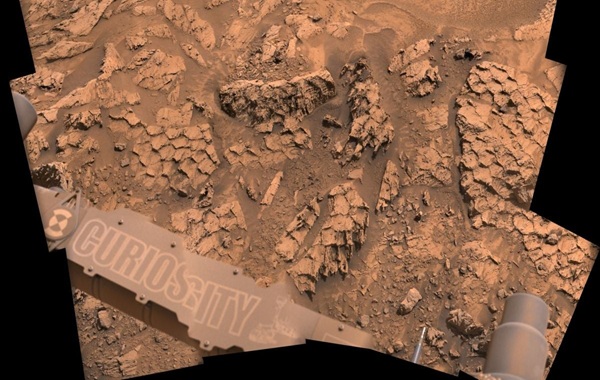
In its journey to a crater named Antofagasta, the Curiosity rover has discovered a strange texture patterning rocks on the planet’s surface. To our eyes, the pattern looks like reptilian scaling, as if a dragon once lay in the mud.
Project scientist Abigail Fraeman of NASA’s Jet Propulsion Laboratory refers to it as “honeycomb-shaped polygons” in a blog post, noting that these tessellations number in the thousands.
“We’ve seen polygon-patterned rocks like these before,” she writes, “but they didn’t seem quite this dramatically abundant, stretching across the ground for meters and meters in our Mastcam mosaics.”
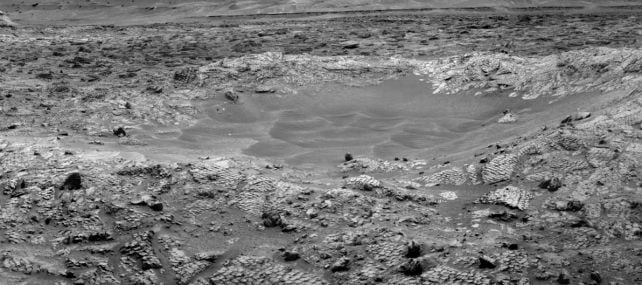
Because the discovery is so recent – the images were taken on Sol 4865, or 13 April 2026 – it may be some time before scientists have a better idea about what the patterns are and how they formed. However, there are some clues about what might be going on.
Here on Earth, polygonal patterns are relatively common. They tend to form when the ground surface repeatedly expands and contracts, often after it has become saturated and then dried.
You might see them at the bottom of a dried-out mud puddle, for example. These are known as desiccation crack patterns.
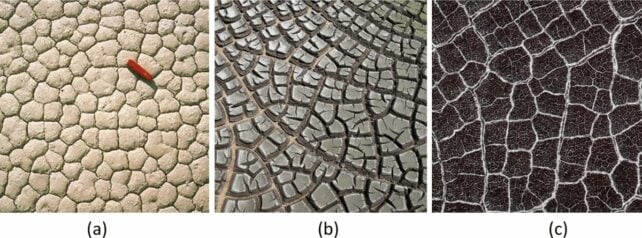
A similar mechanism occurs when the ground is frozen, and the ice within it expands and contracts, as seen in places such as Antarctica. These can also produce polygonal crack patterns, although they form through freezing and thawing rather than drying.
On Mars, however, desiccation cracks are significantly rarer.
The red planet lost its liquid surface water long ago; the first known evidence of dessication cracks on Mars, in the Gale Crater, was discovered by Curiosity less than a decade ago.
A similar mechanism occurs when the ground is frozen, and the ice within it expands and contracts, as seen in places such as Antarctica. These can also produce polygonal crack patterns, although they form through freezing and thawing rather than drying.
On Mars, however, desiccation cracks are significantly rarer.
The red planet lost its liquid surface water long ago; the first known evidence of dessication cracks on Mars, in the Gale Crater, was discovered by Curiosity less than a decade ago.
According to a paper published on the Pontours formation, the pattern seen there is not the result of just one wet spell, but many.
Wet mud that dries just once cracks in T-shaped intersections. Over repeated drying cycles, the pattern matures into Y-shaped crack intersections. These cracks spread and connect with one another to form a hexagonal pattern.
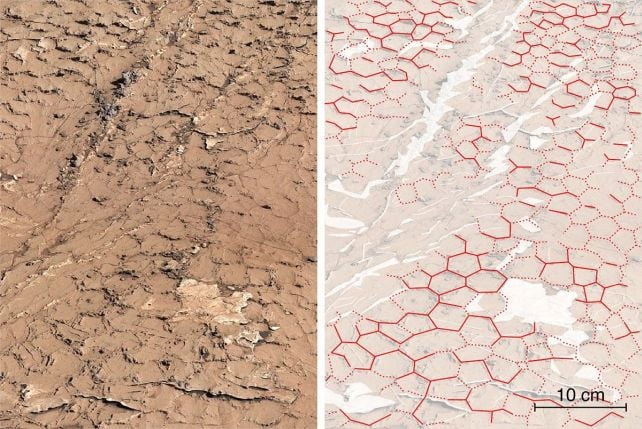
This suggests seasonal or cyclic conditions; then, once the ancient Mars climate changed, the rock set, fossilizing the strange honeycomb formations for Curiosity to find millions of years later.
There are some differences between Pontours and Antofagasta. The patterning at Antofagasta appears, as Fraeman notes, more extensive, with raised ridges that could indicate a slightly different process or stage in the process at the time the rocks set.
On Mars, these ridges can form when minerals fill ancient cracks and later resist erosion more effectively than the surrounding rock.
But, if it’s anything like Pontours, Antofagasta is yet another site indicative of wet-dry weather cycling on ancient Mars, and that would be tremendously exciting.
It’s too early to declare with any certainty that the two sites are analogous. We don’t yet know whether the mineral composition of the rocks at both sites is similar. This information is expected to yield some hints; Pontours, for example, was riddled with salts indicating deposition from evaporating brines.
Curiosity collected data on the Antofagasta site before moving on, and scientists will now have to analyze it to piece together the puzzle presented by the strange pattern. However, a growing body of evidence supports the notion that Mars’s water history was a lot more complex than its dusty, dry surface would suggest at a cursory glance.
“We continued to collect lots of images and chemical data that will help us distinguish between different hypotheses for how the honeycomb textures formed,” Fraeman says.
Source: Science Alert
One of the Universe’s Largest Stars May Be Getting Ready To Explode
Curiosity Found Strange ‘Dragon Scale’ Rocks on Mars, And Scientists Are Excited/Curiosity Found Strange ‘Dragon Scale’ Rocks on Mars, And Scientists Are Excited