A “Hybrid” That Rewrote History—But What If the Biggest Discovery Was Actually a Decades-Long Mistake?
What if one of the most intriguing fossils in human evolution was never what we believed it to be? For decades, the Hahnöfersand frontal bone stood as a possible bridge between two human species. However, new scientific scrutiny has rewritten that narrative entirely.
A skull fragment discovered more than fifty years ago along the Elbe River in Germany has now been definitively identified as belonging to a robust Homo sapiens. This finding challenges long-standing assumptions and forces us to reconsider how easily the human story can be misread. Could other “hybrids” also be misinterpretations waiting to be corrected?
>
Hahnöfersand Fossil Discovery: A Fragment Without Context
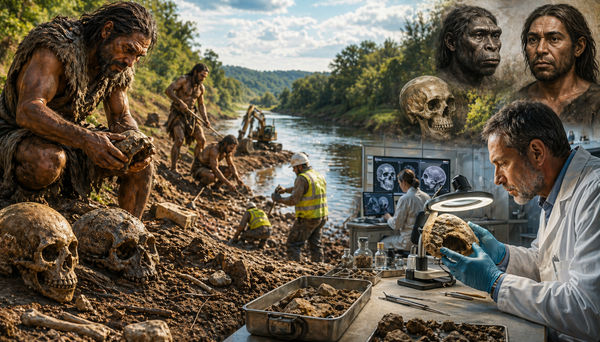
In March nineteen seventy-three, construction workers unearthed a skull fragment near Hahnöfersand during dyke construction. At first glance, it seemed unremarkable. Yet its lack of archaeological context made it a scientific enigma.
Without surrounding artifacts or sediment layers, researchers had to rely almost entirely on visual morphology and early dating techniques. Consequently, the fossil’s identity became a matter of interpretation rather than certainty.
When anthropologist Günter Bräuer examined the bone in nineteen eighty, he noticed a curious combination of traits. The forehead appeared relatively flat, a feature often associated with Neanderthals. Meanwhile, the brow ridge was distinctly modern.
Was this simply variation within Homo sapiens, or something far more extraordinary?
Radiocarbon Dating and the Hybrid Hypothesis: A Perfect Coincidence?
An early radiocarbon analysis dated the fossil to approximately thirty-six thousand years ago. This timeline aligned precisely with the period when Neanderthals and modern humans coexisted in Europe.
Naturally, this coincidence fueled speculation. Bräuer proposed a bold hypothesis: the fossil might represent a hybrid between Homo neanderthalensis and Homo sapiens.
At the time, the idea seemed plausible. After all, genetic evidence now confirms that interbreeding did occur. Yet one critical question lingered—was this fossil truly evidence of that interaction, or merely an illusion created by incomplete data?
Revised Dating Changes Everything: Mesolithic Reality Emerges
The narrative began to unravel in two thousand one. A revised radiocarbon analysis placed the fossil at approximately seven thousand five hundred years old.
This new date shifted the specimen into the Mesolithic period—long after Neanderthals had disappeared from Europe. As a result, the hybrid hypothesis lost its chronological foundation.
However, because this updated finding was published in German and remained relatively obscure, the fossil continued to be cited occasionally as a hybrid.
How many scientific misconceptions persist simply because updated data fails to circulate widely?
Advanced 3D Morphological Analysis: Science Re-examines the Evidence
To resolve the debate conclusively, a research team led by Carolin Röding applied a cutting-edge method known as surface registration. Unlike traditional approaches, this technique does not rely heavily on predefined landmarks. Instead, it analyzes the entire three-dimensional geometry of a specimen.
The team compared the Hahnöfersand fragment with forty-four models, including Neanderthals, Middle Pleistocene hominins, and diverse Homo sapiens populations.
The outcome was clear and unambiguous. The fossil fell entirely within the variation range of Holocene Homo sapiens. There were no intermediate features suggesting hybridization.
Interestingly, the bone most closely resembled medieval German skulls. This unexpected similarity raises another question: how often does normal human variation mimic what we interpret as “archaic”?
Morphological Misinterpretation: Why the Eye Can Be Misled
Visual assessment has long been a cornerstone of paleoanthropology. Nevertheless, this case highlights its limitations.
First, surrounding anatomical structures can influence perception. A robust skull may appear more archaic simply because of its proportions.
Second, isolated fragments present orientation challenges. Even slight misalignment can alter how features like forehead slope are interpreted.
Finally, Homo sapiens exhibits significant internal variation. Late Pleistocene humans were generally more robust than later populations. This overlap can blur the distinction between species.
Therefore, can we truly trust the human eye when subtle geometry determines evolutionary classification?
Other Misidentified Fossils: A Pattern Emerging in Paleoanthropology
The Hahnöfersand case is not unique. Similar misinterpretations have occurred with other fossils, including the Vogelherd remains and the Monti Lessini mandible.
In each instance, robust features or unclear context led to incorrect classification. Only later did improved dating or analytical techniques correct these errors.
This recurring pattern suggests a broader issue. How many fossils currently classified as archaic might actually belong to modern humans?
Human Evolution Complexity: Are We Oversimplifying the Story?
Human evolution is often presented as a linear progression. However, reality is far more complex. Populations overlapped, interbred, and diversified in ways that challenge simple categorization.
The Hahnöfersand fossil reminds us that variation within a single species can be vast. What appears “primitive” may simply be part of natural diversity.
Thus, instead of asking whether a fossil is hybrid or not, should we be asking how flexible our definitions of species truly are?
Scientific Method and Re-evaluation: Why Old Discoveries Need New Eyes
Science is not static. As methods evolve, so too must our interpretations.
The application of three-dimensional imaging and geometric morphometrics has transformed paleoanthropology. These tools allow researchers to quantify differences that were once judged subjectively.
Consequently, previously accepted conclusions must be revisited. This process is not a weakness of science—it is its greatest strength.
What other long-held beliefs might be overturned as technology continues to advance?
Conclusion: A Modern Human, A Timeless Lesson
The Hahnöfersand skull fragment no longer represents a mysterious hybrid. Instead, it stands as evidence of the diversity within our own species.
While the idea of a Neanderthal-human hybrid captured imaginations, the truth is equally compelling. It reveals how easily interpretation can be shaped by limited data and how crucial rigorous analysis is in uncovering reality.
Ultimately, this discovery does more than correct a classification. It challenges us to think critically, question assumptions, and remain open to revision.
And perhaps most importantly—it leaves us wondering: how many secrets about our past are still hidden in plain sight?
Source: A “Hybrid” That Rewrote History—But What If the Biggest Discovery Was Actually a Decades-Long Mistake?
Sources
- Röding, C. et al. (two thousand twenty-four). Three-dimensional geometric morphometric analysis of the Hahnöfersand frontal bone. Scientific Reports.
- Bräuer, G. (nineteen eighty). Initial morphological assessment of the Hahnöfersand fossil.
- Higham, T. et al. Radiocarbon dating revisions in European prehistoric remains.
- Stringer, C. (two thousand sixteen). The Origin of Our Species.
- Hublin, J.-J. (two thousand nine). The modern human colonization of Europe.
A “Hybrid” That Rewrote History—But What If the Biggest Discovery Was Actually a Decades-Long Mistake?