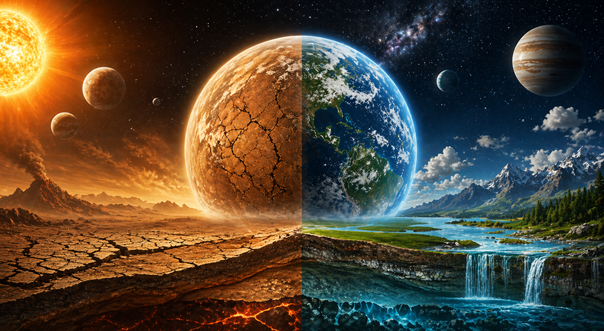
Are We Calling “Habitable” Exoplanets a Lie? What If Water Alone Decides a Planet’s Fate?
When scientists search the cosmos for life, they often begin with a deceptively simple question: Is there liquid water? The concept of the habitable zone—where a planet receives just enough stellar energy to sustain liquid water—has guided decades of exoplanet discovery. However, this framework, while useful, is increasingly proving incomplete.
After all, can a planet truly sustain life with only traces of water? Or does long-term habitability demand something far more complex?
Increasingly, researchers argue that water is not merely a checkbox. Instead, it is a dynamic driver of planetary stability. Without sufficient water, even planets comfortably within the habitable zone may spiral into extreme, inhospitable climates. So the real question becomes: How much water is enough—and what happens when there isn’t enough?
The Carbon Cycle on Earth: How Water Regulates Climate Stability Over Billions of Years
Earth’s long-term climate stability depends on a delicate geochemical balancing act known as the carbon cycle. More specifically, the carbonate-silicate cycle—often called the Urey cycle—acts as a planetary thermostat.
Here is how it works:
Water vapor combines with carbon dioxide in the atmosphere to form carbonic acid. Although weak, this acid plays a powerful role over geological timescales. It reacts with silicate rocks during rainfall, breaking them down in a process known as chemical weathering. The dissolved materials eventually wash into the oceans, where carbon becomes locked into sediments. Over millions of years, tectonic processes recycle this carbon back into the mantle.
This continuous exchange stabilizes atmospheric carbon dioxide levels. As a result, global temperatures remain within a range suitable for life.
But what if this cycle slows down—or stops entirely?
Arid Exoplanets and Carbon Cycle Failure: What Happens Without Enough Water?
This is where arid, desert-like exoplanets enter the picture. These worlds may possess some water, but not enough to sustain consistent rainfall or runoff. And without rainfall, the chemical weathering process weakens dramatically.
Consequently, volcanic outgassing continues to release carbon dioxide into the atmosphere—but nothing removes it efficiently.
The result?
A gradual buildup of greenhouse gases. Rising temperatures. And eventually, a runaway greenhouse effect.
In other words, even if such a planet lies in the habitable zone, it may still become uninhabitable over time.
So, could a planet look promising from afar while silently heading toward climatic collapse?
Minimum Water Threshold for Habitability: How Much Water Do Planets Really Need?
Recent modeling efforts provide a striking answer. Researchers suggest that Earth-like planets require at least roughly twenty percent to fifty percent of Earth’s ocean mass to sustain a balanced carbon cycle over billions of years.
Below this threshold, weathering cannot keep pace with carbon emissions.
Above it, the planetary thermostat begins to function effectively.
This finding reframes the search for life. It is no longer enough to detect water. Scientists must now estimate how much water exists and whether it can actively participate in climate regulation.
So the next question becomes unavoidable: How many of the planets we have already discovered actually meet this requirement?
Runaway Greenhouse Effect and Venus: A Warning from Our Cosmic Neighbor
To understand the stakes, one need only look at Venus.
Today, Venus is a scorching world with surface temperatures hot enough to melt lead. However, evidence suggests it may once have had water. If so, why did it lose its habitability?
One leading explanation points directly to water scarcity. Being closer to the Sun, Venus may have started with less water than Earth. Without sufficient rainfall, its carbon cycle likely failed early. Carbon dioxide accumulated unchecked, triggering a runaway greenhouse effect.
Eventually, any remaining water evaporated into space.
If simple life ever emerged there, it did not survive.
So, is Venus an exception—or a common outcome for arid planets across the galaxy?
TRAPPIST-1 System and Water Inventory Uncertainty: Are These Worlds Truly Habitable?
The well-known TRAPPIST-one system offers a compelling test case. Several of its planets lie within the habitable zone, making them prime targets in the search for life.
However, their water inventories remain uncertain.
Do they possess enough water to sustain long-term climate stability? Or are they dry worlds masquerading as habitable candidates?
Without precise measurements, scientists can only model possibilities. Yet these uncertainties highlight a growing realization: proximity to a star is only part of the story.
Planetary Climate Modeling and Carbon Cycle Dynamics: How Scientists Simulate Alien Worlds
To tackle these questions, researchers employ sophisticated computational models. These simulations track the movement of water and carbon between a planet’s interior, surface, and atmosphere.
They incorporate numerous variables, including:
- Volcanic outgassing rates
- Atmospheric escape processes
- Surface temperature variations
- Land-to-ocean ratios
- Rock composition and porosity
- Rainfall efficiency and runoff dynamics
By running thousands of scenarios, scientists can estimate how different conditions influence habitability over billions of years.
Still, models are only as good as their assumptions. This raises another question: How close are we to testing these predictions with real data?
Future Observations and the Habitable Worlds Observatory: Can We Detect True Habitability?
Directly studying exoplanet surfaces remains beyond current technological capabilities. However, upcoming missions may change that.
Future observatories aim to analyze reflected light from distant planets. Through spectroscopy, scientists hope to infer surface conditions, atmospheric composition, and even the presence of oceans.
These tools could help determine not only whether water exists—but whether it exists in sufficient quantities to sustain a carbon cycle.
If successful, such observations would mark a major leap forward. They would allow researchers to move from speculation to evidence.
Long-Term Habitability and the Search for Life: Are We Looking in the Right Places?
The implications of this research are profound.
Many planets previously considered promising may, in fact, be poor candidates for life. Arid worlds, even within habitable zones, are less likely to maintain stable climates over geological timescales.
This does not mean life is impossible there. Short-lived habitable periods may still occur. Microbial life might emerge briefly.
But for complex ecosystems—or civilizations—to develop, stability over billions of years appears crucial.
And that stability depends heavily on water.
So, as we refine our search, we must ask: Are we prioritizing the right worlds—or overlooking the ones that truly matter?
Conclusion: Water, Carbon Cycles, and the Fragile Balance of Life
In the end, the search for life is not just about finding water. It is about understanding how water interacts with geology, atmosphere, and time.
A planet may sit in the perfect location. It may even contain water. Yet without enough of it, the delicate machinery of climate regulation may fail.
And when that happens, habitability becomes fleeting.
As our tools improve and our models grow more precise, one truth becomes increasingly clear:
Water is not just a prerequisite for life—it is the engine that sustains it.
But how many worlds in the universe truly meet that standard?
Source: Are We Calling “Habitable” Exoplanets a Lie? What If Water Alone Decides a Planet’s Fate?
Scientists May Have Found the Key to Jupiter and Saturn’s Moon Mystery
Scientists May Have Found the Key to Jupiter and Saturn’s Moon Mystery
Are We Calling “Habitable” Exoplanets a Lie? What If Water Alone Decides a Planet’s Fate?
Sources and Further Reading
- White-Gianella, H., & Krissansen-Totton, J. (The Planetary Science Journal) – Carbon Cycle Imbalances on Arid Terrestrial Planets with Implications for Venus
- NASA Exoplanet Exploration Program
- Research on carbonate-silicate (Urey) cycle and planetary climate regulation
- Studies on Venus climate evolution and runaway greenhouse effects
- TRAPPIST-one system observational data and modeling studies
Are We Calling “Habitable” Exoplanets a Lie? What If Water Alone Decides a Planet’s Fate?