Time Moves Faster on Mars—but What Does That Mean for Human Survival There?
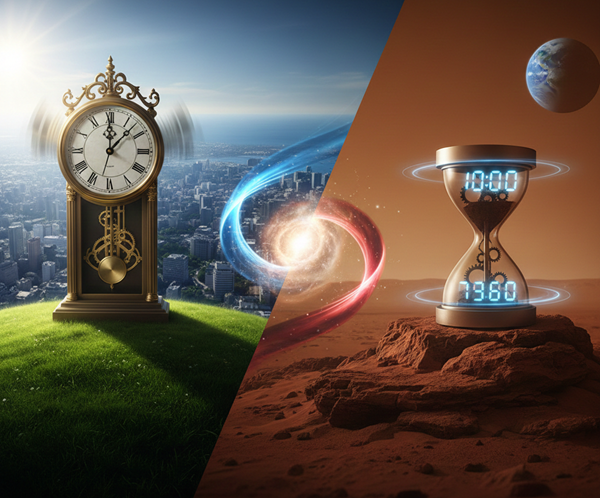
Time moves faster on Mars, and scientists now understand precisely why.
New research on Mars time dilation shows that clocks on the Red Planet tick four hundred seventy-seven microseconds faster per day than clocks on Earth. Although the difference appears small, it has major implications. Accurate timekeeping is essential for Mars exploration, navigation, and human missions. Even tiny timing errors can compound quickly. Could time itself become a hidden obstacle for life on Mars?
Gravitational Time Dilation on Mars: Why Time Runs Faster
To understand why time runs faster on Mars, scientists turn to Einstein’s general relativity. According to the theory, gravity slows time. Strong gravity stretches each second. Weaker gravity allows time to pass more quickly.
Mars has much less mass than Earth. As a result, its surface gravity is significantly weaker. Therefore, clocks on Mars experience less gravitational time dilation. Each second ends slightly sooner than it does on Earth.
Meanwhile, this effect already influences modern technology. For example, GPS satellites experience weaker gravity than Earth’s surface. Their atomic clocks run faster by thirty-eight microseconds per day. Engineers must correct this shift. Otherwise, navigation systems would fail.
Mars Timekeeping Systems: How Scientists Measure Time on Mars
Scientists at the National Institute of Standards and Technology developed a precise Mars timekeeping system. Physicists Neil Ashby and Bijunath Patla led the work. Their goal was clear. They wanted a Mars equivalent of Coordinated Universal Time.
UTC already supports astronomy and deep-space navigation. It stays accurate within one hundred picoseconds per day. Earlier, the same team built a time standard for the Moon. Lunar clocks run fifty-six microseconds faster per day than Earth clocks.
However, Mars proved more complex.
Mars, Earth, Moon, and Sun: A Complex Mars Time Problem
Mars does not orbit Earth. Instead, it interacts with the Sun, Earth, and the Moon. This creates a four-body gravitational system. Each body affects how time flows on Mars.
According to Patla, even three-body problems are difficult. Adding Mars increases complexity. Therefore, scientists had to model constant gravitational shifts.
Moreover, Mars has about one-tenth Earth’s mass. Its surface gravity is roughly five times weaker. These factors push Martian clocks even further ahead.
Mars Orbit and Time Fluctuations: Why Mars Time Is Not Constant
Mars follows a highly eccentric orbit. Therefore, its distance from the Sun changes during the year. Because gravity weakens with distance, Mars time dilation fluctuates.
On average, Mars clocks run four hundred seventy-seven microseconds faster per day. However, this value changes by two hundred sixty-six microseconds across a Martian year.
That year lasts six hundred eighty-seven Earth days. In addition, a Martian day is longer. Mars needs forty extra minutes to complete one rotation. As a result, daily rhythms also differ.
How will humans adapt to a planet where time itself shifts?
Why Mars Time Matters for Mars Exploration and Human Missions
Accurate Mars time synchronization is essential. It supports spacecraft navigation. It also guides rover movement and landing systems. Even microsecond errors can cause drift.
Over time, these errors disrupt communication. Therefore, Mars missions cannot rely only on Earth-based clocks. They need local precision.
Ashby stresses early preparation. Humans may not land on Mars soon. However, planning must start now. Reliable Mars timekeeping enables autonomy.
Interplanetary Timekeeping and the Future of Mars Settlement
As space agencies expand outward, interplanetary timekeeping becomes critical. Lunar missions already require it. Mars missions will demand even more independence.
This research builds the foundation for autonomous planetary time systems. These systems will support navigation, communication, and long-term settlement.
Patla summarizes the moment clearly. The timing is right for the Moon and Mars. Humanity stands closer than ever to becoming multi-planetary.
If time defines civilization on Earth, what will it define on Mars?
Source: Time Moves Faster on Mars—but What Does That Mean for Human Survival There?
Could Ultraviolet Light Expose the True Origins of Comet 3I/ATLAS
Could Ultraviolet Light Expose the True Origins of Comet 3I/ATLAS