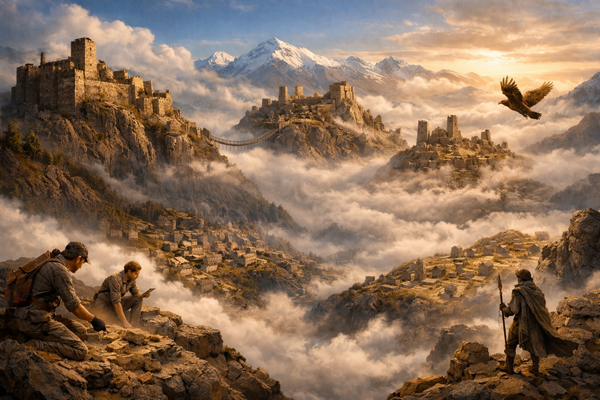
A Lost Civilization in the Clouds—Who Built Georgia’s Mysterious Highland Fortresses, and Why Did They Disappear
High in the rugged peaks of the South Caucasus, a story long buried beneath stone and silence is beginning to emerge. Archaeologists have revealed a lost civilization in the Georgia highlands—one that thrived not for centuries, but for millennia. How could such a complex society remain hidden for so long? And what does its discovery mean for our understanding of human resilience in extreme environments?
A groundbreaking study published in Antiquity by the Samtskhe-Javakheti Archaeological Project has documented one hundred sixty-eight ancient sites across southern Georgia’s highlands. These include monumental cyclopean fortresses, layered settlements, and vast necropolises. Together, they form a dense archaeological landscape that challenges the long-held assumption that high-altitude zones were marginal or sparsely inhabited.
Until recently, the Javakheti Plateau—rising between one thousand five hundred and three thousand three hundred meters—was largely overlooked. However, since two thousand seventeen, a Georgian–Italian collaboration has combined satellite imaging, GPS mapping, and GIS-based spatial analysis with targeted excavation. As a result, what once appeared empty has been revealed as a thriving cultural network. Could it be that we have underestimated the adaptability of ancient societies all along?
Cyclopean Fortresses and High-Altitude Settlements: Evidence of a Lost Civilization in the Georgia Highlands
Among the most visually striking discoveries are the cyclopean fortresses—massive stone structures built from unworked basalt blocks without mortar. These imposing constructions, such as the Abuli and Shaori complexes, dominate the highland landscape. At first glance, they appear to be defensive citadels. Yet, recent analysis suggests a more nuanced function.
Rather than permanent strongholds, many of these enclosures were likely used as seasonal refuges. Mobile pastoralist groups may have relied on them during migrations across the plateau. This reinterpretation shifts our perspective: were these fortresses symbols of power, or practical responses to environmental and social pressures?
Sites like Abulis Gora and Saro-one show repeated occupation from the Bronze Age onward. This continuity indicates long-term adaptation rather than temporary survival. Meanwhile, nearby necropolises—especially those near Bertakana and Lake Tabatskuri—demonstrate enduring burial traditions. These were not transient communities. They were deeply rooted societies with memory, identity, and ritual.
Interestingly, thick ash layers discovered at several locations, including Baraleti Natsargora—literally “hill of ashes”—suggest repeated episodes of destruction. Were these caused by warfare, accidental fires, or ritual burning? Each possibility opens a new line of inquiry, deepening the mystery rather than resolving it.
Bronze Solar Disk and Ritual Artifacts: Symbolism in the Lost Civilization of the Georgia Highlands
One of the most compelling discoveries is a finely crafted bronze solar disk found at Baraleti Natsargora. Decorated with concentric bands, raised knobs, angular motifs, and evenly spaced perforations, the artifact reflects a sophisticated symbolic tradition. But what did it represent?
Comparable objects in southern Georgia are often linked to elite female burials. This association raises important questions. Did women hold significant ritual or social power in these communities? Was solar symbolism tied to gender, status, or cosmology?
The disk, now housed in the Akhalkalaki Museum, likely originated from a nearby grave. Its craftsmanship suggests not only technical skill but also a shared symbolic language across the region. Such artifacts hint at belief systems that remain largely unexplored. What myths, rituals, or cosmological ideas guided these people?
Decorated Clay Plaques and Domestic Ritual Space: Cultural Complexity in Highland Settlements
Equally revealing are findings from Meghreki Fortress. This site presents continuous occupation from the Early Bronze Age Kura-Araxes culture—dating from approximately three thousand five hundred to two thousand five hundred BC—through the Iron Age and into medieval times. Such longevity is rare and significant.
Within two domestic structures dated to the Late Iron Age or Achaemenid period, archaeologists uncovered clay installations adorned with fired plaques. These plaques feature intricate geometric designs in red, white, and dark blue pigments. Their presence raises intriguing questions. Were these purely decorative, or did they mark sacred domestic spaces?
Decorated interiors are uncommon in the South Caucasus. Therefore, their appearance here suggests elevated social or ritual importance. Perhaps these homes belonged to elites. Alternatively, they may have served communal or ceremonial functions. Either way, they point to a level of cultural sophistication that challenges earlier assumptions about highland societies.
Trade Networks and Obsidian Exchange: Connectivity in the Lost Civilization of the Georgia Highlands
Despite their remote location, these highland communities were far from isolated. Evidence of obsidian tools sourced from distant volcanic regions indicates active participation in long-distance trade networks. This raises a crucial question: how extensive were these connections?
Obsidian sourcing studies suggest movement of goods across vast distances. Such exchange networks imply not only economic interaction but also cultural transmission. Ideas, technologies, and beliefs may have traveled alongside materials. Could the highlands have served as a crossroads rather than a periphery?
This perspective transforms the narrative. Instead of viewing the Javakheti Plateau as a marginal zone, it becomes a dynamic hub of interaction. The flow of goods and ideas would have shaped identities and innovations over generations.
Multiphase Occupation and Cultural Continuity: Rethinking the Georgia Highlands Civilization
The integrated analysis of sites like Meghreki and Baraleti Natsargora reveals a pattern of multiphase occupation. These locations were not abandoned after a single period. Instead, they were revisited, rebuilt, and reinterpreted across centuries.
This continuity suggests resilience. Communities adapted to environmental challenges, social changes, and external pressures. They did not merely survive—they evolved. What strategies allowed them to endure in such harsh conditions? And what lessons might they offer for understanding human adaptability today?
Moreover, the archaeological record captures both conflict and creativity. Burn layers hint at violence or disruption. Yet, artistic artifacts and architectural innovations reveal cultural vitality. This duality reflects the complexity of human experience—past and present alike.
A Dynamic Crossroads, Not a Marginal Landscape: Redefining the Lost Civilization of the Georgia Highlands
The Samtskhe-Javakheti Archaeological Project, funded by ISMEO and supported by Georgian institutions, is reshaping our understanding of this region. With hundreds of sites mapped and ongoing excavations, a new framework is emerging.
Future research will expand excavations, refine ceramic typologies, and apply radiocarbon dating to establish clearer chronologies. However, even now, one conclusion is evident: the Javakheti Plateau was not an isolated backwater. It was a vibrant, interconnected landscape.
Stone walls and ash layers tell stories of endurance, belief, and transformation. Yet, many questions remain unanswered. Who were these people, truly? What languages did they speak? What stories did they tell under the vast highland skies?
Perhaps the most compelling aspect of this discovery is not what it reveals—but what it leaves open. The story of this lost civilization is only beginning. And with each excavation, the past speaks a little louder.
Source: A Lost Civilization in the Clouds—Who Built Georgia’s Mysterious Highland Fortresses, and Why Did They Disappear
Homeric Literature and Gold Covered Mummies Discovered in Egypt
Homeric Literature and Gold Covered Mummies Discovered in Egypt
Sources and Further Reading
- Licheli, V., et al. (two thousand twenty-two). Research on cyclopean fortresses in southern Georgia.
- Antiquity Journal – Samtskhe-Javakheti Archaeological Project publication.
- ISMEO (International Association for Mediterranean and Oriental Studies).
- Tbilisi State University Archaeological Reports.
- Archaeological Association of Georgia Field Surveys (since two thousand seventeen).
A Lost Civilization in the Clouds—Who Built Georgia’s Mysterious Highland Fortresses, and Why Did They Disappear