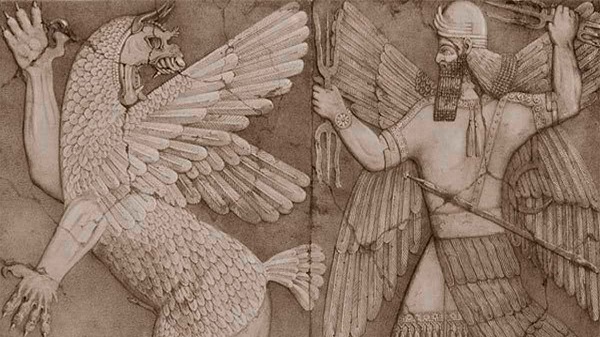
The Origins of Mankind in Ancient Sumerian Documents
Around 4500 B.C., Sumer, the “land of civilized kings,” flourished in Mesopotamia (present-day Iraq). The Sumerians built an advanced civilization with an elaborate language and script, architecture and art, and a unique system of astronomy and mathematics. Their religious system was complex, consisting of hundreds of gods. According to ancient texts, each Sumerian city was guarded by its own gods, and while humans and gods coexisted, humans served the gods.
The Nipple Tablet Discovery of Ancient Sumerian Documents
The Sumerian creation legend, known as the earliest creation story, is of great significance because it provides valuable insight into the religious, political, and cultural aspects of ancient Mesopotamia.
The Sumerian creation myth is described on a tablet from Nippur, an ancient Mesopotamian city built in approximately 5000 BC. According to the Sumerian tablet, the creation of the earth (Enuma Elish) begins thus
The heavens did not yet have a name
And the earth beneath it had not yet a name,
The primordial apse gave birth to them,
And chaos, Tiamut, the mother of both.
Their waters were mingled,
No fields were formed, no marshes were seen;
Of the gods, none was called,
None had a name, none had a predestined destiny;
Then the gods were created in the heavens,
Laham and Laham was called.
The text tells us that at some point the gods revolted against their labor.
The gods, like mortals
endure their labors.
The labor of the gods was great,
The work was heavy and the pain great.
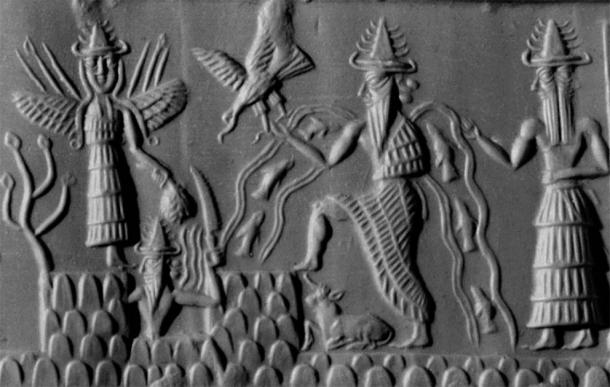
They are identified as gods by their pointed hats with multiple horns. The figure with streams of water and fish flowing from his shoulders is Ea (Sumerian Enki), god of underground water and wisdom. Behind him stands the duplicitous vizier Ushim. In the center of the scene is the sun god Shamash (Sumerian Utu), with rays of light rising from his shoulders. He is carving out a mountain to rise at dawn. To his left is the winged goddess Ishtar (Sumerian Inanna). The weapon that rises from her shoulder symbolizes her warrior characteristics. ( Public domain )
The Oneness of God and Man: How the First Humans Came into Being
Anu, the god of the gods, agreed that the labor of the gods was too great. His son, Enki (Ea), proposed the creation of man to carry out that labor, which he did with the help of his half-sister Ninki. Then, with the help of his half-sister Ninki, he created man. From that material the first humans were created who resembled the gods.
You slaughtered the gods.
Along with his personality
I removed your heavy work
I imposed your labor on man.
…
In the clay, God and man
Are united
And become one;
Until the end of days.
Flesh and soul
Ripe in God.
And their souls shall be joined together in the bond of blood.
This first man was created in Eden, Sumerian for “flat terrain.” In the Epic of Gilgamesh, Eden is referred to as the garden of the gods, located somewhere between the Tigris and Euphrates rivers in Mesopotamia.
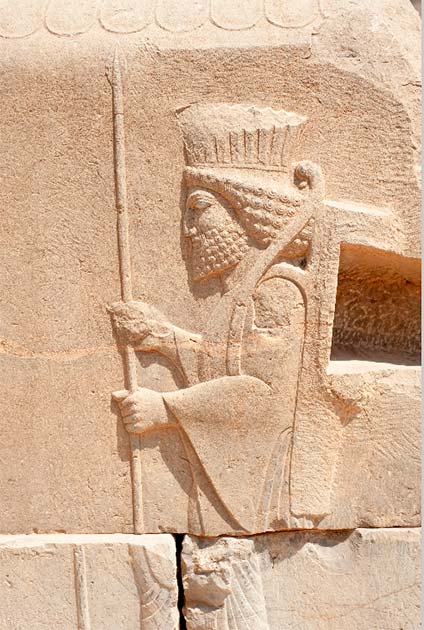
Initially, man was unable to reproduce on his own, but later improved with the help of Enki and Ninki. Thus Adapa was created as a fully functioning independent human being. This “remodeling” was done without the approval of Enki’s brother Enlil, and the conflict between the gods began. Enlil became man’s adversary, and Sumerian tablets record that man served the gods and experienced much hardship and suffering.
Adapa ascended to Anu with the help of Enki, where his questions about the “bread and water of life” were not answered.
There are various opinions about the similarities between this creation story and the biblical story of Adam and Eve in Eden. Adapa was given great wisdom and knowledge by Enki, but when offered the “bread and water of life,” he unwittingly rejected the gift of immortality. Adam and Eve were placed in the Garden of Eden and instructed not to eat from the tree of the knowledge of good and evil. However, they were tempted by the serpent to eat the forbidden fruit and were banished from paradise.
Overall, the Sumerian creation myth provides valuable insights into the religious, political, and cultural aspects of ancient Mesopotamia and is significant as one of the oldest documented creation stories.
Note: Ancient Sumerian translations were taken from William Bramley’s book, The Gods of Eden.
Source: The Origins of Mankind in Ancient Sumerian Documents
Sumerians invented the time system 5,000 years ago.
The Origins of Mankind in Ancient Sumerian Documents