
Sumerians invented the time system 5,000 years ago.
Why not multiples of 10 or 12? Simply put, because the inventors of time were not in decimal or decimal 12, but in 60. For the ancient Sumerian innovators, who were the first to divide the movements of the heavens into countable intervals, 60 was the perfect number.
Sixty, a useful number.
Sixty can be divided into 1, 2, 3, 4, 5, 6, 10, 12, 15, 20, and 30 equal parts. Furthermore, ancient astronomers believed that the year had 360 days. The Sumerian Empire did not last long. But for more than 5,000 years, the world has been obsessed with their division of time.
Sumerian Time
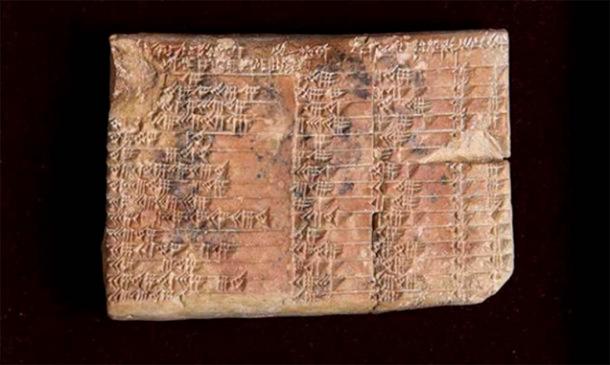
Many ancient civilizations roughly approximated the passage of time. Obviously, when the sun rises, the day begins, and when the sun sets, night begins. The passage of time in terms of weeks, months, and years was less obvious, but these too were approximated by the ancients: a month is the length of one lunar cycle; a week is the length of one lunar cycle; a year can be estimated from the changing of the seasons and the relative position of the sun; a year is the length of one lunar cycle; a month is the length of one lunar cycle; a year is the length of one lunar cycle; a year is the length of one lunar cycle. Once the sun’s zenith was determined, scholars could count the number of sunrises and sunsets until the sun reached its zenith again. In this way, the ancient Egyptians, Mayans, Babylonians, and others determined that the year was 360 days long. However, it was Sumerian astronomers and mathematicians who first systematically divided the passage of time. Their work was widely accepted and spread throughout Eurasia.
The decimal system was not the first way to count.
The decimal system is the basis for the most widely used numerical system today. Considering that humans have 10 fingers for counting, the decimal system is a readily available counting system. For this reason, several people claim to have invented the decimal system, most notably the Greeks (circa 300 BC), the Chinese (circa 100 BC), and the Indians (circa 100 AD). The origins of the dodecimal system are not well known, but ancient Nigerian, Chinese, and Babylonian languages seem to have emerged independently from the belief in the twelve signs of the Chinese zodiac. All of these, however, predate the ancient Sumerians, who developed the decimal system in the 3rd millennium BC. Invention of the Hexadecimal System by the Sumerians
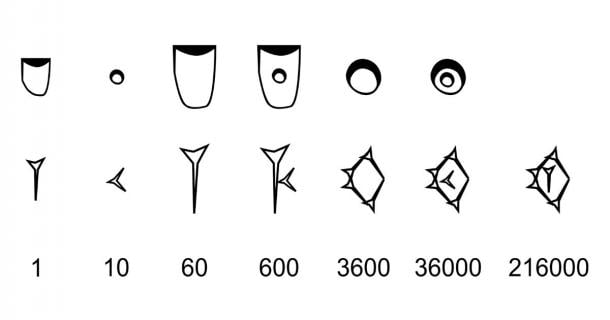
The Sumerians initially preferred 60 as a divisible number; not only were there few remainders when dealing with 60 and its multiples, but even when there were remainders, there were no repeating decimals (e.g., 1/3 = 0.333…) . The land of Sumer was conquered by the Akkadians in 2400 BC and by the Amorites (also known as Babylonians) in 1800 BC. Each subsequent ruling power also appreciated the easy-to-use decimal system and incorporated it into their own mathematics. Thus, the idea of dividing time into 60 units persisted and spread eastward to Persia, India, and China, and westward to Egypt, Carthage, and Rome. This system nicely complemented the work of Chinese astronomers who discovered the 12 astronomical hours of the stars (a mostly theoretical discovery, since most people lived by the sun). It also worked well with the military strategy of the empire, especially the division of the night watch into multiple even units. The Egyptians had three nightly watches and the Romans had four.
Greek and Islamic innovations in geometry discovered that 360 was not only the length of the ideal orbit of the earth, but also the perfect measurement of a circle. Thus, the decimal system became an integral part of mathematics and navigation (dividing the earth into longitude and latitude) and began to consolidate its place in history. Then, with the invention of the clock in the 14th century, the circular clock face was divided into four equal parts, with one minute being 60 seconds.
Source: Sumerians invented the time system 5,000 years ago.