Supernova graveyard? 10 million years ago, neutron stars crashed on Earth, reveal traces
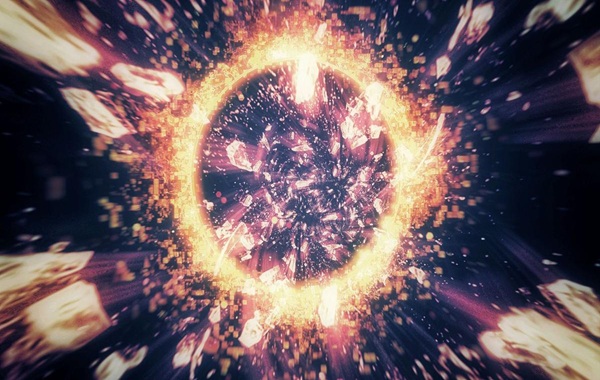
Do we live in a supernova graveyard? A team of researchers proposes that 10 million years ago two giant neutron stars crashed into each other and debris from that intense explosion (called kilonova) fell on Earth and the Moon.
The researchers have detected the presence of a radioactive plutonium isotope in samples from the deep sea. The traces of the unique isotope are believed to be remnants of the kilonova.
Surprisingly, lead researcher Brian Fields, who is a professor of astronomy at the University of Illinois at Urbana-Champaign, had found debris from supernovae that exploded three million and eight million years ago.
However, when he later detected plutonium in those samples, he realized they couldn’t have come from those supernovae. This meant the plutonium must have come from a different, even more extreme cosmic event—a kilonova.
The new findings from the deep-sea samples further strengthen their theory. It suggests that Earth has been exposed to debris from multiple stellar explosions over millions of years, supporting the idea that “We live in a supernova graveyard,” Fields said.
From supernova to kilonova
Some stars are so massive that they eventually blast in a powerful event called a supernova. This happens after they use up all their hydrogen fuel, converting it into heavier elements like helium, then carbon, and so on, until they reach iron.
At that point, fusion stops because iron is too stable to produce energy. With nothing left to counter gravity, the star collapses. If the collapsing core is extremely massive, it turns into a black hole.
However, if it’s a bit smaller, it squeezes protons and electrons together into neutrons, forming an incredibly dense neutron star. When two neutron stars orbit each other, their gravity pulls them closer until they eventually collide in a massive explosion (kilonova),
The explosion released elements heavier than iron—like gold and platinum—through a process known as rapid neutron capture (r-process). Some of these elements later decay, releasing energy that produces bright flashes of light.
Over time, the heavy elements from kilonova have scattered across Earth. However, our planet’s weather conditions, atmosphere, and geology cause these elements to mix and be lost with other materials on the surface and in the ocean.
Therefore, it is highly unlikely that we’d ever find the whole plutonium and gold that showered on Earth during a kilonova.
Lunar samples can confirm the theory
Earth isn’t the only place where kilonova remnants have fallen. According to researchers, the Moon also received debris, and since it lacks an atmosphere and oceans, it is much easier to find kilonova remnants there.
“On Earth, things sink to the bottom of the ocean, and you have to worry about currents and the atmosphere. But the moon is awesome because when stuff lands, it just lands,” Fields said in an interview with Live Science.
Currently, the researchers don’t have access to enough lunar samples to confirm their supernova graveyard theory, but they are hopeful that upcoming Moon missions will provide them with the opportunity to analyze more samples.
Fields and his colleagues are also reaching out to the people involved in the Artemis mission regarding their research and related requirements.
Source: Interesting Engineering
Mysterious Martian Spheres: Signs of Ancient Life or Something Else?
Supernova graveyard? 10 million years ago, neutron stars crashed on Earth, reveal traces