What Secrets Are Hidden İn The Ancient Teeth Of Our Ancestors, Dating Back Millions Of Years? Could These Findings Change Everything We Know bout the Origins Of Humanity
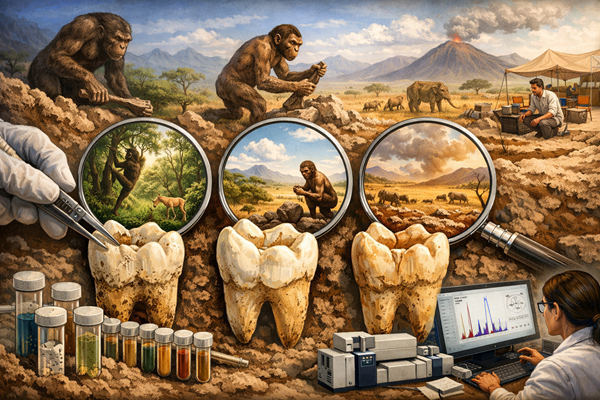
Teeth are not merely biological structures; rather, they function as microscopic archives of deep time. Long after soft tissues decay and bones fragment, tooth enamel persists. It resists chemical alteration and preserves a remarkably stable record of early life conditions. But what exactly can a fossilized tooth reveal? And how can something so small reconstruct entire ecosystems that vanished millions of years ago?
To begin with, enamel forms during early life and remains unchanged thereafter. Consequently, it locks in chemical signatures derived from diet and water intake during youth. These signatures, embedded at the atomic level, serve as enduring indicators of environmental conditions. Therefore, when scientists analyze fossilized teeth, they are not simply studying anatomy—they are decoding ancient climates, vegetation, and ecological dynamics.
Fossil Tooth Enamel Analysis: Reconstructing Diets, Climate, and Lost Landscapes
Over the past several decades, researchers have refined methods to extract and interpret chemical signals from enamel. By collecting minute samples of enamel powder, scientists can examine isotopic compositions that differentiate between plant types. This distinction is crucial because plants follow different photosynthetic pathways, leaving unique chemical fingerprints.
For instance, trees and shrubs typically produce one type of isotopic signal, while grasses produce another. When animals consume these plants, the signals are incorporated into their teeth. As a result, fossil enamel becomes a direct proxy for ancient diets. But more importantly, it becomes a proxy for entire landscapes.
So, what does it mean if an animal’s teeth show a strong grass-based signal? It suggests open savanna environments. Conversely, signals associated with browsing indicate wooded habitats. By comparing these patterns across multiple fossil layers, scientists can trace environmental transitions over immense timescales.
East African Rift Valley Ecosystems: A Four-Million-Year Environmental Transformation
Approximately four million years ago, the region now known for its arid conditions presented a vastly different ecological picture. Instead of dry plains, it hosted a mosaic of rivers, lakes, forests, and grasslands. How do we know this? The answer lies, once again, in fossil teeth.
Chemical evidence reveals that animals living during this period consumed a diverse range of vegetation. Some species grazed on grasses, while others browsed on leaves and shrubs. This dietary diversity implies a complex environment—one that supported both dense woodlands and open plains simultaneously.
However, environmental stability did not persist indefinitely. Over time, tectonic activity reshaped the region. The gradual separation of geological plates altered drainage systems and climate patterns. Consequently, between roughly two million and three million years ago, a significant ecological shift occurred.
Grasslands expanded. Forested areas receded. Species that could not adapt faced decline. Meanwhile, those capable of dietary flexibility thrived. But what drove this adaptability? And how did it influence evolutionary trajectories?
Early Human Ancestors and Dietary Flexibility: Survival in a Changing World
Early human ancestors lived within this dynamic and unpredictable environment. Fossil evidence indicates that species such as early hominins did not specialize in a single food source. Instead, they maintained varied diets, consuming fruits, roots, leaves, and other available resources.
Why is this significant? Because adaptability often determines survival. In fluctuating ecosystems, rigid dietary strategies can become liabilities. Flexible feeding behaviors, on the other hand, allow species to respond to environmental pressures more effectively.
This raises an important question: Did dietary flexibility directly influence human evolution? Evidence suggests that it may have played a critical role. During this same period, early humans began exhibiting notable changes. They adopted upright walking, increased brain size, and developed more complex behaviors.
Moreover, they started using tools. These technological innovations were not isolated developments. Rather, they were responses to environmental challenges. As landscapes shifted, early humans adapted—not just biologically, but culturally and cognitively.
Diet, Evolution, and Survival: What Ancient Teeth Teach Us About Human Origins
The relationship between diet and evolution is neither simple nor linear. Instead, it is deeply interconnected with environmental conditions. Fossil teeth provide a unique window into this relationship. They reveal not only what ancient species ate but also how ecosystems evolved and how life adapted in response.
Species that successfully adjusted their diets were more likely to endure environmental changes. Those that could not adapt often disappeared. This pattern underscores a broader evolutionary principle: survival favors flexibility.
But this leads to deeper questions. If early humans had not developed dietary adaptability, would they have survived? Would technological innovation have emerged in the same way? And how much of modern human success can be traced back to these ancient ecological pressures?
Unlocking Earth’s Deep Past Through Fossil Teeth: Scientific Insights and Future Questions
Modern analytical techniques continue to enhance our understanding of ancient ecosystems. By integrating isotopic data with fossil records, researchers can reconstruct detailed environmental histories. These reconstructions, in turn, inform broader scientific inquiries about climate change, biodiversity, and evolutionary processes.
Yet, despite significant progress, many questions remain unanswered. For example:
- How rapidly did environmental shifts occur during critical evolutionary periods?
- To what extent did climate variability drive cognitive and technological advancements?
- Are there undiscovered patterns hidden within fossil records that could reshape current theories?
Each fossil tooth analyzed adds another piece to this complex puzzle. Each chemical signature brings us closer to understanding not only where we come from, but also how life responds to change.
Conclusion: Are We Still Shaped by the Same Forces Today?
Ancient teeth tell a story that extends far beyond individual organisms. They reveal ecosystems in flux, species under pressure, and evolution in motion. They remind us that life on Earth has always been shaped by environmental change.
But perhaps the most compelling question is this: Are we still governed by the same forces today?
As modern climates shift and ecosystems transform, the lessons embedded in fossil enamel become increasingly relevant. Adaptability, resilience, and innovation once defined survival. They may continue to do so.
So, when we look at a fossilized tooth, are we simply observing the past? Or are we glimpsing a reflection of our future?
Source: What Secrets Are Hidden İn The Ancient Teeth Of Our Ancestors, Dating Back Millions Of Years? Could These Findings Change Everything We Know bout the Origins Of Humanity?
Monumental ship burial beneath ancient Norwegian mound predates the Viking Age
Monumental ship burial beneath ancient Norwegian mound predates the Viking Age
Sources
- Peer-reviewed studies on isotopic analysis of fossil enamel
- Research on East African Rift Valley paleoecology
- Scientific literature on early hominin diets and evolution
- Paleoanthropological field studies from Ethiopia’s Afar region
- General references on climate-driven evolutionary adaptation
What Secrets Are Hidden İn The Ancient Teeth Of Our Ancestors, Dating Back Millions Of Years? Could These Findings Change Everything We Know bout the Origins Of Humanity?