Mysterious Martian Spheres: Signs of Ancient Life or Something Else?
NASA’s Perseverance Finds Strange Spheres-What Could They Mean?
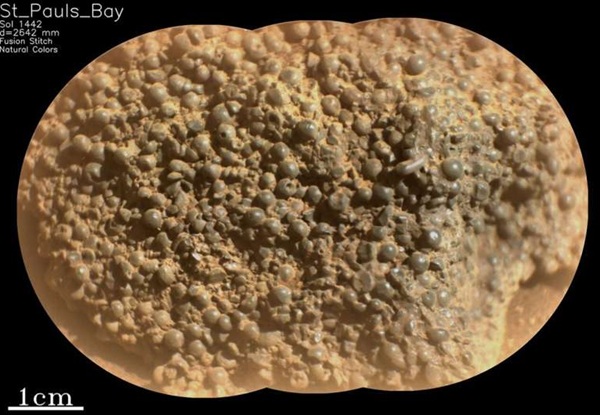
Last week, NASA’s Perseverance rover made a startling discovery—hundreds of millimeter-sized dark gray spheres embedded in a rock on the lower slopes of Witch Hazel Hill at the Jezero crater rim. The rock, named St. Pauls Bay, revealed these peculiar formations, some appearing as perfect spheres, while others were elliptical or broken fragments. Even more intriguingly, some had tiny pinholes. But what geological phenomenon could have created these mysterious structures?
Spherules on Mars: A Repeated Phenomenon
This isn’t the first time Mars has presented scientists with strange spherical formations. In 2004, the Opportunity rover discovered the so-called Martian Blueberries at Meridiani Planum. Similarly, Curiosity encountered spherules in the rocks of Yellowknife Bay at Gale crater. Even Perseverance itself recently found popcorn-like textures in sedimentary rocks at Neretva Vallis.
How Do These Spheres Form?
There are several possible explanations for the formation of these spherules, each with vastly different implications for Mars’ geological history:
Groundwater Concretions: Water circulating through rock pores could have gradually cemented minerals into spheres.
Volcanic Eruptions: Rapid cooling of molten rock droplets may have created these shapes.
Meteorite Impact Condensation: A high-energy impact could have vaporized rock, later condensing into these spherules.
Which of these scenarios best explains the formations at St. Pauls Bay? The team is racing to find out.
Placing the Spherules in Geologic Context

A major challenge is that St. Pauls Bay is a float rock—it was found out of place, making it difficult to link directly to the surrounding stratigraphy. However, early observations suggest a possible connection to the dark-toned bands seen from orbit at Witch Hazel Hill.
Understanding the relationship between these spherules and their geological surroundings will be crucial. Could this discovery redefine our understanding of Mars’ watery past, volcanic activity, or impact history? As the Perseverance team analyzes this unexpected find, one thing is certain—Mars continues to surprise us at every turn.
Source: Mysterious Martian Spheres: Signs of Ancient Life or Something Else?