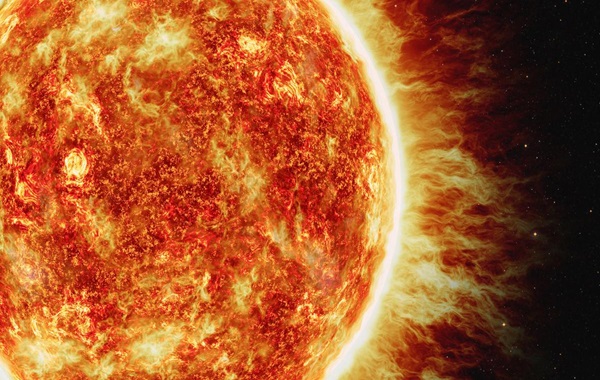
Spacecraft flying in formation near the sun could unlock new physics
A new space mission could unlock never-before-understood physics.
Scientists are increasingly looking to make sense of the biggest mysteries of the cosmos, including dark matter and dark energy.
In a new paper, a team of NASA researchers proposed a mission that would fly spacecraft in a tetrahedral formation near the sun, which could help to uncover some of the universe’s biggest mysteries.
Spacecraft flying in formation
The proposal would see several spacecraft flying in a tetrahedral formation using atom interferometers. Using this formation could help shed light on the sun’s gravitational field and unknown physics, the scientists claim.
The concept was devised by Slava G. Turyshev, a research scientist with NASA’s Jet Propulsion Laboratory (JPL). He was joined by Sheng-wey Chiow, an experimental physicist at NASA JPL, and Nan Yu, a senior research scientist at NASA JPL.
In their paper in Physical Review D, the scientists detail how their spacecraft formation will work. The spacecraft will use atom interferometers to detect the presence of non-gravitational noise, allowing them to negate it in readings. Flying in a tetrahedral formation will improve the spacecraft’s ability to compare measurements.
The mission would search for deviations from the predictions of general relativity at the solar system scale. According to the scientists, its precision will make it a first-of-its-kind mission.
In an interview with Universe Today, Turyshev explained that “these deviations are hypothesized to manifest as nonzero elements in the gravity gradient tensor (GGT), fundamentally akin to a solution of the Poisson equation.”
“Due to their minuscule nature, detecting these deviations demands precision far surpassing current capabilities—by at least five orders of magnitude,” he continued. “At such a heightened level of accuracy, numerous well-known effects will introduce significant noise. The strategy involves conducting differential measurements to negate the impact of known forces, thereby revealing the subtle, yet nonzero, contributions to the GGT.”
Testing general relativity at the smallest scale
The team’s concept paper was awarded a Phase III grant in 2020 by NASA’s Innovative Advanced Concepts (NIAC) program.
Their mission will test general relativity on the smallest scale. In doing so, it will provide a type of data that the scientific community is lacking. To date, scientists have largely investigated the effects of gravitational fields on spacetime using galaxy clusters as lenses.
The innovative mission could use a series of spacecraft and our sun to answer some of the biggest questions about our place in the universe.
Source: Interesting Engineering
NASA Just Received Laser Message Beamed From A Colossal 226 Million Kilometers Away
Spacecraft flying in formation near the sun could unlock new physics