Six Billion Tons per Second: Can a Planet Really Grow Like a Star?
Astronomers have made a groundbreaking discovery: a free-floating rogue planet is devouring gas and dust at an astonishing rate of six billion tons every second. Unlike planets in our solar system, rogue planets drift through space untethered to a star. Now, new observations reveal that these wandering worlds can grow more violently than previously imagined—offering clues about how planets and even stars take shape.
Rogue Planet Accretion: A Cosmic Growth Spurt Never Seen Before
Using the European Southern Observatory’s Very Large Telescope (ESO’s VLT) in Chile, researchers recorded the strongest planetary growth rate ever observed. The object, officially named Cha 1107-7626, is still forming and is surrounded by a thick disk of gas and dust. This material cascades down onto the young world in a process called accretion.
But here’s the surprise: the accretion rate is far from steady. By August 2025, the planet was swallowing material eight times faster than only months before. Lead researcher Víctor Almendros-Abad explains, “This is the strongest accretion episode ever recorded for a planetary-mass object.”
How can a planet in the depths of interstellar space suddenly erupt into such violent growth?
Planet or Star? The Blurred Boundaries of Cosmic Formation
The rogue planet’s mass is estimated at five to ten times that of Jupiter and lies about six hundred twenty light-years away in the constellation Chamaeleon. Its explosive growth mirrors phenomena usually seen in young stars, raising a provocative question: Are rogue planets more like failed stars than giant planets?
Astronomer Aleks Scholz of the University of St Andrews notes: “The origin of rogue planets remains an open question. Are they born like stars, or are they giant planets ejected from their original systems?”
This discovery blurs the line between star and planet formation. If low-mass objects can mimic stellar processes, the definitions astronomers rely on may need to shift.
Magnetic Fields and Water Vapor: Clues Hidden in the Disk
By analyzing the light emitted before and during the growth burst, researchers found evidence that magnetic activity fueled the mass infall—a mechanism long associated with stars but never with a planet. This means even rogue planets might host strong magnetic fields powerful enough to shape their growth.
Equally striking was a chemical transformation. During the burst, astronomers detected water vapor in the disk—a feature observed in stars but never before in a planetary object. Could this mean that rogue planets have more complex, evolving environments than we thought?
The Role of Next-Generation Telescopes in Rogue Planet Discoveries
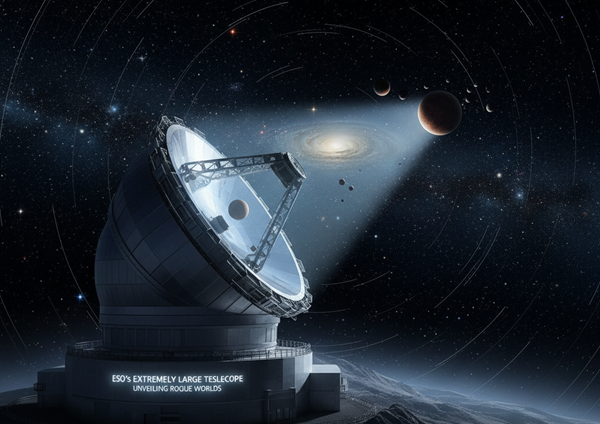
Rogue planets are notoriously hard to spot. They emit little light, making them faint and nearly invisible against the cosmic backdrop. But the next decade promises change. ESO’s upcoming Extremely Large Telescope (ELT), with its giant mirror and cutting-edge instruments, is expected to reveal many more of these free-floating worlds.
As ESO astronomer Amelia Bayo reflects, “The idea that a planetary object can behave like a star is awe-inspiring and invites us to wonder what worlds beyond our own could be like during their earliest stages.”
Will these discoveries force us to rethink the boundary between stars and planets? And if rogue planets can mimic stars, could they also host conditions we never imagined possible?
Why This Rogue Planet Discovery Matters
This record-breaking growth spurt of Cha 1107-7626 does more than shatter planetary records—it reshapes our understanding of cosmic evolution. By showing that rogue planets may share the same fiery infancy as stars, astronomers have unlocked new questions about the nature of planetary birth, the role of magnetic fields, and the hidden chemistry of early-world disks.
The universe is filled with wanderers like this, lonely worlds adrift in darkness. But as telescopes sharpen their gaze, we are beginning to see that these “quiet” planets may be far more dynamic, violent, and star-like than anyone imagined.
Source: Six Billion Tons per Second: Can a Planet Really Grow Like a Star?
Five of Six Essential Elements for Life Found on Enceladus—What’s Still Missing?
Five of Six Essential Elements for Life Found on Enceladus—What’s Still Missing?