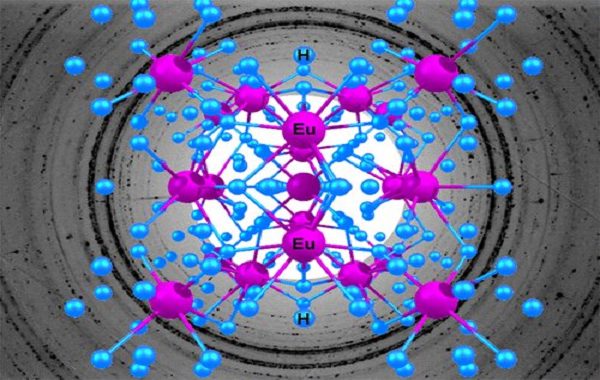
Scientists discover a new complex europium hydride
A team of researchers from Russia, the United States and China led by Skoltech Professor Artem R. Oganov have discovered an unexpected very complex europium hydride, Eu8H46. The paper detailing the discovery has been published in the Journal of Physical Chemistry letters.
Superhydrides of rare-earth metals are interesting compounds that form under pressure: Some exhibit high-temperature superconductivity that scientists have been chasing for over 100 years, and some possess magnetic properties. Although devoid of superconductivity, europium hydrides are very interesting in view of chemical anomalies that make europium different from other rare earth atoms.
Armed with the efficient and reliable USPEX crystal structure prediction tool developed by Oganov and his students, the team predicted the structure of the remarkably complex compound Eu8H46, which helped explain the experimental data.
“I am pleasantly surprised that USPEX has easily predicted a highly complex structure of 54 atoms, which is quite a lot. Curiously enough, our colleagues obtained this hydride in experiment earlier but got the structure and composition wrong, assuming it was EuH5. Now we know that the compound is much trickier,” Oganov comments.
“Such unusual compounds can be predicted in theory and proved by experiment, but there is no simple rule for identifying probable chemical compositions of stable compounds without performing arduous calculations,” says Dmitrii Semenok, the first author of the paper and a Ph.D. student at Skoltech.
Source: Dmitrii V. Semenok et al. Novel Strongly Correlated Europium Superhydrides, The Journal of Physical Chemistry Letters (2020). DOI: 10.1021/acs.jpclett.0c03331
The hidden structure that engulf the already known Fermi bubbles of gamma radiation revealed in the Milky Way
A new survey of the sky in X-rays has revealed a previously hidden structure in the Milky Way galaxy. Giant bubbles of X-radiation from the galactic centre have been found extending vast distances above and below the galactic plane.
They’re so huge, they engulf the already known Fermi bubbles of gamma radiation – but, according to a team of astrophysicists led by Peter Predehl of the Max Planck Institute for Extraterrestrial Physics in Germany, it’s likely that the two phenomena are somehow linked. To continue click the link