
New Maya Ruler Discovered: What Does This Ancient Inscription Mean?
In the dense Mexican jungle at the tip of the Yucatán Peninsula, archaeologists have unearthed a hidden historical treasure in the ancient, long-abandoned Maya city of Cobá, near the towering Nohoch Mul pyramid.
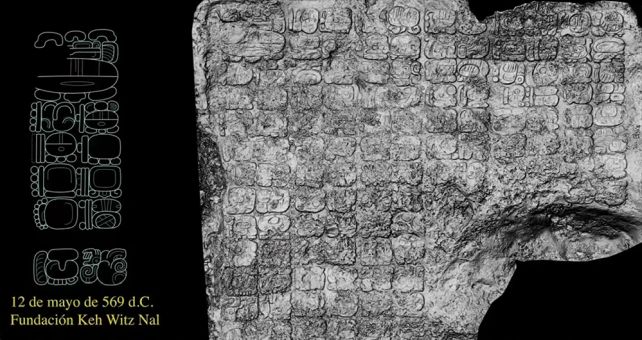
A vast stone slab, once part of the floor of a sacred pool, was discovered. What makes this slab remarkable is the inscription it bears: 123 glyphs, meticulously carved into its surface. Initial analysis suggests the glyphs detail the founding of a town called Keh Witz Nal, or “Deer Mountain,” on 12 May 569 CE. They also introduce a previously unknown Maya ruler named K’awiil Ch’ak Chéen, invoking K’awiil, the Maya god of lightning.
Other glyphs mention the gods believed to have founded Cobá, including Bolón Tz’akab Ajaw – the lord of countless generations.
Cobá, located in modern-day Quintana Roo on the Yucatán Peninsula, is thought to have been established by the Maya as early as 50 BCE, with continuous habitation for over one thousand five hundred years. At its peak, the city was a thriving cultural hub, home to an estimated fifty thousand inhabitants. Cobá, meaning “rough waters” in Maya, is rich in engravings and sculptures that provide insight into the spiritual and aesthetic lives of its former inhabitants.

The discovery of this stone slab, measuring eleven square meters (118 square feet) and featuring an L-shaped arrangement of glyphs, has been a significant archaeological find. Previous research identified fourteen rulers of Cobá, including three women, one of whom ruled for forty years. The newly uncovered inscription supports that many of these rulers adopted the name of the god K’awiil.
While a more detailed study of the inscription is planned, the immediate focus is on restoring and preserving the stone to prevent further damage from water and erosion. A high-resolution 3D reconstruction has been created, allowing for continued study without disturbing the stone further.
Source: New Maya Ruler Discovered: What Does This Ancient Inscription Mean?