Are We Looking at the Most Habitable Alien World Ever Found… or a Perfectly Silent Cosmic Illusion?
What if humanity is already staring at one of the most promising alien worlds ever discovered… yet still hearing only silence?
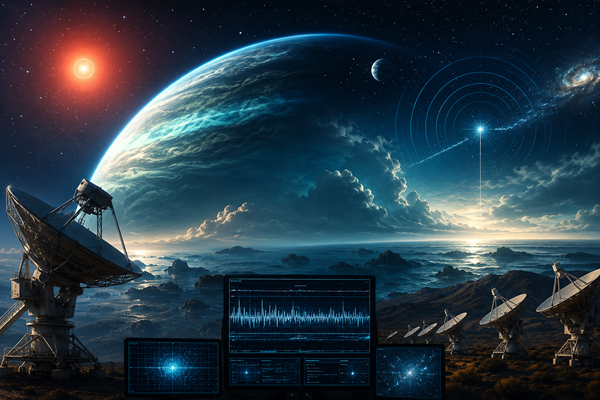
That question now surrounds the mysterious exoplanet known as K2-18b, a distant world orbiting a small red dwarf star approximately one hundred twenty-four light-years away in the constellation Leo. Over the last few years, K2-18b has become one of the most debated planets in astronomy. Some researchers believe it could possess conditions capable of supporting life. Others remain skeptical. Yet nearly everyone agrees on one thing: this strange world deserves attention.
Now, scientists involved in the Search for Extraterrestrial Intelligence, commonly known as SETI, have completed one of the most sophisticated radio signal searches ever conducted on the planet. The result? No confirmed alien radio transmissions were detected.
However, the silence may be just as important as the search itself.
Because every unsuccessful search teaches scientists how to listen better.
And perhaps more importantly, it raises a haunting possibility:
If intelligent life exists on K2-18b, why is it not speaking?
K2-18b Atmosphere Discovery: Why Scientists Believe This Planet Could Be Habitable
K2-18b sits inside the habitable zone of its parent star. This means temperatures there may allow liquid water to exist under the right atmospheric conditions. In astronomy, liquid water remains one of the most important ingredients associated with life.
Yet K2-18b is not Earth-like.
Instead, researchers suspect it may belong to an entirely different category of planet called a “Hycean world.” The name combines “hydrogen” and “ocean.” Scientists use the term to describe planets covered by deep global oceans beneath thick hydrogen-rich atmospheres.
This possibility transformed K2-18b from a simple exoplanet into a scientific obsession.
Observations from the James Webb Space Telescope strengthened that excitement even further. Researchers detected large amounts of methane and carbon dioxide in the planet’s atmosphere. These molecules are especially intriguing because, on Earth, methane can be associated with biological activity.
Could an alien ocean exist beneath those clouds?
Could microbial ecosystems survive there?
Or could something far more advanced already be watching the cosmos from beneath an endless hydrogen sky?
Scientists do not yet know.
Nevertheless, the atmospheric chemistry was compelling enough to justify a direct SETI investigation.
SETI Search on K2-18b: Why Two Giant Radio Telescopes Joined Forces
To search for possible technosignatures, researchers used two of the most powerful radio observatories on Earth.
The first instrument was the Karl G. Jansky Very Large Array in New Mexico. The second was the MeerKAT radio telescope in South Africa.
Coordinated observations between facilities of this scale are extremely rare. Together, they formed an enormous listening network capable of scanning huge portions of the radio spectrum with incredible precision.
Why use radio waves?
Because radio signals can travel enormous interstellar distances with relatively little energy loss. Humanity itself has used radio communication for more than a century. Therefore, many SETI scientists believe another technological civilization might also rely on radio transmissions.
But there is a major problem.
Earth is unbelievably noisy.
Modern civilization floods space with artificial radio interference from satellites, military systems, aircraft, communications towers, and countless electronic devices. Separating a genuine extraterrestrial signal from human-made contamination is like trying to hear a whisper inside a hurricane.
Therefore, scientists depended heavily on advanced software systems.
The Very Large Array used the Commensal Open-Source Multi-Mode Interferometer Cluster system, while MeerKAT relied on the Breakthrough Listen User Supplied Equipment system, often shortened to BLUSE.
These systems processed millions of incoming signals while attempting to isolate anything that behaved unlike normal terrestrial interference.
In many ways, the software became just as important as the telescopes themselves.
Alien Signal Detection Methods: How Scientists Filtered Earth’s Radio Noise
Searching for alien signals is not as simple as pointing a telescope toward the stars and waiting.
Researchers had to eliminate enormous amounts of false data before they could even begin evaluating possible technosignatures.
First, they applied Radio Frequency Interference masking, commonly called RFI masking. This process removed frequencies already known to be contaminated by Earth-based transmissions.
Ironically, if extraterrestrials were transmitting exactly within those noisy human frequencies, scientists might never hear them from Earth’s surface.
Could that mean alien civilizations already exist beyond our detection methods?
It is a possibility scientists cannot completely dismiss.
Researchers also used Doppler shift analysis. Doppler effects change how waves behave as objects move relative to one another. Humans experience this phenomenon when an ambulance siren changes pitch while passing by.
Signals arriving from another planetary system should naturally display Doppler drift due to orbital motion. Therefore, any signal showing almost no Doppler variation likely originated from Earth and was discarded immediately.
Scientists then applied strict signal-to-noise filters.
They rejected signals weaker than a defined threshold because extremely weak detections often emerge from random noise. They also removed unusually strong signals because instrumentation errors can produce artificial spikes.
Yet this created an unsettling dilemma.
Could a genuine alien transmission have been too faint to survive the filters?
Could humanity unknowingly erase the very evidence it seeks?
These questions continue to challenge SETI research today.
K2-18b Technosignature Search: Why Multi-Beam Analysis Matters
One of the most powerful techniques used during the search involved multi-beam analysis.
The telescopes created multiple focused beams across different regions of the sky simultaneously. One beam targeted K2-18b directly, while other beams observed unrelated locations nearby.
Why is this important?
Because terrestrial interference tends to appear across multiple beams at the same time. A true extraterrestrial signal, however, should emerge only from the exact direction of the target planet.
This method dramatically improved the reliability of the observations.
Scientists also considered using transit filtering. In theory, if K2-18b emitted a detectable signal, that signal should disappear when the planet moved behind its parent star.
However, the planet did not enter a secondary transit during the observational period. Therefore, researchers could not apply that final verification step.
Even so, the combined filtering methods represented one of the most advanced technosignature investigations ever attempted on a potentially habitable exoplanet.
Did Scientists Detect Alien Life on K2-18b? The Surprising Final Result
After processing millions of candidate detections, scientists found no confirmed artificial narrowband radio signal originating from K2-18b.
No unmistakable alien beacon emerged from the data.
No advanced civilization announced its presence.
No hidden transmission survived the filters.
At first glance, that may sound disappointing.
Yet scientifically, the result remains extremely valuable.
Negative results help researchers establish “upper limits” on possible extraterrestrial technology. According to the study, if an intelligent civilization exists on K2-18b, it likely is not transmitting radio signals stronger than technology comparable to the former Arecibo Observatory radar system once used on Earth.
In simple terms, nobody there appears to be shouting into space with gigantic radio beacons.
But another question quickly follows:
What if advanced civilizations do not use radio at all?
Human technology itself is already changing rapidly. Fiber optics, encrypted communication systems, quantum technologies, and directional transmissions increasingly replace older broad radio broadcasts.
Perhaps alien civilizations evolve beyond detectable radio leakage long before we learn how to hear them.
If so, the galaxy may be filled with intelligent life hidden behind technological silence.
Future SETI Technology: How New Radio Telescopes Could Change Everything
Perhaps the most important achievement of this search was not the result itself, but the system developed to analyze the data.
Future observatories will generate data volumes so enormous that humans alone will never manage them manually.
The upcoming Square Kilometer Array, expected to become the most powerful radio telescope ever constructed, will collect staggering amounts of information every single day. Without automated filtering systems, scientists would drown beneath the sheer scale of incoming signals.
The techniques tested during the K2-18b search therefore serve as a blueprint for the future of SETI science.
Humanity is learning how to listen more intelligently.
And with every new telescope, every improved algorithm, and every deeper survey, the silence of space becomes slightly easier to interpret.
But perhaps the greatest mystery remains psychological rather than technological.
Are we truly alone?
Or are civilizations across the galaxy listening just as carefully as we are… waiting for someone else to speak first?
The K2-18b Alien Life Question: Silence Does Not Mean Emptiness
Throughout history, humans often mistook silence for absence.
Ancient civilizations once believed the oceans were empty beyond the horizon. Later, humanity assumed planets were lifeless rocks drifting through darkness. Today, modern astronomy reveals thousands of exoplanets scattered throughout the galaxy.
Some may possess oceans.
Some may possess atmospheres.
Some may even possess biology.
And somewhere among them, intelligence may already exist.
K2-18b remains one of the most fascinating candidates ever discovered because it sits at the intersection of chemistry, habitability, and technological curiosity. Even without detecting alien signals, scientists now understand far more about how to conduct future searches.
In many ways, this investigation was never only about one distant world.
It was about humanity learning how to ask one of the oldest questions ever imagined:
Who else is out there?
And if another civilization eventually answers, will humanity even recognize the signal when it arrives?
Source: Are We Looking at the Most Habitable Alien World Ever Found… or a Perfectly Silent Cosmic Illusion?
Are We Looking at the Most Habitable Alien World Ever Found… or a Perfectly Silent Cosmic Illusion?
Sources
arXiv preprint study on K2-18b technosignature observations
NASA Exoplanet Archive
James Webb Space Telescope atmospheric observations
SETI Institute research publications
Breakthrough Listen scientific reports
National Radio Astronomy Observatory documentation
MeerKAT Observatory technical publications
Are We Looking at the Most Habitable Alien World Ever Found… or a Perfectly Silent Cosmic Illusion?