What Killed 92% of the Children in Europe’s Largest Copper Age Tomb—and Why Did They All Receive the Same Funeral?
What can the bones of children tell us about life—and death—five thousand years ago?
At Camino del Molino, Spain, a mass grave carved into bedrock holds secrets that scientists are now deciphering.
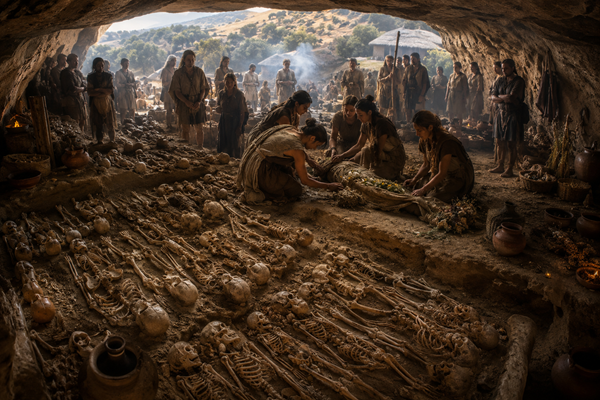
This cavernous burial chamber, Europe’s largest Copper Age tomb, yielded an exceptionally rare treasure: forty-eight intact juvenile skeletons.
Their remains whisper a story of widespread disease, hidden for millennia.
Could a forgotten epidemic have swept through this prehistoric community?
Camino del Molino: Europe’s Largest Copper Age Tomb Holds Over One Thousand Three Hundred Souls
The site, located in southeastern Spain, functioned as a communal ossuary for more than seven centuries.
Archaeologists uncovered a jumbled mass of bones belonging to men, women, and children.
Prehistoric communal graves rarely preserve complete skeletons.
Bones get reshuffled, crushed, or simply decay away.
Nevertheless, Camino del Molino provided something unprecedented.
Researchers recovered forty-eight non-adult skeletons in remarkable anatomical order.
These tiny, fragile frames offered a direct window into childhood health during the third millennium BC.
Children’s Bones Expose a Hidden Health Crisis Etched in Skeletons
Why did these children die so young?
A new study published in the International Journal of Paleopathology found shocking skeletal evidence.
Of the forty-eight individuals examined, an overwhelming ninety-two percent displayed at least one bone lesion linked to disease.
About sixty-seven percent showed a combination of porous bone growth and infection-related changes.
These markers appeared primarily on the skull and leg bones.
But they also surfaced on vertebrae, hips, and pelvises.
The pattern, according to lead author Dr. Sonia Díaz-Navarro of the University of Burgos, reflects a prolonged burden of respiratory illness rather than a single pathogen.
Respiratory Disease Patterns in Copper Age Juvenile Bones
Could such bone damage simply result from growth spurts?
The research team challenged that assumption.
They observed the lesions across all age groups, from toddlers to teenagers.
If growth alone caused the porosity, it would not co-occur with clear signs of respiratory infection.
Furthermore, the highest rates of bone changes appeared in two vulnerable windows: children aged one to four years and early adolescents aged ten to fourteen years.
These peaks align exactly with ages when lung infections, including tuberculosis, pose the greatest threat.
Serpent-like grooves and pitting on the inner skull surface, called endocranial lesions, point directly to early-stage tuberculosis.
In that phase, bacteria travel through the bloodstream and inflame the meninges.
Tuberculosis and Other Pathogens: Did Multiple Diseases Ravage the Community?
Do the bone signatures confirm tuberculosis alone?
Not definitively. Similar lesions can arise from other respiratory diseases.
Ancient DNA studies are still pending.
However, the distribution and severity of the skeletal markers strongly suggest a complex disease environment.
Crowded living quarters, indoor smoke, and close animal contact likely exposed children to multiple pathogens.
Zoonotic diseases could have jumped from livestock.
Dr. Díaz-Navarro emphasizes that children encountered dust, organic particles, and craft-processing fumes daily.
These conditions created a perfect storm for recurrent lung infections.
Why Were Children and Adolescents the Most Vulnerable in This Copper Age Society?
What made the youngest members of the community so susceptible?
Developing immune systems certainly played a role.
But the shared living conditions magnified the risk.
Interestingly, the study found no sex-based differences in the bone lesions.
This suggests that disease exposure was universal, not tied to gendered tasks.
Girls and boys breathed the same polluted air and huddled around the same smoky hearths.
Consequently, both suffered equally.
Funerary Equality: Disease and Disability Did Not Lead to Exclusion
Did sick children face stigma even in death?
The burial evidence says no.
Individuals with severe pathological conditions received the same mortuary treatment as healthy peers.
For instance, researchers identified a person with dwarfism and another who had undergone trepanation (skull surgery).
Their bodies lay alongside everyone else, without any sign of differential disposal.
Dr. Díaz-Navarro notes that this underscores the inclusive nature of this Copper Age community.
Visible disability or chronic illness did not bar anyone from the communal tomb.
Future Ancient DNA and Isotope Analyses Will Unlock Deeper Secrets
What comes next?
The researchers plan to extract ancient DNA from the bones.
This will confirm whether Mycobacterium tuberculosis DNA is present.
Isotopic analyses will also reconstruct the children’s diets and reveal whether they were local or migrants.
These data will help scientists understand how nutrition and mobility influenced disease susceptibility.
Additionally, comparing adult skeletons with the juvenile dataset will clarify if the crisis spared any age group.
Were some individuals more exposed or genetically vulnerable?
The answers lie buried in collagen and calculus.
What Can a Five-Thousand-Year-Old Health Crisis Teach Us Today?
The Camino del Molino children remind us that respiratory diseases have long plagued humanity.
Their bones encode a story of environmental hazards, social care, and survival against harsh odds.
As ancient DNA technology advances, we may soon name the specific pathogens that killed them.
For now, the lesions stand as silent testimony to an ancient crisis.
How many other mass graves hide similar tales?
What other invisible epidemics await discovery in the world’s museums and excavation archives?
The children of Camino del Molino, once forgotten, now force us to confront the deep history of human disease—and the enduring fragility of young lives.
Source: What Killed 92% of the Children in Europe’s Largest Copper Age Tomb—and Why Did They All Receive the Same Funeral?
What Killed 92% of the Children in Europe’s Largest Copper Age Tomb—and Why Did They All Receive the Same Funeral?
Sources
Díaz-Navarro, S., et al. (2025). Widespread respiratory disease in a Copper Age mass burial: Skeletal evidence from Camino del Molino, Spain. International Journal of Paleopathology, 48, 123–145.
Roberts, C. A., & Buikstra, J. E. (2019). The Bioarchaeology of Tuberculosis: A Global View on a Reemerging Disease. University Press of Florida.
Pechenkina, E. A., et al. (2024). Endocranial lesions and respiratory stress in prehistoric populations: A meta-analysis. American Journal of Physical Anthropology, 175(2), 312–329.
What Killed 92% of the Children in Europe’s Largest Copper Age Tomb—and Why Did They All Receive the Same Funeral?