Why Did Ancient Humans Mourn Their Dead Seventy-Eight Thousand Years Ago… And What Truth About Humanity Has Been Buried With Them Ever Since?
Seventy-Eight Thousand Years of Human History Hidden Inside Kenya’s Panga ya Saidi Cave
What does it mean to uncover a place where humanity survived for nearly eighty thousand years without interruption? Could one cave rewrite everything scientists believed about early human migration, culture, and survival?
Deep within the tropical forests of coastal Kenya, surrounded by twisting vines, flowering plants, and towering limestone cliffs, archaeologists carefully move toward one of the most extraordinary prehistoric sites ever discovered. The cave, known as Panga ya Saidi, stretches through winding tunnels beneath the earth like a hidden memory preserved by time itself.
Cool air rises from the stone floor. Ferns and mosses cling to the damp walls. Sunlight breaks through openings in the collapsed ceiling, illuminating a chamber that has protected generations of humans for tens of thousands of years. Even today, the cave feels stable and alive, almost as though it still remembers the people who once called it home.
Located near Kenya’s Nyali Coast, this remarkable site has become one of the most important archaeological discoveries in Africa. More importantly, it is changing how scientists understand the origins of human behavior, migration, innovation, and ritual.
For decades, researchers focused heavily on the African Rift Valley when investigating early human evolution. However, discoveries at Panga ya Saidi suggest something entirely different. What if coastal forests, rather than open savannas alone, played a major role in shaping humanity’s story?
Environmental Stability Allowed Humans to Survive for Thousands of Years
One of the greatest mysteries surrounding the cave involves its incredibly long occupation. Why did humans continue returning to this place for nearly eighty thousand years?
Scientists from the Max Planck Institute for the Science of Human History spent more than a decade examining the cave and its surrounding ecosystem. Their interdisciplinary research revealed a surprising answer: environmental stability.
Unlike many regions of prehistoric Africa that experienced severe climatic swings, the area around Panga ya Saidi remained relatively predictable. Seasonal rains regularly fed rivers and lakes. Tropical forests blended into open grasslands, creating an ideal environment for survival.
Humans living near the cave could hunt animals in grassland habitats, gather edible plants from nearby forests, and collect shellfish from the Indian Ocean coast. Because resources remained available across different seasons, the region provided security during periods when other parts of Africa became increasingly hostile.
Sediment layers inside the cave revealed little environmental disruption over thousands of years. Animal remains, plant evidence, shell fragments, and stone tools showed remarkable continuity across generations. This stability likely encouraged humans to remain in the region instead of constantly migrating in search of safer territory.
Could this environmental consistency explain why human occupation persisted through some of Earth’s harshest climatic events?
Ancient Stone Tools Reveal Human Adaptation and Innovation
As archaeologists excavated deeper into the cave floor, they uncovered layer after layer of artifacts spanning tens of thousands of years. Each layer told part of a larger human story.
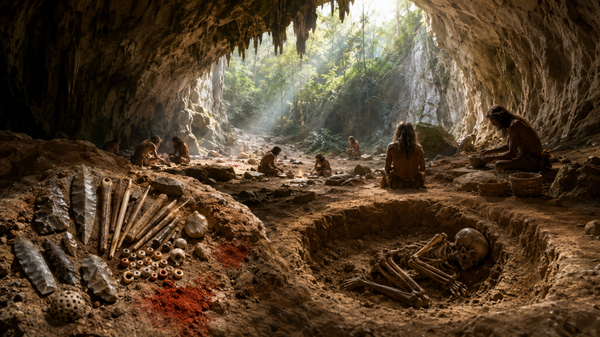
Scattered throughout the sediments were stone tools, beads made from ostrich eggshells, sharpened bone implements, and fragments of red ochre. These objects were not random debris. Instead, they reflected traditions carefully passed from one generation to the next.
The oldest stone toolkits discovered at the cave date back approximately seventy-eight thousand years. Interestingly, many of these tools remained similar over long periods of time. This consistency suggests that ancient humans favored reliable methods rather than constantly inventing entirely new technologies.
However, around sixty-seven thousand years ago, important changes began to appear.
During the Later Stone Age, tools became smaller, lighter, and easier to transport. Hunters adapted their equipment to new survival strategies. Innovation accelerated, yet people still retained many older traditions. Rather than abandoning the past, they combined familiar practices with practical improvements.
This balance between adaptation and continuity may reveal something profound about early humans. Survival was not always about dramatic revolutions. Sometimes, survival depended on preserving knowledge that already worked.
How Did Humans Survive the Toba Volcanic Winter?
One of the most astonishing discoveries connected to Panga ya Saidi involves timing.
Around seventy-four thousand years ago, the massive Toba supervolcanic eruption in present-day Indonesia triggered what scientists describe as a volcanic winter. Ash clouds spread across the atmosphere, temperatures dropped, and ecosystems around the world suffered enormous disruption.
Many researchers once believed this catastrophe nearly wiped out early human populations.
Yet evidence from Panga ya Saidi tells another story.
Instead of abandonment, archaeologists found signs that human occupation may actually have increased during this difficult period. Somehow, the people living near the cave adapted successfully while other populations struggled.
How did they survive such a devastating global event?
Researchers believe the answer once again lies in environmental diversity. The surrounding forests, grasslands, rivers, and coastal resources created multiple food sources. If one resource declined, another remained available.
This flexibility may have allowed humans at Panga ya Saidi to endure environmental crises that proved deadly elsewhere. The discovery challenges older theories suggesting that prehistoric humans depended on narrow ecological conditions to survive.
Ancient Beads and Symbolic Artifacts Reveal Early Human Culture
Beyond survival, the cave also reveals something equally important: symbolism.
Why did ancient humans create jewelry? Why did they preserve decorative traditions for thousands of years? And what do these objects say about identity, communication, or belief?
Archaeologists uncovered some of the oldest symbolic artifacts ever found in East Africa. Among them was Kenya’s oldest known bead, dating back roughly sixty-five thousand years.
For nearly forty thousand years, many beads discovered at the site were crafted from coastal marine shells. Later, around twenty-five thousand years ago, ostrich eggshell beads became more common.
These ornaments may seem small, but their significance is enormous.
Jewelry often reflects social identity, cultural belonging, trade networks, or spiritual meaning. The persistence of bead-making traditions across millennia suggests that symbolic behavior remained deeply important within these communities.
Interestingly, researchers found relatively little evidence showing extensive use of marine resources for food despite the cave’s proximity to the coast. This detail weakens earlier theories claiming that coastal diets alone drove human expansion and innovation.
Instead, the evidence points toward a more complex reality. Human culture developed through flexibility, adaptation, and stable social traditions rather than through one single environmental advantage.
Africa’s Oldest Human Burial Changes Archaeology Forever
Perhaps the most emotional discovery at Panga ya Saidi emerged during excavations conducted in two thousand twenty-one.
Buried carefully beneath the cave floor lay the remains of a young child approximately three years old. The grave dates back nearly seventy-eight thousand years, making it Africa’s oldest known intentional human burial.
The discovery stunned archaeologists.
Researchers found the child positioned carefully in a fetal posture. According to the excavation team, the head may have rested on a pillow-like support. The body appeared wrapped before burial and was gently covered with layers of soil.
This was not accidental disposal. It was a deliberate act of care.
What does this reveal about the minds and emotions of ancient humans?
Intentional burials often indicate emotional attachment, ritual behavior, grief, and symbolic thinking. The burial practices discovered at Panga ya Saidi closely resemble ancient burials found at Skhul and Qafzeh caves in present-day Israel, where groups connected to similar African tool-making traditions once lived.
The similarities raise powerful questions.
Did early humans already possess complex spiritual ideas tens of thousands of years earlier than previously assumed? Were mourning rituals and symbolic funerary practices already widespread across prehistoric populations?
The child’s burial transforms the cave from a simple archaeological site into something deeply human. It reminds us that even seventy-eight thousand years ago, people loved, mourned, protected, and remembered one another.
Panga ya Saidi Cave Challenges Old Human Migration Theories
For many years, scientists proposed that early humans rapidly migrated out of Africa using coastal routes that functioned like prehistoric “superhighways.” According to this theory, populations depended heavily on marine resources while traveling along the Indian Ocean rim.
However, discoveries at Panga ya Saidi complicate this narrative.
Professor Michael Petraglia explained that the evidence from the cave undermines simplistic migration models. Despite the cave’s location near the coast, researchers found limited dependence on marine food resources.
Instead, humans appeared highly adaptable. They survived using forests, grasslands, rivers, and coastal environments simultaneously.
Dr. Nicole Boivin, Director of the Department of Archaeology at the Max Planck Institute for the Science of Human History, emphasized the importance of this shift in understanding. For decades, scientists considered East Africa’s coastal forests relatively unimportant in human evolution. Today, that assumption no longer holds.
The cave reveals that human success may have depended less on one ideal migration route and more on the ability to adapt creatively to diverse environments.
Could this discovery force archaeologists to rewrite major chapters of human history?
What Panga ya Saidi Cave Reveals About Humanity’s Deep Past
Panga ya Saidi is more than an archaeological site hidden beneath Kenyan limestone cliffs. It is a living archive of human endurance.
Within its layers of sediment lie stories of innovation, survival, ritual, grief, adaptation, and continuity stretching across nearly eighty thousand years. Few places on Earth preserve such an uninterrupted record of human life.
The cave demonstrates that ancient humans were not primitive wanderers blindly struggling against nature. They were intelligent observers capable of adapting to environmental changes while maintaining cultural traditions across countless generations.
Most importantly, the discovery forces modern humanity to confront deeper questions about itself.
How much of human identity was already formed tens of thousands of years ago? When did compassion begin? When did symbolism emerge? When did humans first understand loss, memory, and belonging?
Perhaps the greatest mystery of Panga ya Saidi is not how ancient humans survived there for so long.
Perhaps the real mystery is how much of ourselves we can still recognize in them.
Source:Why Did Ancient Humans Mourn Their Dead Seventy-Eight Thousand Years Ago… And What Truth About Humanity Has Been Buried With Them Ever Since?
Unique Human Artifacts Dating Back 430,000 Years Have Been Discovered in Greece
Unique Human Artifacts Dating Back 430,000 Years Have Been Discovered in Greece
Why Did Ancient Humans Mourn Their Dead Seventy-Eight Thousand Years Ago… And What Truth About Humanity Has Been Buried With Them Ever Since?