NASA Unveils a Hidden Universe of Supermassive Black Holes
By combining data from NASA’s IRAS and NuSTAR telescopes, scientists have uncovered more hidden supermassive black holes than earlier estimates suggested.
Their findings indicate that over a third of these black holes are obscured by thick gas and dust, influencing how galaxies grow and evolve. The study demonstrates the power of combining archival infrared data with modern X-ray observations to better understand these mysterious cosmic objects.
Searching the Skies for Supermassive Black Holes
Multiple NASA telescopes have recently helped scientists search the skies for supermassive black holes — colossal objects that can be billions of times more massive than the Sun. What makes this survey unique is its ability to detect both black holes that are hidden behind thick clouds of gas and dust and those that are not.
Astronomers believe that nearly every large galaxy in the universe has a supermassive black hole at its center. However, proving this theory is challenging because counting the billions or even trillions of these black holes across the universe is impossible. Instead, scientists analyze smaller samples and use them to estimate the larger population. By accurately determining how many black holes are hidden within a given sample, researchers can make better predictions about the total number of supermassive black holes in the universe.
Published in the Astrophysical Journal, the new study found that about 35% of supermassive black holes are heavily obscured, meaning the surrounding clouds of gas and dust are so thick they block even low-energy X-ray light. Comparable searches have previously found less than 15% of supermassive black holes are so obscured. Scientists think the true split should be closer to 50/50 based on models of how galaxies grow. If observations continue to indicate significantly less than half of supermassive black holes are hidden, scientists will need to adjust some key ideas they have about these objects and the role they play in shaping galaxies.

Hidden Treasure: Illuminating the Darkness
Although black holes are inherently dark — not even light can escape their gravity — they can also be some of the brightest objects in the universe: When gas gets pulled into orbit around a supermassive black hole, like water circling a drain, the extreme gravity creates such intense friction and heat that the gas reaches hundreds of thousands of degrees and radiates so brightly it can outshine all the stars in the surrounding galaxy.
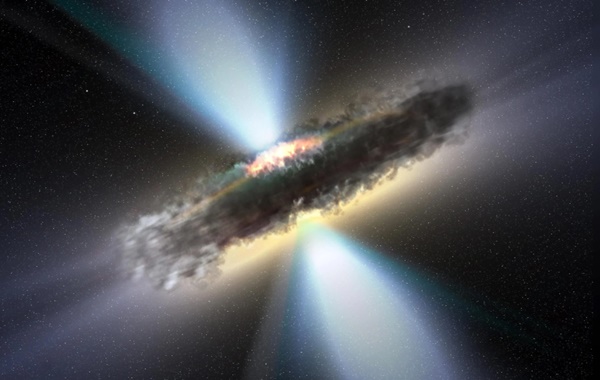
The clouds of gas and dust that surround and replenish the bright central disk may roughly take the shape of a torus, or doughnut. If the doughnut hole is facing toward Earth, the bright central disk within it is visible; if the doughnut is seen edge-on, the disk is obscured.
Source: https://scitechdaily.com
Could Primordial Black Holes Be the Missing Link to Dark Matter?