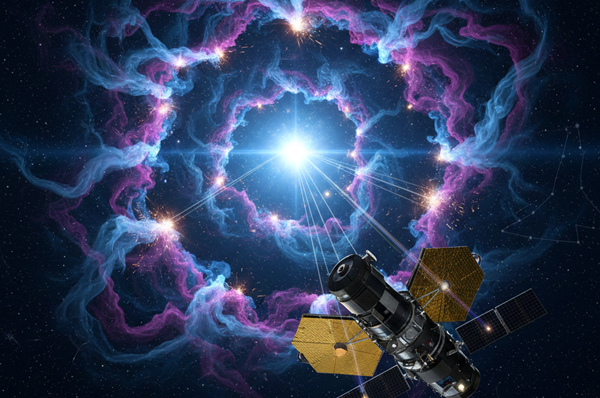
JWST Sees “Smoke” Around a Distant Star—Are Alien Comets Actively Destroying Themselves?
James Webb Space Telescope discovery has revealed exocomet-driven carbon monoxide gas inside a nearby debris disk, offering new insight into planetary formation around young stars. Observations of HD 131488 show ultraviolet-fluorescent CO gas released by crashing exocomets, providing the first direct evidence that comet destruction replenishes gas in CO-rich debris disks.
JWST and Exocomets: A New Window into Debris Disk Chemistry
The star at the center of this discovery, HD 131488, lies about 500 light-years away in the Upper Centaurus Lupus subgroup of the Centaurus constellation. At roughly 15 million years old, the star remains extremely young by stellar standards. Astronomers classify it as an early A-type star, meaning it is hotter and more massive than the Sun.
Researchers have studied HD 131488 before, but JWST now reveals details that earlier telescopes could not. Previous observations hinted at complex disk structures, yet the inner regions remained poorly understood. JWST’s infrared sensitivity finally exposed the missing chemical and thermal puzzle pieces.
Could this nearby system resemble what our own Solar System once looked like during its violent youth?
ALMA, Gemini, and the Clues Leading to JWST’s Breakthrough
Before JWST turned its mirrors toward HD 131488, ALMA radio observations had already identified large reservoirs of cold carbon monoxide gas and dust located between 30 and 100 astronomical units (AU) from the star.
Meanwhile, infrared data from the Gemini Observatory and NASA’s Infrared Telescope Facility (IRTF) suggested something more dynamic closer in. Those measurements pointed to hot dust and solid-state features in the inner disk. Optical studies added another layer by detecting hot atomic gas, including calcium and potassium.
Yet none of these instruments could confirm the molecular composition of the inner disk gas. That critical insight required JWST.
Infrared Spectroscopy with JWST: Detecting Warm Carbon Monoxide Gas
In February 2023, JWST observed HD 131488 for roughly one hour. That brief window proved sufficient. The telescope detected a small but crucial amount of warm carbon monoxide gas, totaling only one hundred-thousandth the mass of the cold outer disk gas.
This CO gas occupies the region between 0.5 and 10 AU, a zone comparable to the terrestrial planet region in our own Solar System. Its properties immediately stood out.
Instead of behaving like gas in thermal equilibrium, these molecules told a far stranger story.
Non-Thermal CO Fluorescence: Why the Gas Glows Like Smoke
Under normal conditions, a gas’s rotational temperature and vibrational temperature match. Collisions between particles equalize their energy, producing what physicists call local thermal equilibrium.
That balance does not exist here.
Around HD 131488, the CO molecules rotate at temperatures between 150 K and 450 K, yet their vibrational temperature reaches a staggering 8,800 K. The star’s intense ultraviolet radiation excites the molecules, forcing them into a non-equilibrium fluorescent state.
This mismatch explains why JWST detected the gas glowing in infrared light. The molecules do not simply sit and cool—they actively fluoresce.
What else could push molecular gas so far from equilibrium?
Isotopes, Dust Grains, and the Role of Collisional Partners
JWST also measured an unusually high carbon-12 to carbon-13 ratio, an indicator that dust grains partially shield the gas from stellar radiation. Without that shielding, the isotopic balance would look very different.
However, fluorescence alone cannot explain the emission pattern. CO molecules require collisional partners—other particles that bump into them and siphon off energy.
Researchers tested two possibilities. Hydrogen gas, while common in young systems, did not fit the data well. Water vapor, on the other hand, matched the observations far more convincingly.
That result points directly toward a dramatic source.
Exocomets as the Source: Evidence for Ongoing Comet Destruction
The most compelling explanation is exocometary activity. In this scenario, icy bodies plunge toward the star, vaporize under intense heat, and release water vapor and carbon monoxide into the inner disk.
This process would continuously replenish the gas, solving a long-standing mystery. Carbon monoxide breaks down quickly under UV radiation, so a static reservoir should not survive for millions of years.
The data now strongly favor active comet destruction over the idea that the gas is simply leftover from the star’s formation.
Are we witnessing the aftermath of countless cometary deaths shaping an alien planetary system?
Implications for Planet Formation and Terrestrial Worlds
This discovery carries major consequences for planetary formation theory. The inner disk around HD 131488 contains abundant carbon and oxygen, yet shows very little hydrogen.
Any planets forming in this region would likely develop high metallicity, meaning they would contain a large proportion of heavy elements rather than hydrogen-rich atmospheres. Such worlds would differ fundamentally from gas giants formed in primordial nebulae.
This chemistry may resemble the building blocks that once shaped rocky planets like Earth.
Could exocomets play a central role in delivering key ingredients for habitable worlds?
JWST and the Future of CO-Rich Debris Disk Research
These observations exemplify exactly what JWST was built to achieve: revealing invisible processes that shape planetary systems. Since its launch, the telescope has steadily rewritten textbooks, and HD 131488 is likely only the beginning.
Astronomers expect to find more CO-rich debris disks, each offering new insights into how planets emerge from chaos. For now, this study provides some of the strongest evidence yet that exocomets actively sculpt young planetary systems.
If JWST can already see the smoke from destroyed comets, what other hidden stories are waiting in the infrared dark?
Source: JWST Sees “Smoke” Around a Distant Star—Are Alien Comets Actively Destroying Themselves?
Five Newly Found Planets Face Stellar Fury: Which Ones Will JWST Reveal as Survivors?
Five Newly Found Planets Face Stellar Fury: Which Ones Will JWST Reveal as Survivors?
JWST Sees “Smoke” Around a Distant Star—Are Alien Comets Actively Destroying Themselves