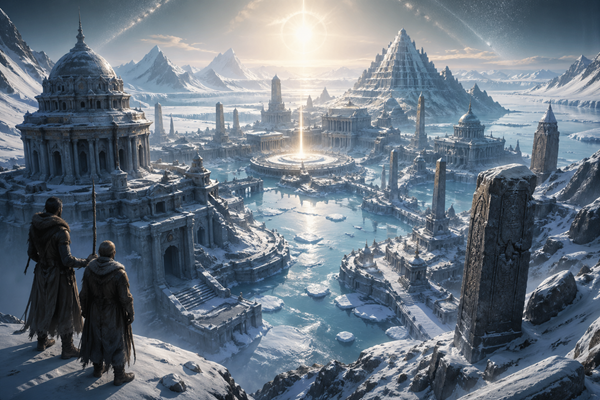
What If the Arctic Was Never Empty? The Lost Civilization Beneath Hyperborea We Were Never Supposed to Find?
For centuries, the legend of Hyperborea has stirred the imagination of explorers, historians, and dreamers alike. A paradise beyond the reach of the harsh north wind. A land untouched by disease, war, or decay. But what if this was not just myth? What if this story was a distant echo of a forgotten human past?
At first glance, the idea seems implausible. Yet, as new discoveries emerge and old assumptions are challenged, the line between myth and history begins to blur. Could an advanced Arctic civilization have existed long before recorded history? And if so, why has it remained hidden for so long?
Hyperborea Myth Origins: Ancient Greek Descriptions of a Lost Arctic Paradise
The earliest references to Hyperborea come from ancient Greek writers. Among them, Pindar described a land where music never ceased and suffering did not exist. Life there was long, peaceful, and deeply connected to the divine.
Similarly, Herodotus mentioned the Hyperboreans as a real people who sent sacred offerings across vast distances. These accounts were not dismissed as fantasy at the time. Instead, they were treated as distant geography.
Even more intriguing, the god Apollo was said to travel there every winter. Why would such consistent narratives emerge across different sources? Were these merely symbolic stories, or fragments of inherited knowledge?
And here’s the deeper question: how did ancient Mediterranean cultures describe phenomena like months of continuous daylight without firsthand experience?
Ancient Arctic Civilization Theory: Could Hyperborea Have Been Real?
Modern alternative historians suggest a provocative idea. What if the Greeks inherited knowledge from an older civilization? A civilization that once thrived in the Arctic before dramatic climate shifts reshaped the planet?
At first, this sounds speculative. However, consider this: human history is far from complete. Entire civilizations have been lost before. Why should the Arctic be any different?
Moreover, the concept of cultural memory—knowledge passed down through generations—offers a compelling explanation. Could Hyperborea be a distorted memory of a real place?
Arctic Megalithic Structures: Evidence from Russia’s Remote North
In recent decades, attention has turned to northern Russia, especially the Kola Peninsula. This region, harsh and remote, holds puzzling archaeological features.
Massive stone formations have been reported. Some appear artificially shaped. Others are arranged in ways that suggest deliberate construction. These are not small structures. Some stones weigh hundreds of tons.
How were they moved? Who built them? And more importantly—why?
In addition, the Solovetsky Islands reveal intricate stone labyrinths. These spiraling patterns resemble those found across Europe. Their purpose remains unclear. Ritual? Navigation? Symbolism?
Or could they be remnants of a shared, ancient culture that once spanned vast distances?
Mercator Map Hyperborea Mystery: Ancient Maps That Shouldn’t Exist
One of the most controversial pieces of evidence comes from cartography. The sixteenth-century map by Gerardus Mercator depicts the North Pole as a structured landmass divided into four regions.
At the center lies a mysterious black mountain.
Mercator claimed his work was based on older, now-lost maps. But this raises an unsettling question: how could such detailed representations exist without advanced exploration?
Modern seabed mapping has revealed underwater ridges like the Lomonosov Ridge. Yet, these do not match Mercator’s design. So was he wrong—or referencing something we still don’t understand?
Arctic Climate History: Was the North Once Habitable for Humans?
From a scientific perspective, the Arctic has not always been frozen. During the Eocene Epoch, the region supported lush vegetation and diverse wildlife. However, this predates human existence.
A more relevant period is the Holocene Climatic Optimum. During this time, temperatures in northern regions were significantly warmer.
Could early humans have adapted to these conditions?
While it may not have been a paradise, it was certainly more livable than today’s Arctic. This opens the door to a fascinating possibility: small, advanced communities could have existed there, developing unique survival strategies.
If so, what happened to them when the climate shifted again?
Hyperborea Scientific Perspective: Myth, Memory, or Lost Civilization?
At this point, skepticism is necessary. There is no definitive proof of a lost Arctic super-civilization. Many claims remain speculative. Yet, dismissing everything outright may be equally shortsighted.
History has repeatedly shown that myths often contain fragments of truth.
So we must ask:
- Why do multiple ancient sources describe the same distant land?
- Why do unexplained structures exist in such inhospitable regions?
- Why do ancient maps depict geography that doesn’t align with current knowledge?
Are these coincidences—or clues?
The Future of Arctic Discoveries: What Lies Beneath the Ice?
Today, climate change is reshaping the Arctic. Ice is melting. Landscapes are shifting. Areas once buried for millennia are becoming accessible.
With each passing year, new discoveries emerge.
Could the Arctic still be hiding evidence of a forgotten civilization?
Or will it reveal something even more unexpected?
One thing is certain: we are only beginning to understand the depth of human history. And perhaps, just beyond the edge of what we know, Hyperborea still waits to be rediscovered.
Conclusion: A Mystery That Refuses to Fade
The story of Hyperborea refuses to disappear. It lingers. It evolves. It challenges assumptions.
Whether myth, memory, or reality, it continues to provoke one powerful question:
What if the greatest chapter of human history was written in ice—and we are only now beginning to read it?
Source: What If the Arctic Was Never Empty? The Lost Civilization Beneath Hyperborea We Were Never Supposed to Find?
What If the Arctic Was Never Empty? The Lost Civilization Beneath Hyperborea We Were Never Supposed to Find?
Sources and Further Reading
Ancient texts by Herodotus and Pindar
Writings of Pliny the Elder
Arctic geological studies on the Lomonosov Ridge
Research on Holocene climate patterns
Historical cartography of Gerardus Mercator