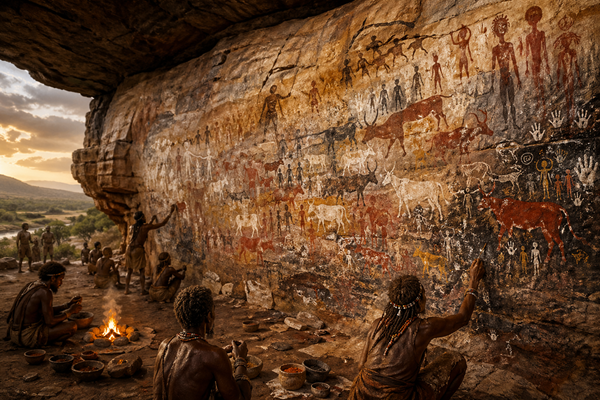
Nine Thousand Years of Paint on One Sacred Rock Wall in Kenya—Why Did Entire Civilizations Return Again and Again to Leave Their Mark?
For decades, archaeologists stood before the layered rock walls of Kakapel Rock Shelter with the same question: Who created these mysterious paintings—and why do so many images overlap each other?
Now, a groundbreaking study led by Catherine Namono has begun to answer that question. The research, published in Azania: Archaeological Research in Africa, reveals that the paintings were not the work of a single ancient culture. Instead, at least three different populations returned to this site repeatedly over nearly nine thousand years.
Through digital mapping, archaeological excavation, and ancient DNA analysis, researchers reconstructed a cultural timeline hidden within the rock itself. Each painted layer represents a different community, a different worldview, and possibly a different belief system.
But perhaps the most fascinating question remains: why did generations of people keep returning to the same rock wall to leave their mark?
Kakapel Rock Art and the Ancient Cultural Layers Hidden in the Stone
At first glance, the rock panels at Kakapel appear chaotic. Images overlap. Pigments fade into one another. Some figures barely remain visible beneath newer designs.
However, researchers suspected that this apparent disorder concealed a chronological story.
Therefore, the team performed millimeter-accurate digital tracing of the paintings. By separating pigment layers one by one, they reconstructed a visual timeline spanning thousands of years.
This technique revealed four major artistic layers.
Each layer corresponds to a different cultural phase in eastern African history. In other words, the rock shelter functioned like a historical canvas, where successive societies painted over the past while still honoring the sacred place.
What could make one location so important that communities returned for millennia?
Early Hunter-Gatherer Rock Art: The Oldest Kakapel Paintings
The earliest artwork discovered at Kakapel consists of faded red and white geometric patterns. These include circles, grids, divided shapes, and abstract forms.
Researchers associate this style with early hunter-gatherer-fisher communities that lived in the region thousands of years ago.
Interestingly, the artistic tradition resembles patterns linked to foraging groups historically labeled “Twa.” These groups lived across parts of eastern and central Africa.
Even more remarkable, genetic analysis provided additional clues.
Scientists extracted ancient DNA from a skeleton discovered near the rock shelter. The genome revealed strong genetic similarities with present-day Central African forest peoples such as the Mbuti people.
This discovery raises intriguing questions.
Were these early painters part of a vast network of hunter-gatherer cultures across Africa?
Did these geometric shapes carry symbolic meanings now lost to time?
Or could they represent some of the earliest visual expressions of spiritual thought in the region?
Cattle Rock Art and the Arrival of Pastoralist Societies
Thousands of years later, a very different artistic layer appeared.
This second phase contains at least twenty-five paintings of cattle.
The animals have long horns and no humps, and they are often shown in profile with twisted horns. This style closely resembles the “Ethiopian-Arabian” rock art tradition seen throughout the Horn of Africa.
These images signal a major turning point in regional history.
By this time, pastoralist societies had introduced cattle herding into eastern Africa.
However, researchers discovered something surprising.
The cattle paintings were not produced by the earliest farmers who lived near the site. Instead, evidence suggests they were created by later Nilotic-speaking agropastoralists who migrated into the area centuries afterward.
Why did these pastoral groups paint cattle so prominently?
Cattle were not simply livestock. Across many African pastoral cultures, they symbolized wealth, social identity, and spiritual power.
Thus, the paintings may have reflected ritual practices, clan identities, or ceremonial gatherings.
But again, the central mystery persists.
Why choose the same rock shelter used by earlier hunter-gatherers?
Ancient DNA Evidence Connects Rock Art to Real People
Archaeology alone could not fully answer these questions. Therefore, scientists turned to ancient DNA analysis.
Human remains discovered near Kakapel allowed researchers to compare genetic data with the timeline of the paintings.
Two skeletons from the Later Iron Age proved especially revealing.
One skeleton showed a genetic mixture that included ancestry from Pastoral Neolithic populations. The other individual, however, displayed ancestry closely related to Western Nilotic peoples.
These populations likely represent ancestors of communities such as the Luo people of modern Kenya.
Consequently, the research links the final artistic layers to these later societies.
The last paintings include:
- thick white geometric shapes
- yellow-white designs
- delicate white brush marks
Each layer added a new chapter to the story of Kakapel.
In effect, the rock wall became a visual archive of human migration and cultural transformation.
Why Kakapel Rock Shelter Became a Sacred Artistic Site
One question fascinates archaeologists more than any other:
Why did people keep returning to Kakapel for thousands of years?
The answer may lie in the spiritual significance of the landscape.
Rock shelters across Africa often serve as sacred spaces where rituals, ceremonies, and storytelling take place. Oral traditions sometimes describe such sites as locations where ancestors communicate with the living.
According to Dr. Namono, many African communities today still view rock art as the work of ancestral spirits.
Therefore, the paintings are not simply ancient decorations. They may represent ceremonial acts, prayers, or messages intended for future generations.
Could it be that each new community recognized the sacred nature of the place and added its own symbols to the walls?
If so, Kakapel was not merely a shelter. It was a shared cultural memory site.
Cultural Memory, Living Traditions, and the Meaning of Kakapel Rock Art
Co-author Benjamin Smith emphasizes that understanding ancient rock art often requires studying living traditions.
In some Kenyan communities, ceremonial painting and symbolic markings remain part of cultural rituals.
By comparing these modern practices with ancient imagery, researchers hope to uncover clues about the meanings behind Kakapel’s paintings.
Did the geometric shapes represent clan symbols?
Were cattle images linked to fertility ceremonies or initiation rites?
Could some paintings mark seasonal gatherings or migration routes?
Each possibility opens new avenues of investigation.
Protecting Kakapel Rock Art: Preserving Nine Thousand Years of Human History
Today, the paintings at Kakapel face multiple threats.
Environmental erosion slowly fades the pigments. Human activity can also damage the fragile rock surfaces.
Therefore, archaeologists emphasize collaborative heritage management. Local communities, researchers, and government agencies must work together to preserve the site.
Because once these paintings disappear, an irreplaceable record of human history disappears with them.
And that history is extraordinary.
For nearly nine thousand years, different societies returned to the same rock shelter. Each group left behind a visual trace of its beliefs, culture, and identity.
Together, those layers form a powerful reminder.
Human history is not a single story. It is a continuum of voices, each one speaking across time.
And Kakapel still whispers those voices today.
Source: Nine Thousand Years of Paint on One Sacred Rock Wall in Kenya—Why Did Entire Civilizations Return Again and Again to Leave Their Mark?
Sources
Azania: Archaeological Research in Africa
Science X Archaeology News
African Archaeological Review publications
Research by Catherine Namono and colleagues on Kakapel rock art
Rock art studies by Benjamin Smith