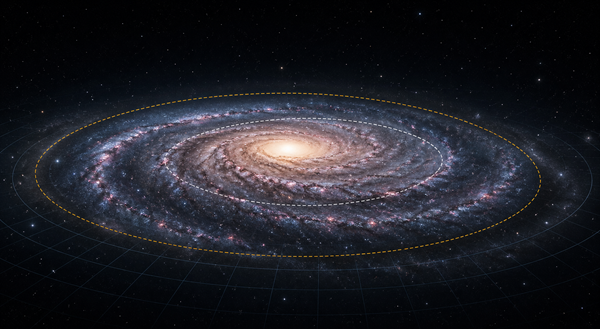
Astronomers Found the Edge of the Milky Way’s Star-Forming Disc—But Why Does Our Galaxy Suddenly Stop Creating Stars There?
For centuries, humans have looked up at the night sky and wondered where our galaxy begins and where it ends. Yet answering that seemingly simple question remains surprisingly difficult. After all, we live inside the Milky Way itself. From this vantage point, the galaxy does not appear as a neat spiral with clear borders. Instead, its stars gradually thin out as distance increases from the center.
So where exactly is the edge of the Milky Way?
A recent scientific study published in Astronomy & Astrophysics proposes a compelling answer. Researchers suggest that the true boundary of the galaxy should not be defined by where stars simply stop appearing. Instead, they define the edge as the outer limit where stars are actively formed.
Using that definition, the study places the boundary of the Milky Way’s star-forming disc between eleven point two eight and twelve point one five kiloparsecs from the galactic center. In other words, star formation appears to stop at roughly forty thousand light-years from the center of the galaxy.
But how did scientists reach such a precise conclusion? And why does star formation suddenly stop at that distance? The answers reveal an intricate story about the evolution of our galaxy.
The Milky Way’s Star-Forming Disc: Defining the True Galactic Edge
At first glance, one might assume that a galaxy simply ends where its stars disappear. However, galaxies rarely behave so neatly. Instead, their stellar populations become gradually more sparse as distance increases.
Because of this gradual fading, astronomers needed a more meaningful definition of the galactic edge.
Therefore, the researchers focused on the star-forming disc—the region where gas clouds collapse and give birth to new stars. If star formation stops beyond a certain distance, that boundary effectively marks the end of the Milky Way’s active stellar production.
Consequently, identifying this limit could reveal where the galaxy’s dynamic inner structure gives way to its quieter outskirts.
Yet locating that boundary required enormous amounts of data and careful analysis.
Analyzing One Hundred Thousand Giant Stars: How Astronomers Measured the Galactic Disc
To uncover the galaxy’s structure, scientists analyzed the ages of more than one hundred thousand giant stars. These stars serve as valuable cosmic markers because their properties reveal when they formed.
The research team gathered data from several major astronomical surveys, including:
- APOGEE Data Release Seventeen
- LAMOST Data Release Three
- Gaia Space Observatory measurements
Together, these datasets allowed astronomers to map stellar ages across large portions of the Milky Way.
However, the key breakthrough came when researchers plotted two variables against each other:
- Distance from the galactic center
- Age of the stars
The result was not random. Instead, a fascinating pattern emerged.
The U-Shaped Age Curve in the Milky Way: A Surprising Galactic Pattern
When astronomers plotted stellar age against distance from the center, they discovered something striking: a U-shaped curve.
This pattern tells a fascinating story.
Stars located near the galactic center tend to be very old. As distance increases, stellar populations gradually become younger. However, beyond a certain point, the trend reverses. Farther out, stars suddenly become older again.
Why would that happen?
The turning point in this U-shaped curve appears precisely where the star-forming disc ends.
In other words, that location marks the boundary where new stars stop forming.
This discovery provides a powerful clue about the galaxy’s structure.
But it also raises a deeper question: why does star formation stop there at all?
Why the Inner Milky Way Contains Older Stars
To understand the pattern, astronomers must first consider conditions in the galaxy’s early history.
Near the center of the Milky Way lies a dense environment filled with gas, dust, and powerful gravitational forces. Billions of years ago, this region contained enormous reservoirs of material capable of forming stars.
As a result, star formation began very early in the inner galaxy.
Over time, those early stellar generations aged. Today, many stars close to the galactic center are therefore extremely old.
Yet as astronomers look farther outward, the environment changes dramatically.
The Gradual Slowdown of Star Formation Across the Galactic Disc
Gas and dust become increasingly sparse with distance from the galactic center. Because star formation requires dense clouds of material to collapse under gravity, this lower density slows the process.
Consequently, stars in the outer portions of the disc formed later in cosmic history.
This explains why stellar ages decrease as astronomers move outward—at least up to a point.
Eventually, however, star formation stops altogether.
That boundary marks the edge of the star-forming disc.
But intriguingly, stars still exist beyond that region.
So where did they come from?
Migrant Stars Beyond the Milky Way’s Star-Forming Edge
The outermost regions of the Milky Way are not empty. They contain numerous stars, and many of them are surprisingly old.
Since star formation does not occur there, astronomers believe these stars originated closer to the galactic center.
Over billions of years, gravitational interactions gradually pushed them outward.
Two major mechanisms may explain this migration.
First, the Milky Way’s spiral arms can gravitationally disturb stellar orbits. As stars pass through these massive structures, their trajectories may shift.
Second, the galaxy’s central bar structure—a dense elongated region near the center—can act like a gravitational slingshot. This mechanism may eject stars from the inner disc toward the outskirts.
Thus, many stars in the galaxy’s distant regions are essentially cosmic travelers.
They formed in the galaxy’s active interior but slowly drifted outward across vast stretches of time.
Why Star Formation Stops at Forty Thousand Light-Years
The study proposes several possible explanations for the sharp decline in star formation beyond the disc’s edge.
Outer Lindblad Resonance and Galactic Dynamics
One major factor may be a gravitational effect called the Outer Lindblad Resonance. This phenomenon occurs when the rotation of the galaxy interacts with the gravitational influence of the central bar.
At certain distances, this interaction disrupts the flow of gas through the galactic disc.
As a result, gas may become trapped closer to the center instead of drifting outward.
Without sufficient gas in the outer regions, star formation becomes impossible.
The Galactic Warp
Another intriguing factor involves the Milky Way’s warped disc.
Unlike a perfectly flat spiral galaxy, the Milky Way bends and twists slightly at large distances from the center.
This warp spreads interstellar gas across a larger vertical area. Consequently, the gas becomes too diffuse to collapse into dense star-forming clouds.
Gas Density and Cooling Limits
Finally, the outer galaxy may simply lack the necessary density of gas.
For stars to form, gas clouds must cool and contract under gravity. If the gas becomes too thin, it cannot effectively collapse.
Thus, the raw material required for star formation simply disappears.
Together, these factors likely combine to produce the observed boundary.
What the Milky Way’s Star-Forming Edge Reveals About Galactic Evolution
This discovery carries important implications for understanding the Milky Way’s overall structure.
Astronomers classify galaxies according to how their brightness changes with distance from the center. Based on the new findings, the Milky Way appears to be a Type-Two down-bending disc galaxy.
In such galaxies, the density of stars declines sharply beyond a certain radius.
Interestingly, about sixty percent of spiral galaxies in the nearby universe share this structural profile.
Therefore, the Milky Way may be far more typical than previously thought.
Yet this discovery also prompts new questions.
How stable is the boundary of the star-forming disc? Has it always existed at the same distance? Could interactions with other galaxies have influenced it?
Future astronomical surveys may provide answers.
A New Perspective on Our Cosmic Neighborhood
Understanding the edge of the Milky Way does more than satisfy scientific curiosity.
It changes how we see our place in the universe.
Our Solar System lies roughly twenty-six thousand light-years from the galactic center. That places us comfortably inside the star-forming region but not particularly close to the core.
However, knowing where the galaxy’s active stellar nursery ends allows astronomers to map the Milky Way with far greater precision.
It also invites deeper reflection.
Where did the stars in the outer galaxy originate?
How many have traveled across the disc over billions of years?
Could our own Sun have migrated from another region long ago?
Every new discovery about the Milky Way reveals another layer of the cosmic story surrounding us.
And perhaps the most fascinating realization is this: even the galaxy we call home still holds countless mysteries waiting to be explored.
Source: Astronomers Found the Edge of the Milky Way’s Star-Forming Disc—But Why Does Our Galaxy Suddenly Stop Creating Stars There?
A Signal No One Expected: Did Astronomers Just Hear the Universe Hint at Something Alive?
A Signal No One Expected: Did Astronomers Just Hear the Universe Hint at Something Alive?
Astronomers Found the Edge of the Milky Way’s Star-Forming Disc—But Why Does Our Galaxy Suddenly Stop Creating Stars There?
Sources
- Astronomy & Astrophysics — Research on the Milky Way’s star-forming disc boundary
- APOGEE Data Release Seventeen Stellar Survey
- LAMOST Data Release Three Stellar Spectroscopic Survey
- European Space Agency — Gaia Mission Stellar Data
- Bland-Hawthorn, J., & Gerhard, O. (Galactic Structure Research)
- NASA Astrophysics Data System
Astronomers Found the Edge of the Milky Way’s Star-Forming Disc—But Why Does Our Galaxy Suddenly Stop Creating Stars There?