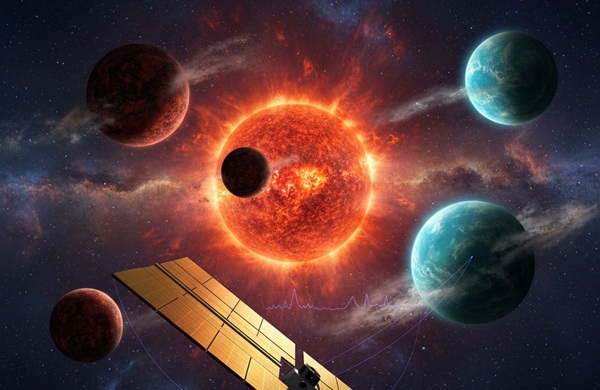
Five Newly Found Planets Face Stellar Fury: Which Ones Will JWST Reveal as Survivors?
Five New Planets and the Battle for Their Atmospheres
exoplanet atmospheres are a central focus of modern astronomy and a primary scientific target of the James Webb Space Telescope (JWST). Scientists study exoplanet atmospheres to understand how planets evolve and lose their gaseous envelopes. They also search for clues about habitability beyond Earth. However, detecting exoplanet atmospheres remains extremely difficult. Many known exoplanets have already lost their atmospheres. Others orbit stars that overwhelm telescopes with light. As a result, only a small number of planets qualify for atmospheric study.
Exoplanet Atmospheres and JWST Atmospheric Observations
JWST was designed to observe exoplanet atmospheres with unprecedented precision. It can analyze starlight as it passes through a planet’s atmosphere during a transit. Moreover, this method allows scientists to identify key gases such as water vapor and carbon dioxide. In theory, these measurements could hint at habitable conditions. In practice, suitable targets remain rare. Therefore, every promising planet receives intense scientific attention.
Exoplanet Atmospheres Discovered by TESS and Follow-Up Telescopes
NASA’s Transiting Exoplanet Survey Satellite, or TESS, first detected five new planet candidates. TESS identifies planets by measuring small dips in starlight. However, detection alone is not confirmation. Scientists must rule out false signals. For this reason, follow-up observations are essential. In this case, researchers used data from nine telescopes. As a result, they confirmed five exoplanets in four planetary systems.
Exoplanet Atmospheres on Super-Earth and Earth-Sized Planets
Four of the confirmed planets are classified as Super-Earths. Their sizes range between 1.28 and 1.56 Earth radii. Meanwhile, one planet, TOI-5716b, closely matches Earth’s size. Size alone does not determine atmospheric survival. In contrast, orbital distance and gravity play critical roles. These planets orbit their stars rapidly, with periods as short as 0.6 days. Consequently, they experience extreme stellar conditions.
Exoplanet Atmospheres Around Active M-Dwarf Stars
All five planets orbit M-dwarf stars. These stars are smaller and dimmer than the Sun. Because of this, exoplanet atmospheres are easier to observe around them. However, M-dwarfs are also highly active. They emit strong X-ray and ultraviolet flares. Over time, this radiation can erode planetary atmospheres. Therefore, scientists must evaluate whether a planet’s gravity can resist this process.
Exoplanet Atmospheres, the Cosmic Shoreline, and Atmospheric Loss
To address atmospheric survival, researchers use a model called the cosmic shoreline. This framework compares stellar radiation with planetary gravity. High radiation promotes atmospheric loss. Strong gravity helps retain gases. As a result, planets fall above or below a clear boundary line. Planets above the line are usually airless. In contrast, planets below it may keep their atmospheres.
Which Exoplanet Atmospheres Can Survive Stellar Radiation?
When scientists applied the cosmic shoreline model, clear differences emerged. Three planets lie well above the boundary. Their exoplanet atmospheres were likely stripped away long ago. One planet, TOI-5736b, occupies an unusual position. Despite intense radiation, its large mass may support a dense atmosphere. Most notably, TOI-5728b falls below the shoreline. Therefore, it is the strongest candidate for atmospheric retention.
JWST Follow-Up Studies of Exoplanet Atmospheres
TOI-5728b is now a prime target for JWST. Its atmosphere could reveal how planets survive near active stars. Moreover, it may help refine models of atmospheric loss. Although complex life is unlikely, simpler organisms cannot be ruled out. As a result, this planet remains scientifically compelling. Eventually, JWST observations may confirm whether its atmosphere truly persists.
When that data arrives, will it support current theories—or force scientists to rethink how exoplanet atmospheres survive across the galaxy?
Source: Five Newly Found Planets Face Stellar Fury: Which Ones Will JWST Reveal as Survivors?
Are We Ready to Build Permanent Infrastructure on the Moon—or Guessing Our Way There?
Are We Ready to Build Permanent Infrastructure on the Moon—or Guessing Our Way There?
Five Newly Found Planets Face Stellar Fury: Which Ones Will JWST Reveal as Survivors?