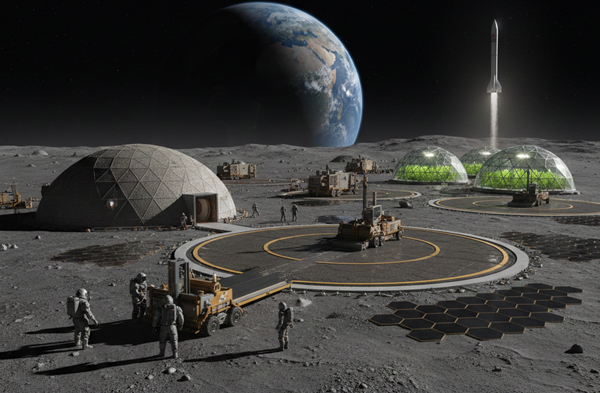
Are We Ready to Build Permanent Infrastructure on the Moon—or Guessing Our Way There?
Engineering Reusable Lunar Launchpads: Building the First Moon Landing Pads from Regolith
Engineering durable structures always begins with data. On Earth, even ancient builders understood this principle. The designers of the Great Pyramids knew that limestone could bear enormous loads when stacked correctly. Today, engineers face a similar challenge on a far more extreme frontier: engineering reusable lunar launchpads on the Moon. Unlike Earth, the Moon offers limited material knowledge and harsh environmental conditions. Yet future lunar missions depend on building reliable infrastructure directly from local resources.
How do you engineer a launchpad on a world where the ground itself is still a mystery?
Why Lunar Landing Pads Are Essential for Sustainable Moon Missions
At first glance, heavy-lift spacecraft such as Starship might appear capable of landing on any sufficiently flat lunar surface. However, rocket landings are violent events. Powerful retrograde plumes blast lunar dust and rock outward at extreme velocities. This debris can damage nearby habitats, scientific instruments, and even the spacecraft itself.
Without lunar landing pads, every landing risks destabilizing a future Moon base. Engineers therefore agree that structured, reusable pads are not optional—they are foundational infrastructure. On Earth, landing pads have supported launches for decades. The question is whether engineers can replicate that success using lunar materials alone.
Using Lunar Regolith as a Construction Material
Transporting construction materials from Earth is prohibitively expensive. As a result, engineers must rely on in-situ resource utilization (ISRU). The most promising candidate is lunar regolith, the fine, powdery soil covering the Moon’s surface.
Researchers favor sintering as a method to bind regolith into solid slabs. However, critical uncertainties remain. Engineers still lack precise data on the mechanical strength, fracture behavior, and thermal response of sintered lunar regolith.
According to Dr. Shirley Dyke of Purdue University, this lack of material certainty forces engineers to design cautiously. How strong is sintered regolith under compression? How brittle is it under tension? These unanswered questions shape every design decision.
Why Regolith Simulants Cannot Fully Replace In-Situ Testing
One might ask: why not rely on lunar regolith simulants? After all, simulants are widely used in laboratories on Earth. They support experiments ranging from excavation to plant growth.
Yet simulants have limits. Dr. Dyke emphasizes that simulants only approximate lunar soil. They cannot fully replicate the Moon’s vacuum, gravity, or extreme thermal cycles. Only in-situ testing on the lunar surface can reveal how regolith truly behaves under real conditions.
Without this data, engineers must design systems that tolerate uncertainty rather than eliminate it.
Mechanical and Thermal Stresses on Lunar Launchpads
Designing a reusable lunar launchpad requires balancing two dominant forces: mechanical loads and thermal stresses. When a spacecraft lands, the pad experiences immense compressive forces. During ascent, it faces intense thermal shock from rocket exhaust.
Studies suggest that sintered regolith behaves as a brittle material. It resists compression well but performs poorly under tension. Thermal insulation further complicates matters. Rocket plumes may heat only the top eight centimeters of a pad. This uneven heating causes cracking during each launch cycle.
Can a structure survive repeated punishment without catastrophic failure?
The Lunar Day-Night Cycle and Structural Warping Risks
Beyond rocket impacts, lunar launchpads must endure the Moon’s brutal 28-day day-night cycle. Temperatures swing dramatically between extreme heat and cold. These changes cause expansion and contraction within the pad.
Friction between the pad and the loose regolith beneath resists movement. If thermal expansion does not occur uniformly, the slab may warp or curl. Over time, this warping introduces stresses that can fracture the structure.
Engineers must design pads that flex just enough—without breaking.
Optimal Thickness for Reusable Lunar Landing Pads
Based on current models, Dr. Dyke’s team proposes a pad thickness of approximately one-third of a meter for a 50-ton lander. This dimension balances load-bearing capacity with thermal resilience.
Making the pad thicker may seem safer. In reality, greater thickness increases thermal stress. Instead of improving durability, excessive depth can accelerate failure. This counterintuitive result highlights how little margin for error exists in lunar engineering.
What seems stronger on Earth may be weaker on the Moon.
Spalling, Fractures, and Long-Term Pad Degradation
Some failure modes are inevitable. One common issue is spalling, where small fragments crack and detach from the surface due to thermal cycling. Over time, spalling degrades structural integrity.
More serious is full-scale fracturing. Cracks may propagate due to thermal stress, repeated launches, or off-angle landings. Each fracture reduces the pad’s load capacity, limiting the size of spacecraft it can support.
Can engineers design a pad that fails gracefully rather than catastrophically?
In-Situ Testing as the Only Path to Reliable Lunar Infrastructure
Given the uncertainties, the research team advocates a clear solution: iterative in-situ testing. Early lunar missions should prioritize collecting material data rather than constructing permanent infrastructure.
Once a pad is built, engineers should instrument it extensively. Monitoring deformation, crack formation, and thermal response will refine future designs. With enough data, predictive models can anticipate failure before it occurs.
Learning from the Moon, on the Moon, may be the only way forward.
Robotic Construction and Maintenance on the Moon
Human construction in bulky spacesuits is impractical. Robotic systems—teleoperated or autonomous—will build and maintain lunar launchpads. Robots can sinter regolith, repair damage, and collect long-term data without risking human life.
According to Dr. Dyke, robotics is not a convenience. It is a necessity.
A Stepping Stone Toward Permanent Lunar Presence
Reusable lunar launchpads remain years away. NASA and international partners are still focused on returning humans to the Moon. Yet the groundwork is already underway. Each mission adds data. Each experiment reduces uncertainty.
If engineers embrace adaptive design and continuous learning, the Moon’s dusty surface could soon host the first truly sustainable extraterrestrial infrastructure.
And when the next generation of spacecraft touches down safely—without blasting the landscape apart—will we finally say that humanity has learned how to build beyond Earth?
Source: Are We Ready to Build Permanent Infrastructure on the Moon—or Guessing Our Way There?
Time Moves Faster on Mars—but What Does That Mean for Human Survival There?
Time Moves Faster on Mars—but What Does That Mean for Human Survival There?
Are We Ready to Build Permanent Infrastructure on the Moon—or Guessing Our Way There?