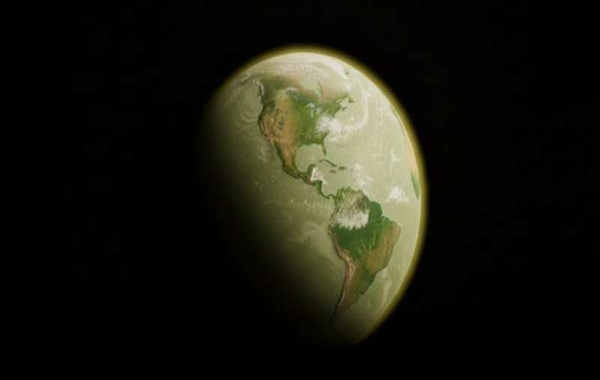
Earth’s Lost Chapter: Scientists Solve the Million-Year Mystery of Our Planet’s Missing Pulse
For eons, a silent gap in Earth’s geological record has baffled researchers—a “missing pulse” in the planet’s history that left scientists questioning the very ground beneath our feet. Now, a groundbreaking study published in Phys.org has finally connected the dots, revealing a hidden cycle that has shaped our world for millions of years.
The Enigma of the Deep Time
Geologists have long observed strange inconsistencies in sediment layers and tectonic shifts that didn’t seem to follow known patterns. It was as if a significant portion of Earth’s “biography” had been erased or hidden within the mantle. This mystery wasn’t just about rocks; it was about understanding the fundamental heartbeat of our planet—the rhythmic dance between the crust and the core.
The Discovery: A Planetary Heartbeat
By utilizing advanced seismic imaging and sophisticated computer modeling, the research team identified a previously unknown feedback loop between deep-sea trenches and volcanic arcs. The study suggests that Earth operates on a much longer, “million-year pulse” than previously thought.
Key findings include:
The Mantle’s Memory: Data shows that the mantle retains “thermal memories” of past subduction events, influencing volcanic activity millions of years later.
Tectonic Synchronization: The researchers discovered that what seemed like random tectonic shifts are actually part of a synchronized global rhythm.
Climate Connection: This deep-earth pulse directly impacts long-term carbon cycles, revealing how the planet’s interior ultimately dictates the habitability of its surface.
Why It Changes Everything
This discovery is the “Rosetta Stone” for historical geology. By solving this mystery, scientists can now:
Predict Long-term Shifts: Better understand how tectonic plates will move in the distant future.
Trace Earth’s Evolution: Fill the gaps in our understanding of how continents were formed and destroyed.
Understand External Impacts: Differentiate between changes caused by Earth’s internal dynamics versus those triggered by cosmic events or climate shifts.
A New Lens on Our World
We are no longer looking at Earth as a collection of random geological events. Instead, we see a complex, living machine with a rhythm that spans epochs. This research proves that even the most “silent” parts of our planet have a story to tell—provided we know how to listen to the heartbeat of the deep.
Source: phys.org
Beyond Biology: Have We Just Uncovered Earth’s ‘Lost’ Third Branch of Life?
Earth’s Lost Chapter: Scientists Solve the Million-Year Mystery of Our Planet’s Missing Pulse