Did Mars Need to Freeze to Stay Wet? A New Theory Challenges Everything
Mars’ı Yaşanabilir Kılan Isı Değil, Buz muydu?
Mars, often described as a cold and lifeless desert, tells a very different story when examined closely. Multiple rover missions have revealed compelling evidence that liquid water once existed on the Martian surface, persisting for extended periods rather than fleeting moments. This discovery raises a fundamental question in planetary science: how could liquid water remain stable on Mars under a faint and distant Sun?
For decades, climate models have struggled to reconcile geological evidence with what is known about early Martian conditions. Now, a new study proposes an unexpected solution. According to research published in AGU Advances, Mars may have preserved liquid lakes not by warming up—but by freezing over.
Liquid Water on Early Mars and the Faint Young Sun Paradox
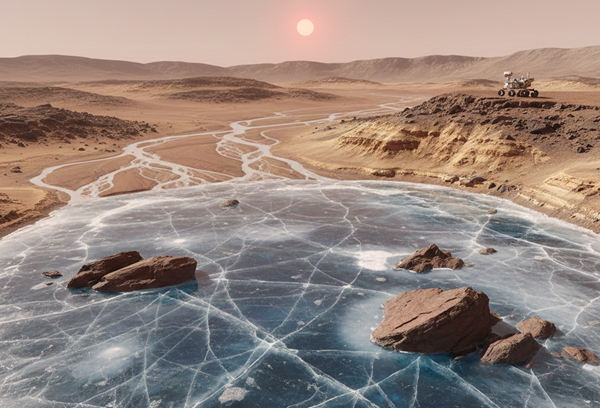
Evidence gathered by NASA’s Curiosity rover in Gale Crater leaves little room for doubt. Ancient river channels, sedimentary layers, and delta formations all point to a once-active hydrological cycle. Scientists estimate that this wet period occurred around three and a half billion years ago.
However, this timing introduces a major contradiction known as the Faint Young Sun Paradox. At that point in solar history, the Sun emitted roughly twenty-five percent less energy than it does today. Even under current conditions, Mars struggles to maintain temperatures above freezing. How, then, could liquid water exist when the planet should have been even colder?
Was Mars briefly warm enough to sustain lakes and rivers, or did liquid water survive in a more subtle and protected way?
Competing Climate Models: Warm and Wet Mars vs. Cold and Icy Mars
Researchers have long debated two primary explanations for early Martian water.
The first hypothesis suggests episodic warming events. Volcanic eruptions or asteroid impacts may have temporarily heated the surface, allowing water to flow freely. Yet these events would have been short-lived. Once the excess heat dissipated, the planet would have quickly refrozen.
The second model proposes a permanently cold Mars, where liquid water existed beneath thick, stable ice sheets. In this scenario, water never truly interacted with the open atmosphere.
Both models explain parts of the geological record. However, neither fully accounts for all observed features. This gap set the stage for a new approach.
Seasonal Ice-Covered Lakes on Mars: Insights from LakeM2ARS Modeling
To resolve this debate, Eleanor Moreland of Rice University and her colleagues developed a new climate simulation tool called Lake Modeling on Mars for Atmospheric Reconstructions and Simulations (LakeM2ARS). This model evaluates how long liquid water could persist in Martian lakes under varying atmospheric pressures, temperatures, and locations.
The results challenged conventional assumptions. In scenarios where Mars remained relatively warm, evaporation rapidly depleted lakes, causing them to vanish sooner than expected. Surprisingly, warmth worked against long-term water stability.
In colder scenarios, however, lakes developed thin, seasonal ice covers. These ice layers acted as natural lids. They reduced evaporation while still allowing liquid water to persist beneath the surface during warmer parts of the year.
Could freezing, rather than warming, have been the key to sustaining water on Mars?
Why Seasonal Ice Fits the Geological Evidence on Mars
Seasonal ice provides a critical middle ground between the two traditional climate models. Unlike permanent ice sheets, it does not require an extremely thick or long-lasting frozen crust. At the same time, it avoids the rapid water loss seen in warm, ice-free conditions.
Most importantly, this model aligns with observations from Gale Crater. If Mars had been locked in permanent ice, scientists would expect to see features such as dropstones or frost wedges. Curiosity detected none of these.
Seasonal ice explains both the presence of ancient lakes and the absence of permanent glacial markers. It also suggests that Mars experienced brief seasonal thaws, even when average temperatures ranged between minus twenty and minus thirty degrees Celsius.
Does this mean Mars was never truly warm—but never entirely frozen either?
Implications for Martian Climate History and the Search for Life
Understanding how liquid water persisted on Mars reshapes how scientists think about the planet’s habitability. Seasonal ice-covered lakes could have provided stable, protected environments where chemical reactions—and possibly microbial life—might have occurred.
This theory also opens new possibilities for exploration. NASA’s Perseverance rover is currently examining Jezero Crater, another site shaped by ancient water. Researchers can now adapt the LakeM2ARS model to simulate conditions there and across other once-wet regions.
As Mars continues to reveal its layered past, one question grows more compelling: if liquid water survived against such odds, what else might have endured beneath the ice?
Source: Did Mars Need to Freeze to Stay Wet? A New Theory Challenges Everything
Are We Chasing Life on Europa, or Discovering the Limits of Habitability?
Are We Chasing Life on Europa, or Discovering the Limits of Habitability?
Did Mars Need to Freeze to Stay Wet? A New Theory Challenges Everything