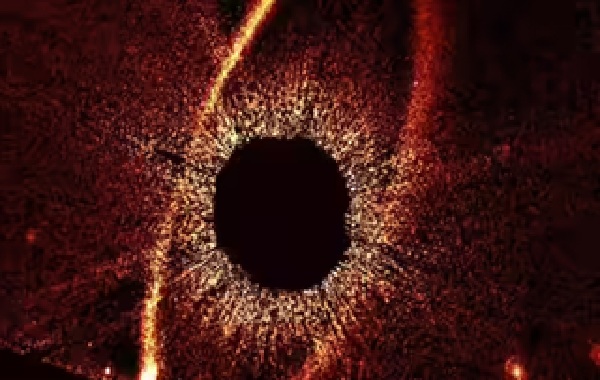
Cosmic Fireworks: Hubble Witnesses a “History of Violence” in a Nearby Star System
Astronomers have long suspected that planetary systems are born in chaos, but NASA’s Hubble Space Telescope just provided the “smoking gun.” In a nearby star system, we are literally watching the violent, bone-crushing collisions that build—or destroy—worlds.
A Rare Glimpse Into Galactic Chaos
For decades, scientists viewed the formation of planets as a slow, graceful process. However, new images from the Hubble Space Telescope have revealed a far more brutal reality. Around the bright star Fomalhaut, located just 25 light-years away, Hubble has captured the immediate aftermath of massive asteroid collisions, turning what we thought was a “planet” into an expanding cloud of radioactive dust and debris.
What was once identified as a planet named Fomalhaut b has effectively vanished, leaving behind a massive wreckage that proves we are witnessing the raw, unfiltered violence of planet formation in real-time.
Two Massive Crashes, One Decade
The discovery is a statistical anomaly that has stunned the scientific community. According to current models, a collision of this magnitude—between objects roughly 60 kilometers (37 miles) wide—should only occur once every 100,000 years.
Instead, Hubble has spotted two such events within just 20 years. “It’s like witnessing a historical milestone,” researchers explain. These aren’t just small rocks bumping into each other; these are catastrophic impacts involving “planetesimals” larger than the asteroid that wiped out the dinosaurs. These collisions are the “recycling centers” of the universe, where old rocky bodies are pulverized into fine dust, eventually settling to form new moons or terrestrial planets.
Why This Rewrites Everything
This “History of Violence” suggests that the chaotic phase of a star system’s youth lasts much longer than we ever imagined.
The “Ghost” Planet: The disappearance of Fomalhaut b confirms that a large dust cloud can “masquerade” as a planet for years, teaching us to be more cautious in our hunt for exoplanets.
Invisible Influences: The fact that these collisions are happening in the same region hints at an undiscovered, massive planet nearby, whose gravity is funneling these asteroids into a “killing zone.”
Our Own Origin Story: By watching Fomalhaut, we are looking into a mirror. This is likely what our own Solar System looked like 4 billion years ago—a chaotic, debris-filled arena where the Earth was born from fire and impact.
Fomalhaut has become a natural laboratory for the end of the world—and the beginning of another. As the starlight pushes these new dust clouds away, it clears the path for the next generation of celestial bodies. Hubble hasn’t just captured a picture; it has captured the heartbeat of a growing planetary system.
Source: timesofindia
Cosmic Fireworks: Hubble Witnesses a “History of Violence” in a Nearby Star System