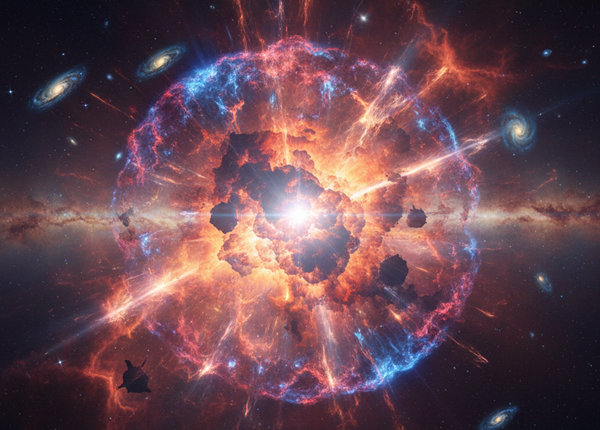
James Webb Captures a Primordial Supernova from the Dawn of the Universe—An Unexpected Cosmic Explosion That Defies Expectations
The James Webb Space Telescope (JWST) has detected a supernova in the early universe, marking a major milestone in observational astronomy. The stellar explosion occurred when the universe was only 730 million years old. As a result, scientists can now study stellar death during the cosmic dawn, when the first stars and galaxies were beginning to form.
Until recently, supernovae at such extreme distances remained out of reach. However, JWST’s unprecedented sensitivity has changed that. What does this ancient explosion reveal about the universe’s very first stars?
Gamma-Ray Burst GRB 250314A Signals a Massive Star’s Death
The event was first detected on March 14, 2025, as a powerful long-duration gamma-ray burst, known as GRB 250314A. The burst was identified by the space-based SVOM observatory. Such gamma-ray bursts often indicate the collapse of a massive star.
Soon after, follow-up observations provided crucial confirmation. The European Southern Observatory’s Very Large Telescope (ESO/VLT) measured an extreme redshift of z ≃ 7.3. This placed the explosion deep within the epoch of reionization. Consequently, astronomers realized they were witnessing one of the earliest stellar deaths ever observed.
James Webb NIRCam Observations Isolate a Distant Supernova
The decisive evidence came approximately 110 days after the gamma-ray burst. Astronomers used JWST’s Near-Infrared Camera (NIRCam) to observe the fading light. These observations successfully separated the supernova’s emission from its faint host galaxy.
This achievement marked a first. For the first time, scientists directly isolated a supernova signature at such a high redshift. Therefore, the long-theorized connection between gamma-ray bursts and massive star collapse was confirmed in the early universe.
Early Universe Supernova Closely Resembles Local Stellar Explosions
To interpret the data, researchers applied models based on GRB-associated supernovae observed in the local universe. These models predicted how the distant explosion should appear. Surprisingly, the predictions matched the observations very closely.
The supernova showed strong similarities to SN 1998bw, a well-known nearby explosion. Its brightness and spectral features appeared familiar. This result was unexpected. Early universe stars formed in low-metallicity environments, which were thought to produce very different explosions. Why, then, does this one look so ordinary?
Why a Superluminous Supernova Was Ruled Out
Some theories suggested that the early universe should favor superluminous supernovae (SLSNe). These events are far brighter than typical stellar explosions. However, the JWST data did not support this idea.
Instead, the observed supernova fell within the range of standard core-collapse events. As a result, astronomers ruled out a superluminous origin. This finding challenges assumptions about how early stars lived and died. Could stellar death mechanisms be more universal than previously believed?
What This Discovery Reveals About Early Universe Stellar Evolution
This observation suggests that massive stars in the early universe may not have been fundamentally different from those seen today. Despite low metallicity and extreme conditions, their final explosions followed familiar patterns.
Moreover, this discovery has broader implications. Supernovae drive chemical enrichment and influence galaxy formation. Therefore, understanding their behavior in the early universe helps refine models of the first galaxies and cosmic evolution.
Future James Webb Observations and Open Questions
The research team plans a second epoch of JWST observations within one to two years. By then, the supernova light will have faded by more than two magnitudes. This will allow scientists to fully characterize the faint host galaxy and confirm the supernova’s contribution.
While this discovery anchors our understanding of early stellar death, it also raises new questions. Were the first stars truly similar to later generations? And how many ancient explosions remain hidden in the depths of the early universe?
Source: James Webb Captures a Primordial Supernova from the Dawn of the Universe—An Unexpected Cosmic Explosion That Defies Expectations
Cassini Found the Ingredients for Life—Are We Ready for What Enceladus May Hold?
Cassini Found the Ingredients for Life—Are We Ready for What Enceladus May Hold?