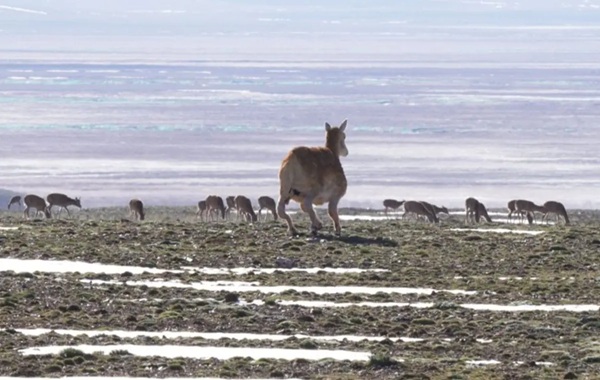
China unveils bionic antelope robot to observe endangered Tibetan species
A lifelike robotic Tibetan antelope is now roaming the high-altitude wilderness of Hoh Xil National Nature Reserve in Northwest China’s Qinghai Province.
Equipped with 5G ultra-low latency networks and advanced artificial intelligence (AI) algorithms, the bionic robot is being used to collect real-time data on Tibetan antelope populations without disturbing them.
This is the first time such a robotic antelope has been deployed in the heart of Hoh Xil, which sits more than 15,092 feet (4,600 meters) above sea level.
The project marks a major milestone for wildlife research and conservation in one of the most challenging environments on Earth.
Blending in with the herd
The Xinhua News Agency, the Chinese Academy of Sciences, and Hangzhou-based robotics firm DEEP Robotics jointly developed the bionic Tibetan antelope.
Its appearance closely matches a real Tibetan antelope, with similar fur color and body shape. While it may not move as smoothly or quickly as a live animal, it has successfully blended into the herds.
This design allows researchers to observe natural behaviors up close without disrupting the animals. The footage and data it collects are more precise and reliable than traditional human observation.
The Tibetan antelope is a flagship species of the Qinghai-Tibet Plateau and a key indicator of the region’s ecological health. Its protection is a major priority for conservationists in China.
Built for harsh conditions
Hoh Xil is often called a “no man’s land” because of its extreme conditions.
The region has an average altitude above 15,092 feet (4,600 meters), strong winds, and frigid temperatures. Despite this, it is a biodiversity hotspot known as the “Kingdom of Animals.”
DEEP Robotics designed the robot to operate in rugged terrain, including steep slopes, muddy wetlands, and rocky ground. It can function up to 1.2 miles away (2 kilometers) from its control point in open areas.
Meng Yuan, a representative from DEEP Robotics, explained that the robot supports research on migration by recording videos of herds in motion.
Researchers analyze herd size and movement speed to understand migration patterns. This data also helps prevent road collisions.
When the system detects antelopes nearing a road, it sends an early warning to a nearby protection station. Staff can then control traffic to let the animals pass safely.
AI-powered ecological insights
The robot’s AI vision recognition system can track migration routes, feeding patterns, and the growth of young antelopes in real time.
This data is transmitted through 5G networks to a backend platform where it is analyzed instantly.
Lian Xinming, head of the project and a researcher at the Chinese Academy of Sciences’ Northwest Institute of Plateau Biology, explained that the system uses a “front-end unintrusive collection plus back-end intelligent analysis” approach.
This method avoids the disturbances caused by human observers while greatly increasing the efficiency of ecological data collection.
The detailed reports generated by the system offer valuable insights for scientific research and long-term conservation strategies.
Source: Interesting Engineering
Record-Setting Tarantulas Boast Longest Sex Organs to Avoid Getting Eaten by Females
China unveils bionic antelope robot to observe endangered Tibetan species