Beyond Zero-G: Russia’s Bold Blueprint for an Artificial Gravity Space Station
For decades, the concept of artificial gravity has been confined to the realms of science fiction, from the rotating wheels of 2001: A Space Odyssey to the massive rings of Interstellar. Now, Russia’s state-owned space giant, RSC Energia, has taken a concrete step toward making this a reality by officially patenting a revolutionary space station design that simulates Earth-like conditions.
The End of Muscle Wasting?
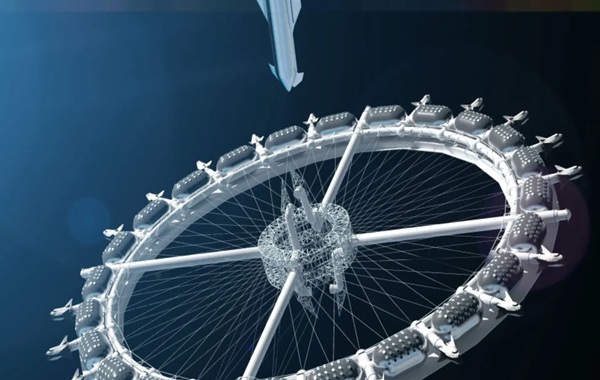
One of the greatest hurdles for long-duration space travel is the devastating effect of microgravity on the human body. Without gravity, astronauts suffer from rapid bone density loss, muscle atrophy, and cardiovascular issues. Russia’s new patent proposes a radical solution: a station that spins to create centrifugal force.
According to the design, the station would feature habitable modules rotating around a central hub at approximately five revolutions per minute. This rotation, combined with a 40-meter radius, would generate roughly 0.5g—half of Earth’s gravity—enough to potentially keep space travelers healthy for years instead of months.
Engineering the Future
The design isn’t just a simple wheel. It involves a complex architecture of:
Central Axial Hub: A core structure containing both static and rotating components.
Flexible Sealing: Hermetically sealed, flexible passages that allow crew members to move between the rotating “gravity zones” and the central zero-gravity docking ports.
Modular Scalability: The station is designed to be assembled through multiple launches, allowing it to grow over time.
Why This Matters Now
With the International Space Station (ISS) nearing the end of its life, the global space race is shifting toward deep-space exploration and lunar colonies. Russia’s patent signals a strategic pivot. By mastering artificial gravity, a station could serve as a vital “rest stop” for Mars missions, allowing crews to maintain their physical strength before descending onto alien worlds.
While the engineering challenges—such as the precision required for docking a moving ship to a spinning station—remain immense, this patent marks the transition of artificial gravity from a cinematic dream to a serious aerospace objective. The era of floating aimlessly may soon be replaced by the era of walking in the stars.
Source: Interesting Engineering
Supercomputers Reveal a Hidden Order Near Black Holes—But What Does It Mean?
Beyond Zero-G: Russia’s Bold Blueprint for an Artificial Gravity Space Station