Supercomputers Reveal a Hidden Order Near Black Holes—But What Does It Mean?
Could These Black Hole Simulations Rewrite What We Know About the Universe?
Black hole research has taken a major step forward with new supercomputer simulations that reveal how black holes absorb and release matter. The study explains how gas, radiation, and magnetic fields interact near a black hole’s edge. Researchers say the findings could reshape our understanding of extreme cosmic environments.
For decades, astronomers believed the regions surrounding black holes were wildly unstable. Matter spirals inward, radiation fights to escape, and violent outbursts appear without warning. Yet modeling this chaos accurately has remained one of astrophysics’ hardest challenges. Until now.
Black Hole Accretion Physics: Why the Edge of Darkness Is So Extreme
Near a black hole, space itself bends. Gas heats to unimaginable temperatures. Light curves, scatters, or vanishes entirely.
This boundary—often called the black hole accretion zone—has long been assumed to be turbulent and unpredictable.
Previous models relied on simplifying assumptions. Researchers had little choice. Fully realistic calculations demanded more computing power than was available. As a result, key physical processes were either approximated or excluded altogether.
But what if those shortcuts were hiding the true behavior of black holes?
Supercomputer Modeling of Black Holes Without Simplifications
A new study led by researchers at the Flatiron Institute changes the picture completely.
Using two powerful supercomputers, the team produced the most detailed simulations ever created of stellar-mass black holes feeding on surrounding matter.
Instead of simplifying the physics, the model integrates:
Einstein’s general relativity
Plasma physics
Magnetic field dynamics
Photon transport in curved spacetime
These simulations track how gas, light, and magnetism interact simultaneously, revealing a system far more structured than expected.
“This is the first time we’ve been able to include all the most important physical processes accurately,” explains astrophysicist Lizhong Zhang. “These systems are extremely nonlinear. Even small assumptions can completely change the outcome.”
Accretion Disks, Radiation, and the Hidden Order Around Black Holes
One major finding stands out: black holes regulate their own feeding.
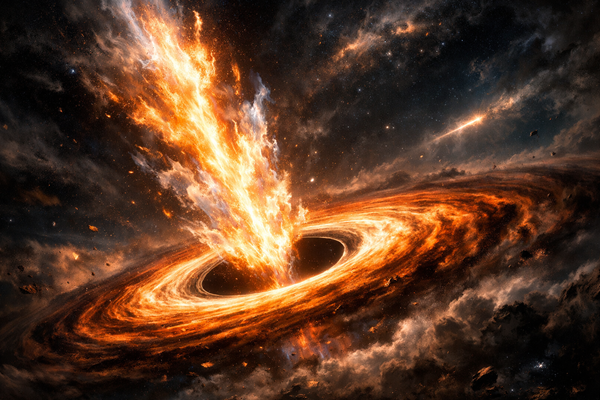
When enough matter accumulates, it forms a thick accretion disk.
This disk absorbs intense radiation instead of letting it explode outward. The energy does not disappear—it escapes in a different form.
The simulations show that black holes release excess energy through:
Powerful winds
Highly focused jets
Radiation beams visible only from specific angles
This explains why some black holes appear quiet while others seem violently active. Could orientation alone change what we observe?
Magnetic Fields Shape Black Hole Jets and Winds
The simulations also highlight the crucial role of magnetic fields.
Rather than acting as background noise, magnetism actively guides matter toward the black hole and channels energy back outward.
Magnetic field configurations determine:
How gas falls into the event horizon
Where jets form
How winds distribute energy into surrounding space
This insight helps explain why similar black holes can behave so differently. Are magnetic fields the hidden architects of cosmic power?
Why These Black Hole Simulations Match Real Observations
The results align closely with observed black hole systems.
While astronomers can now image supermassive black holes, smaller stellar-mass black holes remain unresolved. Their radiation must be interpreted indirectly.
These new models offer a bridge between theory and observation.
They predict how energy should distribute across wavelengths, helping astronomers decode faint signals from distant systems.
The simulations even reproduce known wave and shock behaviors, confirming their physical accuracy.
From Stellar Black Holes to Sagittarius A*: What Comes Next?
The researchers now aim to extend their work beyond stellar-mass black holes.
They want to test whether the same principles apply to Sagittarius A*, the supermassive black hole at the center of the Milky Way.
They also suggest the model could help explain mysterious objects known as “little red dots”, which emit less X-ray radiation than expected. Could black hole geometry, rather than energy output, explain the discrepancy?
Rethinking Black Holes: Chaos or Hidden Structure?
These simulations challenge a long-standing assumption.
The edge of a black hole is not pure chaos. It is a system shaped by balance, feedback, and structure.
As computing power grows, so does our ability to peel back the darkness.
If black holes can regulate themselves so precisely, what else about the universe have we misunderstood?
Source: Supercomputers Reveal a Hidden Order Near Black Holes—But What Does It Mean?
JWST Sees “Smoke” Around a Distant Star—Are Alien Comets Actively Destroying Themselves?
JWST Sees “Smoke” Around a Distant Star—Are Alien Comets Actively Destroying Themselves?
Supercomputers Reveal a Hidden Order Near Black Holes—But What Does It Mean?