
Astronomers Reveal the Hidden Magnetic Skeleton of the Milky Way
New radio observations of the Milky Way are exposing hidden patterns in its magnetic field.
People have scanned the night sky for ages, but some of the Milky Way’s most important features cannot be seen with ordinary light. Dr. Jo-Anne Brown, PhD, is working to chart one of those hidden ingredients: the galaxy’s magnetic field, a vast structure that can influence how gas moves, where stars form, and how cosmic particles travel.
“Without a magnetic field, the galaxy would collapse in on itself due to gravity,” says Brown, a professor in the Department of Physics and Astronomy at the University of Calgary.
“We need to know what the magnetic field of the galaxy looks like now, so we can create accurate models that predict how it will evolve.”
In January, Brown and her colleagues reported their results in two papers in The Astrophysical Journal and The Astrophysical Journal Supplement Series. Beyond the scientific conclusions, the team is also releasing a complete dataset intended for broad use, giving researchers around the world a new reference point for studying the Milky Way’s magnetized environment and testing ideas about how the field developed.
A New View of the Radio Sky
To build that dataset, the team turned to radio observations, which can probe regions of the galaxy that visible light cannot easily reveal.
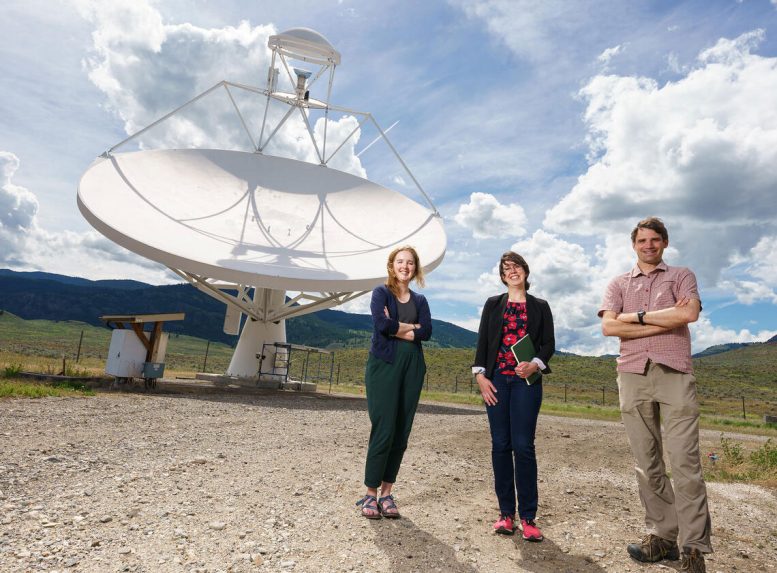
They used a new telescope at the Dominion Radio Astrophysical Observatory in B.C., a National Research Council Canada facility, to scan the northern sky across multiple radio frequencies, an approach that helps separate and untangle overlapping signals along the same line of sight.
“The broad coverage really lets you get at the details about the magnetic field structure,” says Dr. Anna Ordog, PhD, and lead author of the first of the two studies.
The survey produced a large, carefully calibrated collection of measurements for the Global Magneto-Ionic Medium Survey (GMIMS), an effort designed to map the Milky Way galaxy’s magnetic field using radio data.
The observations focused on Faraday rotation, a telltale twist in the orientation of radio waves that occurs when they pass through ionized gas threaded by magnetic fields. Tracking how that twist changes across the sky and across frequencies provides a powerful way to trace the otherwise invisible magnetic architecture surrounding our solar system.
“You can think of it like refraction. A straw in a glass of water looks bent because of how light interacts with matter,” says Rebecca Booth, a PhD candidate working with Brown and lead author of the second study. “Faraday rotation is a similar concept, but it’s electrons and magnetic fields in space interacting with radio waves.”
A Diagonal Mystery in the Sagittarius Arm
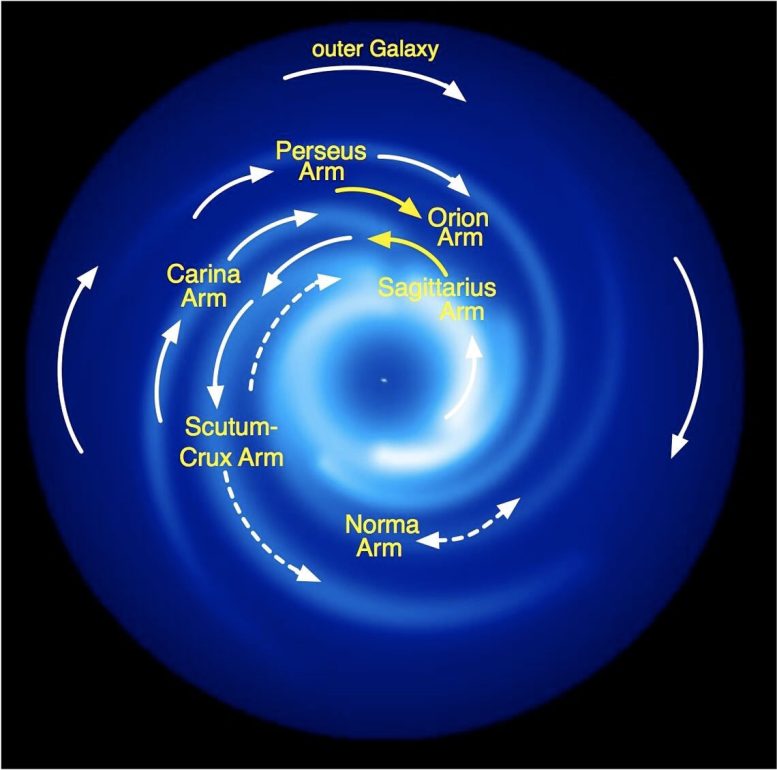
Booth’s work in the second study looked at a unique feature in the Milky Way galaxy — the Sagittarius Arm, which has a reversed magnetic field.
“If you could look at the galaxy from above, the overall magnetic field is going clockwise,” says Brown. “But, in the Sagittarius Arm, it’s going counterclockwise. We didn’t understand how the transition occurred. Then one day, Anna brought in some data, and I went, ‘O.M.G., the reversal’s diagonal!’”
Booth followed up on Ordog’s discovery using the dataset.
“My work presents a new three-dimensional model for the magnetic field reversal. From Earth, this would appear as the diagonal that we observe in the data,” Booth explains.
Source: SciTechDaily
Ancient Martian Water: New Scans Reveal Hidden Hydrogen Reservoirs in ‘Black Beauty’ Meteorite
Astronomers Reveal the Hidden Magnetic Skeleton of the Milky Way