Does Venus Hide Explosive Volcanoes Beneath Its Clouds?
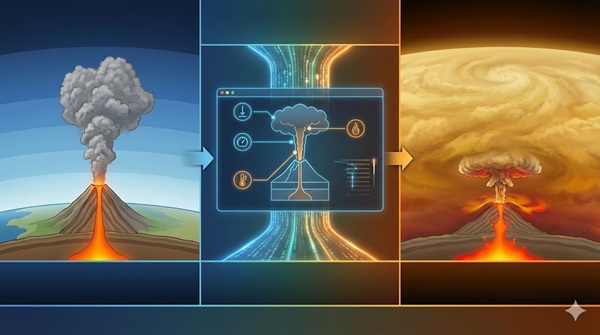
Understanding explosive volcanism on Venus is crucial for unlocking the planet’s climate history, its geological evolution, and its potential similarities to young Earth and distant exoplanets. A recent study published in the Journal of Geophysical Research: Planets explores this by modeling how high volcanic plumes could rise in Venus’ extreme atmosphere—offering new clues to the planet’s past and its dynamic present.
Modeling Venusian Volcanic Plumes: Adapting Earth Tools for an Extreme World
To investigate plume heights, researchers used FPLUME, a one-dimensional volcanic plume model originally developed for Earth in 2016. Adapting this tool for Venus required significant adjustments to reflect the planet’s intense environmental conditions:
Gravity roughly ninety percent of Earth’s
Atmospheric pressure ninety times higher
Surface temperature near four hundred sixty-five degrees Celsius
A thick carbon-dioxide-rich atmosphere with high viscosity
After integrating these variables, researchers studied wind shear, vertical dispersion, and particle content to determine how volcanic plumes behave on Venus.
Volcanic Plume Heights on Venus: Reaching the Edge of the Clouds
The model revealed that explosive volcanic plumes could typically rise to fifteen kilometers, with rare extreme events reaching forty-five kilometers—just below the base of Venus’ dense cloud layer.
The study notes that:
Most plumes rise to the Neutral Buoyancy Layer (NBL)
Only a portion remain stable at that altitude
High-latitude regions and elevated mountains allow plumes to travel even higher
Under exceptional conditions, plumes may reach the region observable by the VenSpec-H instrument, though none appear capable of reaching cloud-top levels near the equator
These findings suggest that even limited explosive volcanism may influence atmospheric chemistry and thermal processes.
Volcanism and the Runaway Greenhouse Effect: Lessons for Earth
One of the study’s broader goals is to understand how volcanism shaped Venus’ transformation into a runaway greenhouse world. Long ago, rising solar energy intensified atmospheric carbon dioxide and water vapor, triggering a feedback loop that now keeps the planet unbearably hot.
Insights into Venusian volcanic activity may help climate scientists evaluate whether Earth could ever follow a similar trajectory—or how resilient our climate system truly is.
What Venus Teaches Us About Exoplanets: The Rise of “Exo-Venuses”
Studying Venus is not only about understanding our neighboring planet; it also guides the search for life elsewhere. Many exoplanets with thick atmospheres, intense heat, or close-orbiting positions resemble early or modern Venus.
Planets like Gliese twelve b, located about forty light-years away and possessing an equilibrium temperature near forty-two degrees Celsius, serve as prime examples of possible “exo-Venuses.”
By interpreting Venus’ evolution, scientists can better evaluate whether these worlds might host life—or what conditions would exclude it.
Upcoming NASA Missions: DAVINCI and VERITAS Redefine Venus Exploration
Two major NASA missions will soon transform our understanding of Venusian volcanism:
DAVINCI will descend through the atmosphere, measuring chemical composition and capturing the first close-up images of the surface in high resolution.
VERITAS will map the planet using updated radar imaging, providing the first comprehensive surface data since the Magellan mission of the nineteen-eighties.
These missions may finally confirm active volcanism by comparing new data with decades-old imagery—opening a new chapter in Venus science.
The Future of Venus Research: What Will Explosive Volcanism Reveal?
With each advancement in modeling, observation, and exploration, scientists move closer to answering fundamental questions:
How active is Venus today?
How has volcanism shaped its climate—and could it reshape our understanding of Earth’s future?
What secrets about exoplanet habitability lie hidden in its scorching atmosphere?
Only time, new missions, and deeper investigation will tell.
And this is why we science.
Source: Does Venus Hide Explosive Volcanoes Beneath Its Clouds?
Is 3I/ATLAS Hiding Clues About Life Beyond Our Solar System?
Is 3I/ATLAS Hiding Clues About Life Beyond Our Solar System?