Archaeologist says his team has finally discovered lost city of Atlantis as they unveil compelling evidence
Joe Rogan was left speechless when his guest discussed the possible discovery of the lost city of Atlantis.
Plato’s writings describe an advanced civilization that built grand temples and massive harbor walls before being swallowed by the sea more than 11,000 years ago.
Independent researcher Ben van Kerkwyk was a recent guest on the Joe Rogan Experience, where he discussed a discovery off the coast of Spain that could be the mythical city.
‘There’s a guy named Michael Donnellan…And he thinks he’s found, at least, if not Atlantis, a part of Atlantis off the coast of Spain. And they 100 percent found some s*** in the waters,’ van Kerkwyk said.
Rogan, looking stunned, could only respond with ‘Wow,’ mentioning Donnellan’s upcoming documentary ‘Atlantica’ that reveals massive linear structures and enormous concentric circular walls littering the seafloor.
Donnellan, an independent archaeologist, told the Daily Mail that descriptions in Plato’s writings, which perfectly match their findings of ruins, prehistoric settlements and ancient mines in the region of Gades, are the strongest evidence for an Atlantic civilization.
These discoveries, including underwater structures and sediment-covered sites indicating sudden destruction, align with Plato’s accounts of climate, societal structures, and ancient mythologies, providing a comprehensive context for their claims.
‘All those details align perfectly with the region we’re studying, as our investigations reflect Plato’s texts with extraordinary precision, truly to a perfect degree,’ Donnellan said.


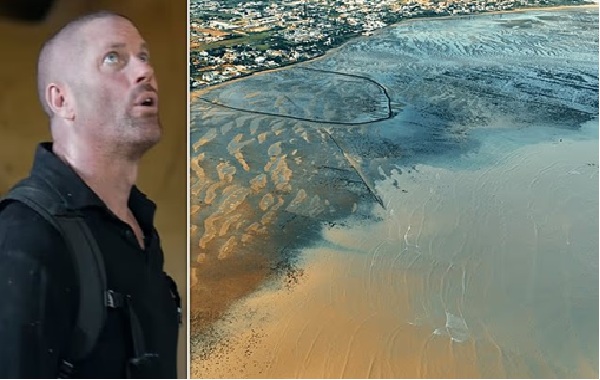
Donnellan found the submerged ruins along the coast around Cádiz, a city in Andalusia.
‘When you read Plato’s texts, the Timaeus and Critias, he’s got all these incredible details of what the place was like, where it was, that you could plant all year long, that it was in the region of Gades in the Atlantic,’ he said
Donnellan spent eight years investigating the coast of Cadiz using an advanced sonar system used for high-resolution seafloor mapping, creating detailed 3D images of the underwater environment.
Van Kerkwyk noted that Donnellan used Merlin Burrows’ satellite investigation techniques and aerial photography to uncover the hidden structures.
‘It’s fascinating, they 100 percent found something that is manmade,’ said van Kerkwyk.
The technology revealed long linear structures etched across the ocean floor, which formed a series of enormous concentric circular walls, each standing more than 20 feet tall and arranged in an organized pattern.
‘The team brings together a wide array of specialists and technologies, from the dive team to the scanning experts and the academics who have contributed to this project,’ said Donnellan.
‘I want to take a moment to thank the extended team for all their hard work and dedication.’

The outermost wall showed the most damage, as if it had been pummeled by a massive tsunami racing in from the sea.
The second and third walls, he said, were ‘completely displaced,’ with scans showing them split into two.
Between the walls sat intricately carved canals, and at the center was a rectangular ruin that, according to Donnellan, echoes Plato’s description of Poseidon’s temple, forming what he believes is the capital city of Atlantis.
Donnellan is among the many scholars who believe in a cataclysmic event around 12,000 years ago that wiped out an advanced civilization.
The controversial Younger Dryas Impact Hypothesis (YDIH) suggests Earth passed through debris from a disintegrating comet.
The resulting impacts and shockwaves destabilized massive ice sheets, causing massive flooding that disrupted crucial ocean currents and triggered rapid climate cooling. However, the theory is not widely accepted by mainstream scholars.
The lost city of Atlantis has also been deemed a myth, but Donnellan is sure that he found something dating to its time deep under the water.
‘Plato tells you about the animals that helped out with the daily activities, the horse, the bull and the elephant,’ he said.
Donnellan explained that the original horse in this area is believed to be the oldest breed in the world, along with the fighting bull from Andalusia, which traces back thousands of years.
He added there was also a prehistoric ivory trade through this part of Spain, noting that three types of elephants were there, including Asian elephants, which suggested there was international commerce between this region and Asia.
‘All of those details coincide perfectly with where we’re studying,’ Donnellan said.
Source: daily mail
Archaeologist says his team has finally discovered lost city of Atlantis as they unveil compelling evidence