An interplanetary shortcut can speed up trips to Mars
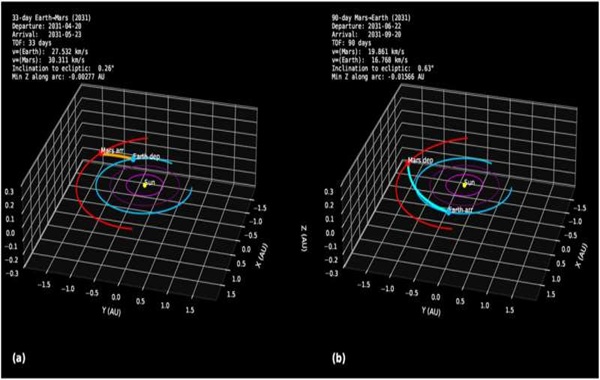
Whether it’s robotic rovers heading to Mars or, one day, a crew of astronauts, a round-trip journey is an incredibly long one. But there may be a way to find a shortcut. A new study published in the journal Acta Astronautica suggests that hundreds of days could be shaved off a return trip to the Red Planet by using the early orbital data of asteroids. This could bring the total mission time down to as low as 153 days.
To identify optimal routes and calculate fuel needs, planners of interplanetary missions use precise planetary data. Sending missions to other worlds rarely involves early orbital data from asteroids.
When it comes to Mars missions, a key planning consideration is a phenomenon known as Mars opposition. This occurs roughly every 26 months when Earth passes directly between the sun and Mars. During this alignment, the two planets are on the same side of the sun, bringing Mars to its closest point to Earth.
Charting a quicker route
Marcelo de Oliveira Souza at the State University of Northern Rio de Janeiro (UENF) wondered whether early asteroid data (an approximation of an asteroid’s path based on a short observation window) could be used to find hidden shortcuts in space.

For his study, he focused on an asteroid called 2001 CA21 because its early predicted path crossed the orbits of both Earth and Mars, even though its official orbital details were later updated. He looked for paths to Mars that stayed within five degrees of the asteroid’s tilt. Staying close to this angle allows a spacecraft to take a more direct path through space.
Then he tested Mars oppositions from 2027, 2029, and 2031 to see which one offered the best conditions for a shorter trip.
The analysis revealed that 2031 was the only year the Earth-Mars geometry aligned favorably with the asteroid’s orbital plane. As Oliveira Souza notes in his paper, “The 2031 Mars opposition supports two complete sub-year round-trip missions consistent with the CA21-anchored plane, illustrating how early small-body orbital data may contribute to the early identification of rapid interplanetary transfer opportunities.”
New tool for mission planning?
The paper does not suggest that future missions must follow this specific asteroid. Instead, it demonstrates a possible way to identify faster flight paths that traditional methods might miss. “This study illustrates how the well-defined plane geometry of a preliminary small-body orbit can be employed as a methodological screening tool for rapid interplanetary transfer identification.”
Source: phys.org
A Signal No One Expected: Did Astronomers Just Hear the Universe Hint at Something Alive?
An interplanetary shortcut can speed up trips to Mars