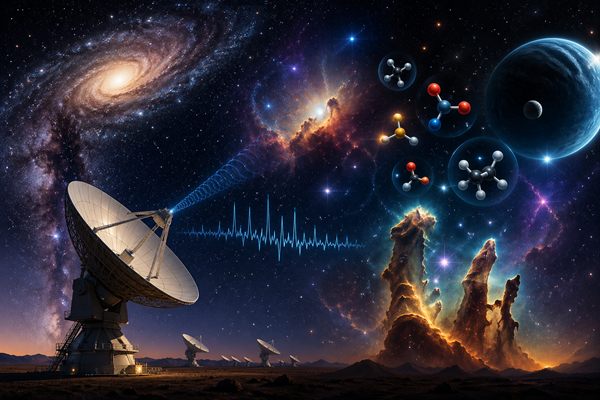
A Signal No One Expected: Did Astronomers Just Hear the Universe Hint at Something Alive?
For decades, astronomers have searched the cosmos for clues that life might exist beyond Earth. The possibility that distant worlds could host biological activity sparks imagination and scientific ambition alike. Yet despite exciting headlines about possible “signs of life,” the truth is more complex. Detecting molecules in the atmospheres of remote planets or in deep cosmic clouds is extraordinarily difficult, and confirming such discoveries can take years of careful verification.
Why does it take so long to confirm potential signs of life on distant planets? And what exactly are astronomers seeing when they claim to detect molecules light-years away?
Understanding how scientists search for cosmic chemistry reveals a story filled with patience, precision, and sometimes surprising uncertainty.
Searching for Potential Signs of Life on Distant Planets Through Cosmic Molecules
Astronomers cannot travel to neighboring planets or distant nebulae. Instead, they rely on powerful telescopes to analyze light coming from space. Within that light lies chemical information that reveals what molecules exist in distant environments.
Over the past century, scientists have discovered more than three hundred fifty molecules in the space between stars. The first confirmed interstellar molecule was reported in nineteen thirty-seven. Since then, discoveries have steadily increased. Each year adds anywhere from several new molecules to dozens more.
Many of these molecules are considered precursors to biomolecules, meaning they may participate in chemical pathways related to life. Consequently, every new detection expands the cosmic chemical catalog and raises intriguing questions. Could the building blocks of life be widespread throughout the universe? Could distant planets host similar chemistry?
However, discovering molecules does not automatically mean discovering life. Many biological molecules can also form through purely chemical processes without living organisms. Therefore, scientists must tread carefully before making extraordinary claims.
How Astronomers Detect Molecules in Space Using Radio Telescopes
So how do astronomers “see” molecules that are thousands of light-years away?
The answer lies in electromagnetic radiation. Telescopes collect light across many wavelengths, from radio waves to visible light and infrared radiation. For astrochemistry, radio telescopes are especially important because they detect long wavelengths produced by rotating molecules in space.
In the cold vacuum of interstellar space, molecules float freely as gas. As they rotate, they release energy in the form of photons. Each molecule emits photons at very specific energies depending on how it rotates.
These emissions create a unique spectral fingerprint.
When a radio telescope observes space, it records these photons. If astronomers detect the complete set of expected signals for a particular molecule, they can confidently identify it.
Yet the process is far from simple.
Space contains countless molecules, and many emit signals at similar frequencies. Consequently, signals may overlap or blend together. A telescope might detect a spectral line, but scientists must determine whether it truly belongs to the molecule they suspect.
Even the most advanced telescopes require careful interpretation.
Infrared observatories such as the James Webb Space Telescope and visible-light telescopes like the Hubble Space Telescope also contribute to astrochemical discoveries. However, their measurements often contain complex overlapping signals that require additional analysis.
Laboratory Astrochemistry: Creating Molecular Fingerprints for Space
Before astronomers can recognize molecules in space, scientists must first measure their spectral fingerprints here on Earth.
This work often takes months or years.
In laboratory experiments, researchers simulate the conditions of interstellar space. They place chemicals inside vacuum chambers to replicate the extremely low pressure found in cosmic environments. Then they measure how these molecules emit radiation when they rotate.
Researchers also use computer models to predict the spectral signatures molecules should produce.
Scientists repeatedly adjust these models until the simulated spectra match the experimental data. Once the two align, astronomers can trust the predicted fingerprints.
These validated spectra allow telescopes to identify molecules even at frequencies that cannot easily be reproduced in laboratory settings.
Although this behind-the-scenes work rarely appears in headlines, it forms the backbone of astrochemical discovery. Without accurate laboratory measurements, telescope data would remain ambiguous.
Why Detecting Potential Biosignatures in Space Is So Difficult
Even with advanced telescopes and precise laboratory models, molecular detections can remain uncertain.
Sometimes the signals are extremely faint. Other times they appear in crowded spectral regions where multiple molecules produce overlapping lines.
When only one or two spectral signals appear, scientists hesitate to claim a discovery. Reliable detections typically require several independent signals matching the predicted fingerprint.
Furthermore, molecules associated with life on Earth do not necessarily indicate life elsewhere. Many biological molecules form naturally in space through purely chemical reactions.
For instance, comets and planetary atmospheres often contain complex organic molecules. Yet these environments do not necessarily host living organisms.
This reality raises an important question:
When does a molecule become a true biosignature rather than merely interesting chemistry?
Scientists continue to debate this issue.
The Glycine Mystery: A Famous False Alarm in Interstellar Chemistry
One of the most intriguing controversies in astrochemistry involved the molecule glycine, the simplest amino acid.
Amino acids are fundamental building blocks of proteins in living organisms. Therefore, detecting glycine in interstellar space would strongly suggest that the ingredients of life form naturally throughout the universe.
More than twenty years ago, scientists announced a potential detection of glycine in a star-forming nebula. The discovery created enormous excitement.
However, follow-up studies revealed missing spectral signals that should have appeared if glycine were truly present.
Without those signals, the evidence collapsed.
Today, most astrochemists agree that glycine has not yet been confirmed in interstellar star-forming regions.
The episode serves as a reminder that scientific discovery often involves revision and correction.
Phosphine on Venus: Could a Molecule Indicate Life?
Another recent controversy involved the potential detection of phosphine in the atmosphere of the planet Venus.
On Earth, phosphine is associated with certain biological processes. Therefore, when researchers reported possible phosphine signatures in Venus’s clouds, speculation about extraterrestrial life spread quickly.
The announcement captured global attention.
Yet soon afterward, other scientists attempted to reproduce the result using additional observations and alternative data analysis methods.
Some studies could not confirm the original detection. Others suggested the signal might arise from instrumental effects or unrelated atmospheric chemistry.
As a result, the scientific community remains divided.
Over the past several years, researchers have continued to examine new observations to determine whether phosphine truly exists in Venus’s atmosphere.
For now, the question remains unresolved.
Why Scientific Confirmation of Extraterrestrial Molecules Takes Years
Why do these confirmations take so long?
Science requires reproducibility.
When researchers report a molecular detection, other teams must verify it using independent data and different analytical methods. Telescopes must observe the same signals again under different conditions.
If the signals repeatedly appear and match theoretical predictions, confidence grows.
However, if follow-up observations fail to reproduce the evidence, the claim weakens or disappears entirely.
This process protects scientific integrity, even though it sometimes slows the pace of discovery.
Patience, after all, is essential when studying the universe.
How to Evaluate Claims of Potential Life Beyond Earth
When news headlines announce potential life beyond Earth, readers should ask a few important questions.
How many spectral signals support the discovery?
Are multiple telescopes involved in the detection?
Have independent research groups confirmed the findings?
Discoveries based on many spectral lines tend to be more reliable than those based on only one or two.
Furthermore, waiting several months after the initial announcement often reveals whether follow-up studies support or challenge the claim.
Science thrives on verification rather than speed.
The Expanding Cosmic Chemical Inventory
Despite occasional false alarms, astrochemistry continues to advance rapidly.
The catalog of molecules detected in space grows every year. Complex organic compounds have been discovered in interstellar clouds, cometary tails, and planetary atmospheres.
Each new molecule tells a story about how chemistry unfolds across the universe.
Some molecules hint at pathways that may eventually lead to biological chemistry. Others reveal unexpected reactions occurring in extreme cosmic environments.
Together, these discoveries paint a picture of a universe rich with chemical diversity.
Yet they also raise deeper questions.
If the building blocks of life appear throughout space, could life itself be common?
Or does biology require conditions far rarer than chemistry alone can provide?
Astronomers and astrochemists continue to search for answers.
A Universe Full of Clues—But Few Final Answers
The search for life beyond Earth is not a single discovery waiting to happen. Instead, it is an ongoing process of collecting clues scattered across the cosmos.
Telescopes detect faint whispers of molecules from unimaginable distances. Laboratories recreate cosmic conditions to decode those whispers. Scientists debate and test every claim.
Slowly, piece by piece, humanity learns how chemistry unfolds among the stars.
Perhaps one day a molecule will be detected whose origin cannot be explained without biology. Perhaps telescopes will observe atmospheric signatures that unmistakably point to living processes.
Until that day arrives, the universe will continue to tease us with possibilities.
And perhaps that mystery is part of what makes the search so fascinating.
After all, every spectral line recorded by a telescope raises another question:
Are we looking at simple chemistry—or the distant echo of life itself?
Source: A Signal No One Expected: Did Astronomers Just Hear the Universe Hint at Something Alive?
A Signal No One Expected: Did Astronomers Just Hear the Universe Hint at Something Alive?
Sources
- Research and publications related to astrochemistry and molecular spectroscopy
- Observational data from the James Webb Space Telescope
- Observational archives from the Hubble Space Telescope
- Reviews of interstellar molecular discoveries in astrophysical journals
- Studies examining phosphine detection in the atmosphere of Venus
- Astrochemistry laboratory spectroscopy research
A Signal No One Expected: Did Astronomers Just Hear the Universe Hint at Something Alive?