Why Did Callisto’s Footprint Stay Invisible for So Long on Jupiter?
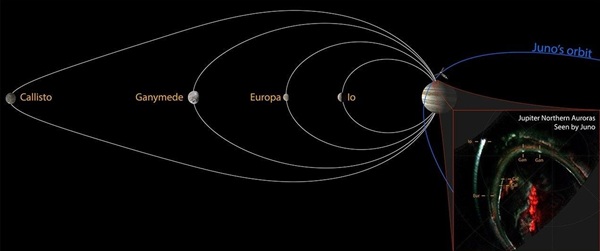
Evious attempts, even with the powerful Hubble Space Telescope, failed to reveal Callisto’s auroral imprint. That changed thanks to NASA’s Juno spacecraft, which has been orbiting Jupiter since 2016. In a recent breakthrough, an international research team led by Jonas Rabia of the Institut de Recherche en Astrophysique et Planétologie (IRAP) announced the discovery of Callisto’s elusive footprint. For the first time, its subtle glow has been captured within Jupiter’s upper atmosphere.
The study—published in Nature Communications on September 1, 2025—marks a turning point. It confirms that all four Galilean moons leave lasting auroral signatures, completing the long-sought picture of moon–magnetosphere interactions.
How Juno Captured Callisto’s Faint Aurora Signature
Detecting Callisto’s footprint was no easy task. Unlike the brighter emissions caused by Io or Ganymede, Callisto’s auroral glow is faint and often masked by Jupiter’s main auroral oval. The team needed rare conditions: Juno had to image the poles only when the main oval shifted away, and it had to cross the exact magnetic field line connecting Jupiter to Callisto.
This opportunity arrived in September 2019, when a massive solar wind stream slammed into Jupiter’s magnetosphere. Much like solar storms push Earth’s northern lights farther south, this event displaced Jupiter’s aurorae, exposing the region where Callisto’s faint footprint appeared.
Instruments That Made the Discovery Possible
Juno’s onboard instruments—the Magnetometer (MAG), Jovian Auroral Distributions Experiment (JADE), and Jovian Energetic Particle Detector Instrument (JEDI)—recorded crucial data. These tools measured energetic particles, electromagnetic waves, and magnetic field shifts tied to Callisto’s interaction. For the first time, researchers could directly link Callisto’s movement through Jupiter’s magnetic field to the faint ultraviolet light observed in the planet’s atmosphere.
Why Does Callisto Matter for Understanding Jupiter?
With Callisto’s footprint finally revealed, scientists can now compare how each Galilean moon interacts with Jupiter’s magnetosphere. Io generates strong currents from its volcanic activity, Europa and Ganymede influence the system with their subsurface oceans and magnetic fields, and Callisto—darker and geologically quieter—still manages to leave its subtle mark.
This raises intriguing questions:
Could Callisto’s weaker footprint be tied to its distance from Jupiter?
Does it hint at unique properties of Callisto’s atmosphere or surface?
And what does this teach us about how moons shape planetary magnetic environments across the Solar System?
A New Chapter in Exploring the Jovian System
The discovery highlights the power of long-term missions like Juno and the importance of studying faint, elusive signals. With Callisto’s footprint now confirmed, researchers have completed the set of Galilean auroral signatures—each one a glowing reminder that Jupiter’s moons are active participants in shaping their giant host’s space environment.
As Juno continues to orbit Jupiter, could even more hidden patterns be waiting to emerge from the planet’s dazzling auroras?
Source: Why Did Callisto’s Footprint Stay Invisible for So Long on Jupiter?
4 Powerful Telescopes Agree: Interstellar Comet 3I/ATLAS Really Is Bizarre
4 Powerful Telescopes Agree: Interstellar Comet 3I/ATLAS Really Is Bizarre