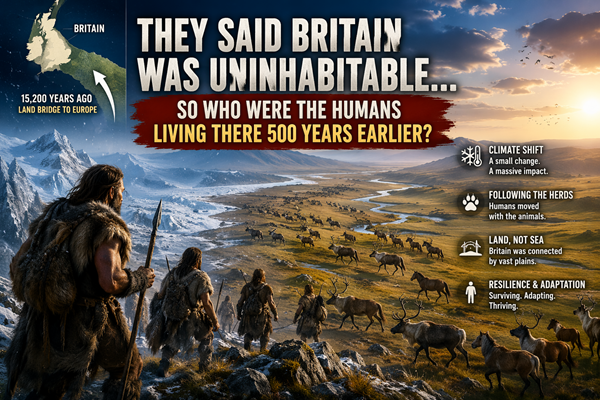
They Said Britain Was Uninhabitable… So Who Were the Humans Living There 500 Years Earlier
What if a subtle shift in temperature—barely noticeable on a modern thermometer—was enough to reshape the course of human history?
Recent research suggests exactly that. Humans returned to the British Isles around fifteen thousand two hundred years ago, nearly five hundred years earlier than previously believed. This adjustment may seem minor at first glance. However, in prehistoric terms, it represents a profound shift in how we understand human resilience, adaptability, and migration patterns after the last Ice Age.
At that time, Britain was not yet an island. Instead, it remained connected to mainland Europe through vast plains now submerged beneath the North Sea. These plains acted as migration corridors, enabling both animals and humans to move freely across regions that would later become separated by water.
So, what triggered this earlier return? And more importantly, how did humans survive in what was thought to be an inhospitable climate?
Post-Ice Age Human Migration Patterns: Following Prey Into a Changing Landscape
Humans did not migrate randomly. Instead, they moved with purpose, tracking the rhythms of the natural world. As herds of reindeer and wild horses advanced into newly habitable regions, human groups followed closely behind.
Why would they take such risks?
Because survival depended on it.
As temperatures gradually increased, even by a few degrees during the summer months, vegetation began to recover. Grasslands expanded. Consequently, grazing animals flourished. In turn, these animals became reliable food sources for human populations.
This raises an intriguing question:
Were humans leading migration patterns, or were they simply reacting to ecological shifts?
Evidence strongly supports the latter. Humans adapted quickly, but they relied heavily on environmental cues. Therefore, when prey animals moved northward, humans followed—step by step, season by season.
Late Upper Paleolithic Climate Shifts: Rapid Warming Events and Human Adaptation
The Late Upper Paleolithic period, spanning roughly fourteen thousand to eleven thousand years ago, was marked by dramatic and abrupt climate fluctuations.
Rather than slow, gradual warming, the climate shifted in bursts—sometimes within decades.
Initially, scientists believed that significant warming began around fourteen thousand seven hundred years ago. Accordingly, they assumed humans only returned to Britain after this point. However, new radiocarbon dating techniques challenged this assumption.
These refined methods revealed something unexpected:
humans were already present before this major warming phase.
This discovery created a paradox.
How could humans survive in what was assumed to be a cold, glacial environment?
Radiocarbon Dating and Archaeological Evidence: Fixing the Timeline Mismatch
Earlier studies suffered from limitations in dating accuracy. Radiocarbon methods, while revolutionary, required calibration improvements to produce precise timelines.
With updated calibration models introduced in the early two-thousands, scientists revisited existing data. As a result, the timeline shifted.
Human remains and artifacts were now dated to between fifteen thousand two hundred and fifteen thousand years ago.
This created a clear mismatch:
- Climate models suggested cold conditions
- Archaeological evidence showed human presence
So, which was wrong?
The answer, it turns out, lay not in the human data—but in the climate reconstruction itself.
Lake Sediment Climate Reconstruction: New Evidence from Llangorse Lake
To resolve this contradiction, researchers turned to an unexpected source: lake sediments.
At Llangorse Lake in south Wales, sediment layers preserved a continuous environmental record spanning nearly nineteen thousand years. These layers contained microscopic clues—fossil pollen, insect remains, and chemical signatures—that allowed scientists to reconstruct past climates with remarkable precision.
Among the most revealing indicators were chironomids, tiny non-biting midges whose larvae are highly sensitive to temperature changes.
By analyzing these organisms, researchers reconstructed past summer temperatures.
The results were striking.
Abrupt Summer Temperature Rise: The Key to Early Human Return
Instead of a delayed warming event, the data showed that temperatures in southern Britain rose sharply around fifteen thousand two hundred years ago.
Summer temperatures jumped from approximately five to seven degrees Celsius to ten to fourteen degrees Celsius.
This was not a gradual shift—it was abrupt.
And it changed everything.
Suddenly, the environment could support:
- Expanding vegetation
- Grazing herbivores
- Sustained human presence
This explains why humans appeared earlier than expected. They were not surviving extreme cold. Rather, they were responding to an earlier, localized warming event that previous models had failed to detect.
So, could it be that small regional climate variations mattered more than global averages?
Human Survival Strategies in Prehistoric Britain: Adaptation Over Endurance
Humans did not merely endure harsh conditions—they adapted intelligently.
Instead of settling permanently, they likely moved seasonally, exploiting temporary windows of opportunity. Warmer summers provided enough resources to sustain hunting groups, even if winters remained severe.
Moreover, proximity to migrating herds ensured food availability. This strategy reduced risk and increased survival odds.
But this raises another compelling question:
How flexible were these early human societies in the face of rapid environmental change?
The evidence suggests they were highly responsive. Their survival depended not on strength alone, but on mobility, awareness, and timing.
Climate Change and Human Behavior: What Can the Past Teach Us Today?
Although this research focuses on events from fifteen thousand years ago, its implications feel surprisingly modern.
Today, the planet is once again experiencing rapid climate shifts. Glaciers are retreating. Polar regions are warming. Ecosystems are transforming.
Could similar patterns of migration emerge again?
History suggests it is possible.
When environmental thresholds shift—even slightly—human movement often follows. The past reveals a fundamental truth:
human behavior is deeply intertwined with climate dynamics.
Why a Small Temperature Change Can Reshape Human History
Perhaps the most striking insight from this research is how little change was required to produce such a significant outcome.
A modest increase in summer temperature—just a few degrees—was enough to:
- Alter ecosystems
- Redirect animal migrations
- Enable human expansion into new territories
This challenges modern assumptions.
We often think of climate change in extremes. However, this study demonstrates that even subtle variations can trigger cascading effects across entire systems.
So, the question remains:
If such a small change shaped the past so profoundly, what might today’s changes bring?
Unanswered Questions: What Still Lies Beneath the Surface?
Despite these advances, many mysteries remain.
- Were there earlier, undocumented migrations into Britain?
- How did human populations communicate and share knowledge across regions?
- Did different groups respond differently to the same environmental shifts?
Each discovery opens new avenues of inquiry. And with every answer, more questions emerge.
Conclusion: A New Perspective on Human Resilience and Climate Interaction
This revised timeline does more than adjust a date—it reshapes our understanding of human adaptability.
Humans did not simply wait for ideal conditions. Instead, they responded dynamically to environmental signals, exploiting opportunities as they arose.
Their story is not one of passive survival, but of active engagement with a changing world.
And perhaps, in that story, we can find reflections of our own future.
Sources
- Recent paleoclimate and archaeological research on post-Ice Age Britain
- Radiocarbon calibration studies (early two-thousands revisions)
- Sediment analysis from Llangorse Lake (Wales)
- Late Upper Paleolithic environmental reconstructions
- Climate adaptation and human migration studies in north-west Europe
Source: They Said Britain Was Uninhabitable… So Who Were the Humans Living There 500 Years Earlier
The Ghost of Columbus and the Impossible Geometry of the Piri Reis Map
The Ghost of Columbus and the Impossible Geometry of the Piri Reis Map
They Said Britain Was Uninhabitable… So Who Were the Humans Living There 500 Years Earlier