What Surprises Await When Black Holes Go Full-Color on the Radio Sky?
Will Color “Radio RGB” Reveal Hidden Secrets of Black Hole Jets?
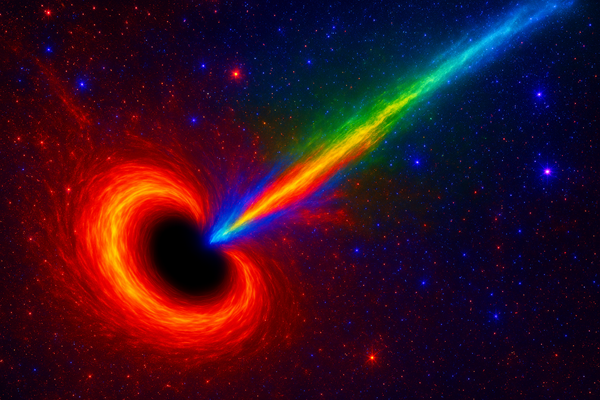
Astronomers collaborating on the Event Horizon Telescope (EHT) have pioneered a technique to observe the radio sky at multiple frequencies simultaneously, paving the way for full-color images of supermassive black holes. By treating each radio band like a unique “color” channel—akin to red, green, and blue in optical photography—they’ve unlocked the potential for rich, multi-frequency radio imaging that captures the dynamic environments around these cosmic giants.
How Does Radio “Color” Work? Understanding Frequency Bands in Radio Astronomy
In physics, light’s “color” corresponds to its wavelength or frequency: longer wavelengths (lower frequencies) skew toward radio “red,” while shorter wavelengths (higher frequencies) lean “blue.” Although our eyes and digital cameras rely on three RGB sensors to create color, radio telescopes use narrow frequency bands as channels. By layering data from different bands, astronomers can assemble a composite image that reveals structural and energetic differences around a black hole.
Overcoming Atmospheric Distortions with Frequency Phase Transfer (FPT)
However, simultaneous multi-band observations face a major hurdle: Earth’s atmosphere. Turbulence distorts incoming radio waves, blurring fine details—especially at shorter, 1 mm wavelengths. To conquer this, the team implemented frequency phase transfer (FPT). By continuously observing the sky at a stable 3 mm wavelength, they tracked atmospheric phase shifts in real time, then applied those corrections to sharpen the 1 mm data. This mirrors how optical telescopes use laser guide stars to compensate for atmospheric flicker.
Why Simultaneous Observations Matter for Fast-Changing Black Hole Environments
Most radio dishes can only tune to one band at a time, meaning researchers must stitch together separate observations. That works for static targets, but black hole accretion disks and jets evolve on timescales shorter than the hours needed to cycle through frequencies. Imagine your phone’s camera capturing red, green, and blue sequentially—you’d end up with ghosting if your subject moved. Simultaneous multi-band imaging avoids these artifacts, giving a true-to-life snapshot of black hole activity.
Next-Generation EHT and BHEX: Towards Live, Full-Color Black Hole Movies
This proof-of-concept demonstration sets the stage for future projects such as the next-generation EHT (ngEHT) and the Black Hole Explorer (BHEX). Equipped with advanced multi-frequency receivers and FPT calibration, these arrays will capture rapid-fire sequences across several bands. What could we learn by watching a black hole in living color? From real-time jet formation to magnetic field dynamics, color movies will deepen our understanding of gravity, plasma physics, and the environments that feed black holes.
Questions That Drive the Future of Black Hole Astronomy
What surprises await when we watch accretion disks glow in multi-frequency hues?
How will color-coded jets inform our models of black hole feedback in galaxy evolution?
Can live, full-color imaging reveal transient events—like magnetic reconnection flares—in unprecedented detail?
By combining multi-frequency radio imaging, FPT atmospheric correction, and next-gen telescope arrays, astronomers are closer than ever to bringing black holes into living, breathing color. Get ready for a new era of color black hole imaging, where every frame uncovers fresh insights into the universe’s most extreme objects.
Source: What Surprises Await When Black Holes Go Full-Color on the Radio Sky?
Scientists Discover New Dwarf Planet in Solar System, Far Beyond Pluto
Bilim İnsanları Güneş Sisteminde Plüton’un Çok Ötesinde Yeni Bir Cüce Gezegen Keşfetti