What Secrets Do Reddened Cores Hold for Planet Formation?
Protoplanetary Disks in the Galactic Center: Unveiling Planet Birth in Extreme Environments.
Protoplanetary disks—those dynamic rings of gas and dust encircling nascent stars—serve as cosmic nurseries where planets take shape. Spanning hundreds of astronomical units (AU), these structures mark the earliest phase of planetary system formation. In their swirling expanses, microscopic dust grains collide, adhere, and grow into pebbles, boulders, and ultimately planetary embryos through core accretion. As these embryonic worlds mature, they carve telltale gaps and spiral patterns into the disk, signatures that observatories like ALMA (Atacama Large Millimeter Array) and the James Webb Space Telescope can detect.
Breakthrough Discoveries in the Central Molecular Zone of the Milky Way
Until now, studies of protoplanetary disks focused primarily on our Galaxy’s quieter, local neighborhoods. However, an international collaboration—featuring Peking University, the Shanghai Astronomical Observatory, and the University of Cologne—has conducted an unprecedented survey of three molecular clouds in the Milky Way’s Central Molecular Zone (CMZ). By pinpointing over 500 dense cores in this turbulent, high-pressure region, the team challenges long-held assumptions about where and how planets can form.

High-Resolution ALMA Observations: Peering Through the Dust
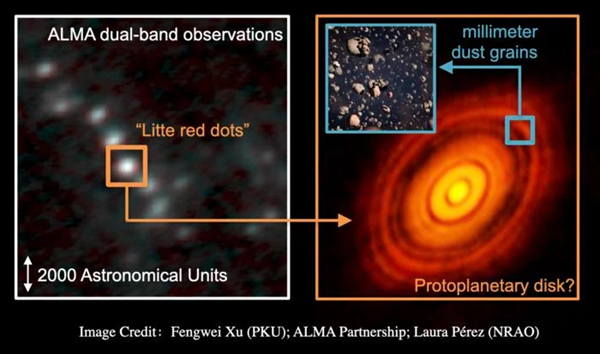
Detecting infant planetary systems near the Galactic Center poses formidable obstacles: vast distances, low luminosity, and heavy dust obscuration all conspire to hide nascent disks. To overcome these hurdles, researchers employed ALMA’s powerful dual-band imaging capabilities, capturing two wavelengths at identical resolution. From 17 billion AU away, they resolved structures as small as 1,000 AU. Moreover, more than 70% of the observed dense cores appeared unexpectedly red—an intriguing clue that hints at the presence of compact, optically thick disks or unusually large, disk-grown dust grains.
Interpreting the ‘Little Red Dots’: Protoplanetary Disks or Dust Anomalies?
“We were astonished,” recalls Fengwei Xu of the University of Cologne’s Institute of Astrophysics, “to see these ‘little red dots’ scattered across the clouds. They reveal the hidden nature of star-forming cores.” Two principal explanations have emerged:
Optically Thick Disk Structures: Compact, dense disks absorb shorter wavelengths, reddening the emitted light.
Large Dust Grain Populations: Grains grown in disks and ejected by protostellar outflows can dominate the core’s thermal emission.
Both scenarios suggest that over 300 potential disk-forming systems lie within these three CMZ clouds—an astonishing rate that defies earlier theoretical models.
Planet Formation in Extreme Galactic Neighborhoods: Questions and Implications
What mechanisms enable protoplanetary disks to withstand the CMZ’s intense radiation, turbulence, and magnetic fields? Could these extreme conditions accelerate or hinder planet assembly? As telescopes push deeper into the Galactic Center, scientists aim to answer these pressing questions and determine whether these early disks evolve into fully fledged planetary systems.
Looking Ahead: Expanding the Search for Galactic Diversity
This pioneering study opens a window onto planet formation under radically different conditions from those near our Sun. As future deep surveys and next-generation observatories extend our reach, researchers hope to map the Galaxy’s full range of planet-forming environments. How might planet populations vary between tranquil spiral arms and the turbulent heart of the Milky Way? By exploring these diverse cosmic nurseries, astronomers will gain critical insight into the universality—and variety—of worlds beyond our own.
Source: What Secrets Do Reddened Cores Hold for Planet Formation?