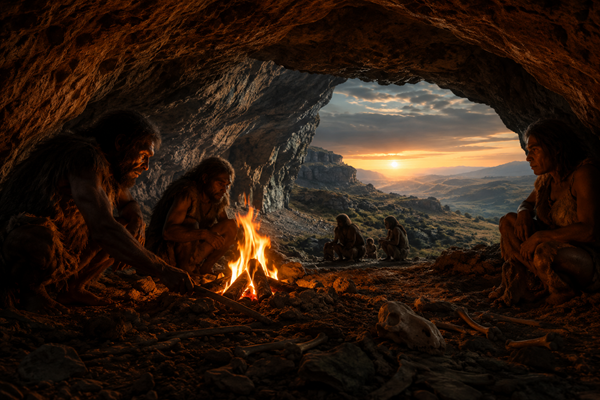
Who Carried Fire into the Darkness Nearly Two Million Years Ago—And What Secret Did They Leave Behind?
For generations, scientists have regarded the control of fire as one of the most transformative achievements in human evolution. Fire provided warmth during cold nights, protection from dangerous predators, illumination in darkness, and eventually the ability to cook food. Yet one question has remained unresolved: when did our ancestors first learn to harness and manage fire?
A remarkable new discovery from South Africa may now force researchers to rethink one of humanity’s most important evolutionary milestones. Deep inside an ancient cave, archaeologists have uncovered evidence suggesting that human ancestors may have been using fire as far back as one point seventy-nine million years ago. If confirmed, this finding would dramatically extend the timeline of fire use and reshape our understanding of early human behavior.
But what exactly was discovered inside the cave? And could this evidence reveal a forgotten chapter of humanity’s distant past?
Wonderwerk Cave Discovery Reveals Ancient Evidence of Fire Use
Hidden within the arid landscape of South Africa lies Wonderwerk Cave, one of the world’s most significant archaeological sites. For decades, researchers have excavated its ancient sediments, uncovering clues about the lives of early humans who occupied the region over immense stretches of time.
The cave has already transformed our understanding of prehistory. Previous excavations revealed evidence that humans used fire approximately one million years ago. Burned bones, heat-altered stone tools, and traces of combustion were discovered in a cave layer known as Stratum Ten.
However, researchers suspected that an even older story might be buried deeper beneath these sediments.
Their curiosity led them into lower and far more ancient layers of the cave. There, within a deposit known as Stratum Eleven, they encountered evidence that could push the origins of fire use back by hundreds of thousands of years.
Could these deeper layers preserve some of the earliest signs of controlled fire ever found?
Burned Animal Bones Provide Clues to Early Human Fire Management
Among the most important discoveries were the remains of small mammals embedded within the sediments of Stratum Eleven.
At first glance, these fossilized bones appeared unusual. Many displayed gray and white coloration often associated with burning. Yet appearances alone could not provide definitive proof. Scientists needed a more reliable way to determine whether these bones had truly been exposed to fire.
To answer this question, researchers employed an innovative analytical technique known as bone luminescence.
This method involves exposing fossilized bones to intense blue light while examining them under a microscope. When viewed through a specialized filter, bones that have been burned emit a distinctive red glow.
The results were striking.
Numerous bones from Stratum Eleven displayed the unmistakable luminescent signature associated with combustion. This strongly indicated that they had been subjected to significant heat in the distant past.
The finding immediately raised a profound question: who or what caused these fires?
Why Natural Wildfires Cannot Easily Explain the Wonderwerk Cave Evidence
Whenever evidence of ancient fire is discovered, scientists must first eliminate natural explanations.
Wildfires frequently occur across landscapes, and fire can enter caves through their openings. Therefore, researchers carefully examined whether the burned bones could have resulted from a naturally occurring blaze.
Their analysis suggested otherwise.
The fossilized remains were discovered approximately thirty meters inside the cave, far beyond the entrance. Flames from a passing grassland fire would have struggled to penetrate such a distance while producing repeated burn patterns deep within the cave system.
Moreover, the burned materials appeared in concentrated locations rather than being randomly scattered. This pattern suggests repeated combustion events occurring within the cave itself.
If wildfires were not responsible, then another possibility emerges.
Could early humans have intentionally transported fire into the cave and maintained it there?
The evidence does not yet provide a definitive answer. Nevertheless, it raises one of the most fascinating questions in paleoanthropology.
Dating Ancient Fire Evidence to Between One Point Zero Seven and One Point Seventy-Nine Million Years Ago
Determining the age of archaeological discoveries is often as important as the discoveries themselves.
To establish when these combustion events occurred, scientists analyzed the cave sediments using two independent dating techniques.
The first method, magnetostratigraphy, examines changes in Earth’s magnetic field that became recorded in sediment layers over time.
The second method, cosmogenic burial dating, measures rare isotopes produced by cosmic radiation before sediments become buried underground.
By combining results from both approaches, researchers concluded that the burned bones were deposited sometime between one point zero seven million and one point seventy-nine million years ago.
This time range falls within the Early Pleistocene, an era during which early members of the human lineage were expanding across diverse environments and developing increasingly sophisticated technologies.
If these dates withstand future scrutiny, the Wonderwerk evidence could represent one of the oldest known records of fire use anywhere on Earth.
How Fire May Have Influenced Human Evolution Millions of Years Ago
The implications of this discovery extend far beyond a single cave.
Fire fundamentally altered the relationship between humans and their environment. It enabled warmth during colder periods, extended waking hours after sunset, and provided protection against predators.
Many researchers also believe that cooking transformed human biology itself.
Cooked food is easier to digest and often yields more calories than raw food. Some scientists argue that access to cooked meals contributed to changes in anatomy, energy use, and even brain development.
Yet the Wonderwerk findings do not necessarily prove that cooking was already common nearly two million years ago.
Instead, the evidence suggests something equally intriguing.
Early humans may have been capable of collecting naturally occurring fire, transporting it, and maintaining it for extended periods. Such behavior would have required planning, cooperation, and an understanding of how fire behaves.
Could these abilities represent the earliest steps toward the technological mastery that would eventually define our species?
Repeated Combustion Events Suggest More Than a Single Accidental Fire
One of the most compelling aspects of the research is the repeated nature of the evidence.
Scientists identified burned materials in both Stratum Ten and Stratum Eleven. The presence of combustion traces in multiple archaeological layers suggests that fire-related activity occurred more than once.
This pattern is difficult to reconcile with a single accidental event.
Instead, it points toward recurring interactions between humans and fire over long periods of time.
The study’s authors emphasize that the burned bones recovered from the cave provide strong evidence for repeated and spatially patterned combustion events deep within Wonderwerk Cave.
Although researchers remain cautious, the evidence increasingly suggests that these ancient fires were not isolated incidents.
What knowledge did these early humans possess? How did they preserve flames? Did they understand how to ignite new fires, or were they dependent on natural sources such as lightning strikes?
These questions remain unanswered.
The Wonderwerk Cave Fire Discovery Raises New Questions About Humanity’s Origins
Every major archaeological discovery answers some questions while creating many more.
The evidence from Wonderwerk Cave does not conclusively demonstrate that early humans invented fire-making technology nearly two million years ago. Nor does it prove that they routinely cooked food.
However, it does reveal that our ancestors may have interacted with fire far earlier than previously believed.
If future studies confirm these findings, textbooks may need revision. The timeline of human technological development could extend much deeper into the past than many researchers once imagined.
Perhaps the most fascinating aspect of this discovery is not what it tells us, but what it leaves unresolved.
Who first carried a burning branch into the darkness of Wonderwerk Cave?
What motivated them to do so?
And how many other traces of humanity’s earliest experiments with fire remain hidden beneath layers of ancient sediment, waiting to be uncovered?
As archaeologists continue exploring the depths of this remarkable cave, the answers may bring us closer to understanding one of the defining moments in human history—the moment our ancestors first learned to command the power of fire.
Source: Who Carried Fire into the Darkness Nearly Two Million Years Ago—And What Secret Did They Leave Behind?
After Nearly a Century of Debate, What Does the Starchild Skull Actually Tell Us About Humanity?
After Nearly a Century of Debate, What Does the Starchild Skull Actually Tell Us About Humanity?
Who Carried Fire into the Darkness Nearly Two Million Years Ago—And What Secret Did They Leave Behind?
Sources
Chazan, M., et al. (PLOS One) – Research on burned fossil bones from Wonderwerk Cave.
Wonderwerk Cave archaeological investigations and stratigraphic studies.
Research on magnetostratigraphy and cosmogenic burial dating methods used in Early Pleistocene archaeology.
Studies of early Acheulean occupations in southern Africa and the evolution of controlled fire use.
Who Carried Fire into the Darkness Nearly Two Million Years Ago—And What Secret Did They Leave Behind?