
Tiny Genetic Change Turns Female Mice Into Males, Scientists Discover
A new study reveals that an extremely small change in a non-coding region of DNA can dramatically alter how sex develops in mice.
How much can a single letter of DNA matter? According to new research from Bar-Ilan University, one misplaced genetic “letter” can completely change the course of sexual development. In a study published in Nature Communications, researchers showed that adding just one DNA base to a regulatory region caused XX mice, which normally develop as females, to instead develop testes and male reproductive anatomy.
Remarkably, the mutation was not located within a gene. It occurred in non-coding DNA, a vast portion of the genome once dismissed as “junk” but now recognized as a critical control system for gene activity. The results demonstrate how subtle changes in these regulatory sequences can have profound biological effects.
“This is a remarkable finding because such a tiny change — just one DNA letter out of ~2.8 billion — was enough to produce a dramatic developmental outcome,” said Dr. Nitzan Gonen, from the Goodman Faculty of Life Sciences and Institute of Nanotechnology and Advanced Materials at Bar-Ilan University. “It shows that non-coding DNA can have a profound effect on development and disease.”
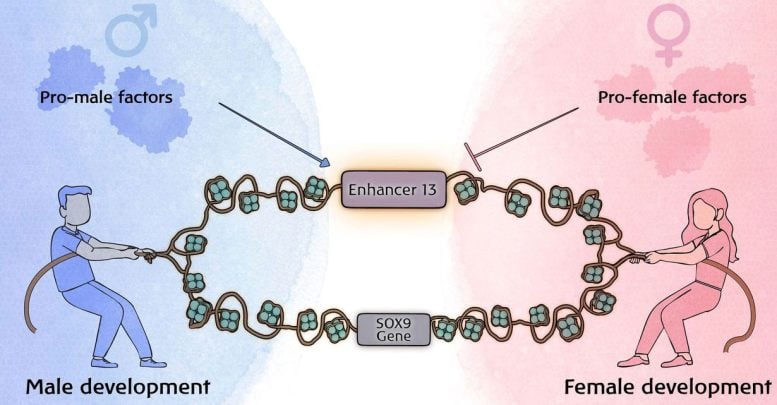
Enh13 Controls the Critical Sox9 Development Switch
The mutation was introduced into a regulatory element called Enh13, which controls the activity of Sox9, a gene required for testis development. For ovaries to form normally, Sox9 must remain inactive. The researchers found that Enh13 functions as a molecular switch. In males, factors that promote testis formation bind to Enh13 and activate Sox9. In females, factors that support ovary development bind to the same region and suppress the gene.
Using CRISPR genome editing, the team introduced the mutation and found that this female-specific repression no longer worked. As a result, Sox9 became active in XX mice, triggering testis formation and complete internal and external male development.
The researchers also generated several mouse models carrying very small changes in Enh13, including a one-base pair insertion and a three-base pair deletion. Both mutations caused XX mice to develop testes. Cell line reporter assays were then used to investigate how these alterations disrupted the normal regulatory process.
Dual Role of Enh13 Revealed in Sex Determination
The findings build on earlier research from the same group published in 2024. That study showed that other small mutations in Enh13 could produce the opposite outcome, causing XY mice to develop as females. Together, the results indicate that Enh13 serves two functions: it promotes male development while also needing to be suppressed during female development.
Beyond advancing basic biological knowledge, the research may have implications for people with Differences of Sex Development (DSD), a group of conditions affecting about 1 in 4,000 births worldwide. More than half of DSD cases still remain genetically unexplained, even after sequencing the protein-coding regions of the genome.
“Our findings show that it is not enough to look only at genes,” said Elisheva Abberbock, the PhD student leading the research. “Important disease-causing mutations may also lie in the non-coding genome, in DNA regions that control gene activity rather than encode proteins.”
The researchers believe Enh13 is likely only one example of many regulatory regions within non-coding DNA that influence sex determination and other developmental disorders. They are now working to systematically identify additional regions and test their biological functions.
Source: SciTechDaily
‘The Heaven Sword’ crowned as East Asia’s tallest tree after a nearly decade-long search
Tiny Genetic Change Turns Female Mice Into Males, Scientists Discover