What If the Universe’s First Galaxies Were Born in Turbulence, Not Harmony?
New Observations Expose How the First Galaxies Took Shape in a Turbulent Cosmic Dawn
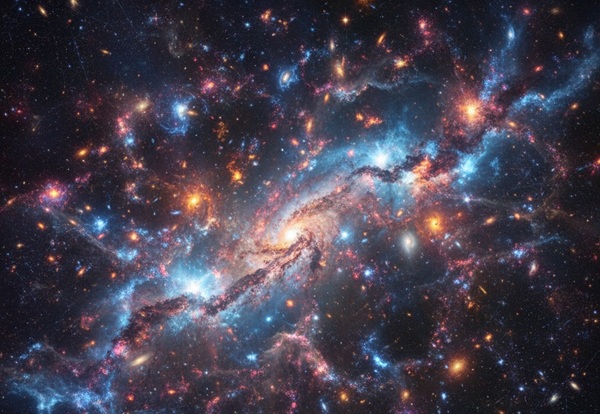
Using the powerful James Webb Space Telescope (JWST), astronomers have captured the clearest picture yet of how galaxies formed in the early universe — and it’s not what anyone expected. Instead of elegant spiral arms and orderly disks, Webb reveals a cosmic landscape of gas-filled, chaotic young galaxies, constantly reshaped by violent starbursts and collisions.
These discoveries bridge a crucial gap between the universe’s earliest light and its era of peak star formation, showing how a cosmos born in chaos gradually evolved toward order and structure.
Chaotic Beginnings: Galaxies in the Early Universe Were Anything but Calm
Astronomers from the University of Cambridge analyzed more than 250 young galaxies that existed when the universe was only 800 million to 1.5 billion years old. What they found challenges earlier assumptions: the majority of these galaxies were turbulent, uneven swirls of gas and dust, rather than the smooth, rotating disks seen in mature galaxies like the Milky Way.
“We don’t just see a few spectacular outliers — this is the first time we’ve looked at an entire population of early galaxies at once,” said Lola Danhaive, first author from Cambridge’s Kavli Institute for Cosmology. “Some galaxies are beginning to settle into ordered rotation, but most remain chaotic, with gas puffed up and moving in all directions.”
Could this cosmic disorder be the missing link between the universe’s explosive birth and its later graceful formations?
A Universe in Transition: From Cosmic Turbulence to Galactic Order
Published in Monthly Notices of the Royal Astronomical Society, the study reveals a striking trend: as the universe aged, galaxies slowly became more stable and structured. In the beginning, however, gravitational forces and starburst activity generated immense turbulence, preventing gas from cooling and rotating smoothly.
This paints a picture of a universe in motion toward order, evolving from wild, stormy systems into the calm galactic architectures we recognize today.
“Previous results suggested massive, well-ordered disks forming very early on — but that didn’t fit our models,” explained co-author Dr. Sandro Tacchella of the Kavli Institute and Cavendish Laboratory. “By studying hundreds of smaller galaxies, we now see the bigger picture: early galaxies were far more chaotic and grew through frequent mergers and bursts of star formation.”
JWST’s Grism Mode Unlocks Hidden Galactic Motion
The team used JWST’s NIRCam instrument in a specialized “grism mode,” designed to detect faint light from ionized hydrogen gas in distant galaxies. This allowed scientists to map the movement of gas and understand how it interacted during early formation phases.
Danhaive developed custom software to interpret the telescope’s intricate spectral data, combining it with imagery from other JWST programs. The result is a detailed visualization of how gas circulates and collides inside galaxies that formed just a few hundred million years after the Big Bang.
Could this cutting-edge technique become the key to uncovering how cosmic chaos evolved into order?
Bridging the Cosmic Gap: From Reionisation to the Age of Stars
“This work helps bridge the gap between the epoch of reionisation — when the first light reionized the universe — and the so-called cosmic noon, when star formation reached its peak,” said Danhaive. “It shows how galactic building blocks gradually transitioned from chaotic clumps into ordered structures, paving the way for galaxies like the Milky Way.”
The findings underscore JWST’s unprecedented ability to trace galaxy dynamics and reveal processes that shaped the visible universe. By pairing these results with upcoming observations of cold gas and interstellar dust, scientists hope to reconstruct the full timeline of how galaxies took shape — from cosmic infancy to maturity.
The Future of Cosmic Discovery: What Will JWST Uncover Next?
“This is just the beginning,” said Tacchella. “With more JWST data, we’ll be able to track how these turbulent systems grew up and became the graceful spirals we see today.”
As JWST continues to push the boundaries of time and distance, one question lingers:
How did the universe transform from a storm of gas and light into the structured beauty we now call home?
The answers, shimmering from galaxies billions of light-years away, remind us that even cosmic order was born from chaos.
Source: What If the Universe’s First Galaxies Were Born in Turbulence, Not Harmony?
The Moon Just Revealed a Secret: Were Life’s Ingredients Delivered from Space?
The Moon Just Revealed a Secret: Were Life’s Ingredients Delivered from Space?