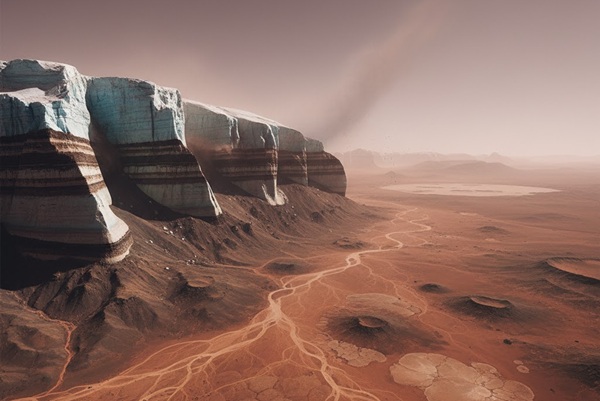
What If the Red Planet’s Past Ice Ages Tell Our Planet’s Future?
For decades, planetary scientists have searched for the answer to one of the Red Planet’s biggest mysteries: How much water did Mars once hold—and why did it fade away?
A groundbreaking study published online on September second, two thousand twenty-five in Geological Society of America’s journal Geology peels back the frozen layers of time, uncovering how Mars endured repeated ice ages spanning hundreds of millions of years—each one leaving the planet a little drier.
Martian craters act like “ice archives”, storing frozen records of ancient climates. By examining these natural vaults, researchers have pieced together a chilling timeline: with every ice age, the amount of preserved ice shrank, signaling a long, slow desiccation of the planet.
Ice Age Cycles in Martian Craters: Tracing a Planet’s Frozen Timeline
The study was led by Trishit Ruj, Associate Professor at the Institute for Planetary Materials in Japan, alongside collaborators Hanaya Okuda, Hitoshi Hasegawa, and Tomohiro Usui.
By investigating glacial landforms between twenty degrees north and forty-five degrees north latitude, they reconstructed the long-term rise and fall of Martian ice.
Dr. Ruj explains,
“Mars experienced repeated ice ages, but the amount of ice in these craters steadily shrank over time. These icy ‘time capsules’ reveal not only how Mars lost its water—but also where future explorers might find it.”
NASA Orbiter Data Reveals Ice’s Hidden Patterns
Using high-resolution images from the NASA Mars Reconnaissance Orbiter, the researchers identified signs of glaciation, including:
Ridges that mark past glacier flows
Moraines, piles of debris left behind by retreating ice
Brain terrain, maze-like patterns carved by melting and refreezing
They discovered that ice consistently clustered in the cold, shadowed southwestern walls of craters. This pattern appeared across multiple glacial cycles—dating from approximately six hundred forty million to ninety-eight million years ago.
But what forced these icy shifts? The culprit lies in Mars’ wildly swinging axial tilt. Unlike Earth, Mars’ obliquity can change drastically over millions of years, redistributing sunlight and triggering cycles of ice accumulation and melting. Over time, these swings stored less and less ice, driving a planet-wide drying process.
From Ancient Ice to Future Water: Why These Craters Matter
Why does this matter now?
Because what’s hidden in those icy layers could determine the future of human exploration.
Buried Martian ice could be:
Melted for drinking water
Converted into oxygen for breathing
Split into hydrogen and oxygen for rocket fuel through in-situ resource utilization (ISRU)
Prof. Usui notes,
“Knowledge of long-lived ice deposits helps identify safe and resource-rich regions for future robotic and crewed landings.”
With the right planning, these frozen time capsules may become life-support stations for future missions—turning Mars’ past into a key for humanity’s future survival beyond Earth.
A Mirror to Earth: Climate Lessons from the Red Planet
The implications stretch far beyond Mars.
What if the Red Planet’s frozen history could help us better understand Earth’s climate future?
As Dr. Hasegawa emphasizes,
“Mars is a natural laboratory for studying ice behavior over vast timescales. The tools we use here can sharpen our understanding of climate processes on Earth.”
The same remote sensing and climate modeling techniques that revealed Martian ice retreats can track glacier melt, permafrost changes, and water reservoir shifts on Earth—where climate change is already accelerating.
Final Thoughts: Will Mars’ Icy Past Shape Our Future?
The discovery of multi-stage Martian glaciations paints a haunting yet hopeful image:
a planet that once cycled through icy abundance, only to watch its frozen lifeblood vanish.
But those frozen clues are more than relics—they’re resources, warnings, and opportunities.
How long will these hidden ice reserves last?
Can humanity learn from Mars’ climate story before repeating it on Earth?
And could these ancient deposits fuel not just rockets—but a new chapter in human exploration?
The answers may be buried not in the future—but in the cold, shadowed craters of Mars.
Source: What If the Red Planet’s Past Ice Ages Tell Our Planet’s Future?
Will the Universe End in a Reverse Big Bang Sooner Than We Think?
Will the Universe End in a Reverse Big Bang Sooner Than We Think?