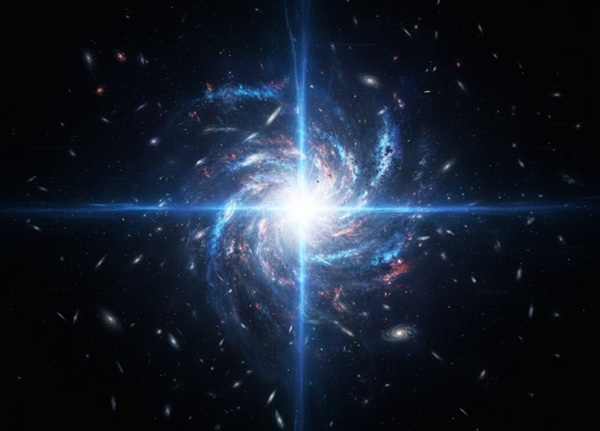
Will the Universe End in a Reverse Big Bang Sooner Than We Think?
The Universe — once thought to expand forever — may be destined for a dramatic collapse. According to new research, cosmic expansion could slow, stop, and reverse in what physicists are calling a “reverse Big Bang”. The model suggests our cosmos has just 20 billion years left before it ends in a cataclysmic Big Crunch.
Dark Energy Evolution Could Rewrite the Universe’s Fate
For decades, cosmologists assumed that dark energy was constant — a mysterious, repulsive force pushing galaxies apart forever. But recent evidence hints that dark energy may evolve over time. If this is true, our cosmic timeline could be finite.
A team including Hoang Nhan Luu of Donostia International Physics Center, Yu-Cheng Qiu of Shanghai Jiao Tong University, and Henry Tye of Cornell University has calculated a new lifespan of the Universe: 33.3 billion years. Since we are already 13.8 billion years in, that leaves less than 20 billion years until the end.
“The new data seem to indicate that the cosmological constant is negative, and that the Universe will end in a Big Crunch,” Tye explains.
From Endless Expansion to a Big Crunch: How the Cosmic Reversal Works
The key lies in Einstein’s cosmological constant, known as λ. When λ is positive, the Universe expands forever. But if λ is negative — as new findings suggest — expansion could reverse.
Initially, a gentle push from ultralight axion fields drives the Universe’s acceleration. But over the next 11 billion years, this push is expected to weaken. When it does, the negative cosmological constant will dominate, halting expansion at about 1.7 times the Universe’s current size. Then, the cosmos will begin to contract, collapsing inward in only 8 billion years.
Think of it like riding a bike uphill with a fading tailwind: the climb slows, stops, and then gravity pulls you downhill — faster than the climb itself.
Axion Fields and the Cosmic Tug-of-War
Axions — hypothetical ultra-light particles — were proposed decades ago to solve fundamental problems in particle physics. In this model, they act as a cosmic force, giving the Universe an initial outward shove. But unlike an unchanging cosmological constant, axions fade over time.
As their influence wanes, gravity takes over. The denser the Universe becomes, the faster the collapse. The crunching phase is shorter and more violent than the expansion, leading to an infinitely dense singularity — the mirror image of the Big Bang.
Could the Universe’s End Be Closer Than We Think?
This isn’t a guaranteed doomsday prediction, but one possible future scenario. To confirm it, scientists must first determine whether dark energy truly evolves. If the cosmological constant remains at zero or positive, the Universe might expand indefinitely. But if negative λ is confirmed, then the cosmic end is inevitable.
And that raises profound questions:
What happens after the Big Crunch?
Could a new Big Bang follow, creating a new Universe?
How does this change our understanding of cosmic evolution and our place in it?
A Beginning, and an End — Just Like Life
“In the 1960s, we learned that the Universe had a beginning,” Tye reflects. “The next question is: Does it have an end? For many years, people thought it would just go on forever. It’s good to know that, if the data holds up, the Universe will have an end.”
The idea of a cyclical cosmos — one that is born, grows, collapses, and is reborn — has long fascinated both scientists and philosophers. If this model is correct, humanity lives somewhere in the middle chapters of that cosmic story.
The question is no longer if the Universe had a beginning. It may now be: When will it end — and what comes after the final act?
Source: Will the Universe End in a Reverse Big Bang Sooner Than We Think?
Is Space Really Empty — or Is the Universe Hiding Something We Can’t See?
Is Space Really Empty — or Is the Universe Hiding Something We Can’t See?