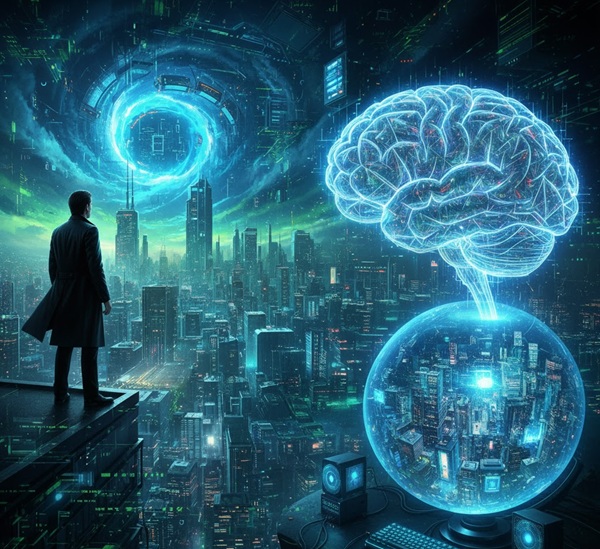
Is Your Reality Real or Just a Highly Advanced AI Simulation?
From The Matrix to Modern Science: Are We Inside a Virtual World?
In the closing moments of the 20th century, The Matrix introduced millions to a provocative idea: What if the world we experience is nothing but a highly sophisticated illusion? In the film, Neo discovers that the reality he knows is actually a virtual environment constructed by artificial intelligence.
Back then, the concept sounded like pure science fiction. Today, however, the “simulation hypothesis” has become a serious intellectual debate. According to this theory, living beings may be characters inside a computer-generated universe — a kind of massively multiplayer simulation. If so, what does that imply about consciousness, creation, and the nature of reality itself?
Remarkably, these questions echo themes explored for centuries by mystics, philosophers, and religious traditions around the world.
Simulation Theory and the Question of Reality: Are We Living Inside a Cosmic Game?
The modern wave of simulation discussions began with philosopher Nick Bostrom’s influential 2003 paper. His core argument is deceptively simple: If technological progress continues, future civilizations will likely be able to create virtual worlds indistinguishable from physical reality. If they can do this, why assume ours is the original world?
Some physicists and mathematicians agree it’s plausible; others insist the question is unanswerable. Columbia University astronomer David Kipping even estimated the odds at roughly fifty–fifty. Meanwhile, a 2025 study argued that no purely algorithmic system could fully account for the universe — raising another question: If not an algorithm, then what?
What makes simulation theory especially intriguing is that it does not demand that simulated beings be soulless or unconscious. In The Matrix, after all, Neo existed both inside and outside the simulation. Could something similar be true for us?
If technology is already generating virtual realities at astonishing speed, how far away is a world indistinguishable from our own — and could such a world already exist?
A Designed Universe? Simulation Theory and the Search for Higher Intelligence
At its core, simulation theory suggests the presence of a higher intelligence outside our own physical universe — an idea deeply familiar to many religious traditions. Transhumanist thinker David Pearce even described Bostrom’s argument as “the first interesting argument for the existence of a Creator in two thousand years.”
Judaism, Christianity, and Islam all describe a universe spoken into existence by a singular creator. The Book of Genesis and the Quran both portray creation emerging through divine command.
Simulation theory draws an unexpected parallel: our universe may have emerged from “commands,” too — only this time through code.
The comparison becomes even more striking with modern AI. Today, people generate lifelike images, characters, and worlds simply by issuing prompts. Some AI-generated characters even insist they are not virtual — a phenomenon dubbed prompt theory.
And with tools like Google’s Genie 3 (released in 2025), users now create explorable virtual worlds in seconds. Once unimaginable in scale, these worlds hint at how easily an advanced civilization could construct a universe far larger than our own.
If we can already build miniature realities, what might a far older intelligence be capable of?
Soul, Body, and Avatar: How Simulation Theory Mirrors Religious Concepts of Incarnation
Another striking parallel between simulation theory and religion lies in the relationship between the body, the soul, and personal identity.
One branch of the hypothesis — the RPG or “role-playing game” model — suggests that each person is like an avatar, controlled by an external consciousness that exists outside the simulation. In this sense, humans may exercise free will not just as characters but as players with deeper origins.
The word “avatar” itself comes from Sanskrit and refers to divine incarnations in Hinduism — spiritual beings taking physical form. Many traditions describe the mystery of the soul entering the body. Islamic Hadith literature speaks of the moment “the soul is breathed into” the unborn child. In the Bible, God breathes the “breath of life” into Adam.
Mystics have long compared the body to clothing that can be put on or taken off. Rumi used this metaphor, and the Bhagavad Gita echoes it clearly: just as we change old garments for new ones, the Self abandons old bodies and takes on others.
If life in a simulated world mirrors this metaphor, what does that say about the nature of the “player” — the soul — outside the simulation? And if the simulation ends, or the body dies, does the player simply log in again, experiencing what religions describe as reincarnation?
The Illusion of the Physical World: Maya, Awakening, and the Virtual Reality Analogy
Perhaps the most profound alignment between simulation theory and religious teachings is the belief that the physical world is not ultimately real.
In Hindu and Buddhist traditions, the cosmos is shaped by maya, often translated as “illusion.” Reality, they suggest, is more like a dream from which one can awaken — a concept echoed in the very definition of “Buddha” as “the awakened one.”
Classical texts offer vivid metaphors: mirages, dream visions, apparitions. Paramahansa Yogananda, writing in the early 20th century, compared human life to actors performing in a film. Were he alive today, he might compare us to players inside an advanced VR game.
In The Matrix, Morpheus tells Neo he has been living in a dream world maintained by intelligent machines. Simulation theory proposes a modern version of this dream — a meticulously coded universe managed by sophisticated AI.
If our universe is a dream, a film, or a simulation, how would we know? And if it is, what — or who — exists beyond it?
A Modern Theory With Ancient Echoes
The simulation hypothesis may be framed in scientific terms, but its implications sit comfortably within a long lineage of philosophical and spiritual thought. It raises questions humanity has wrestled with for thousands of years:
Why are we here? Who created this world? What lies beyond the visible? Is the essence of who we are something more than the body we inhabit?
With AI creating increasingly realistic worlds, and with ancient wisdom providing centuries of metaphors, perhaps the real question is not whether the universe is a simulation —
but whether we are ready to confront what that possibility means.
And like Neo, we may find ourselves thinking only one thing.
Source: Is Your Reality Real or Just a Highly Advanced AI Simulation?
What If the Color of an Exoplanet’s Clouds Reveals Life Above the Surface?
What If the Color of an Exoplanet’s Clouds Reveals Life Above the Surface?
Is Your Reality Real or Just a Highly Advanced AI Simulation?