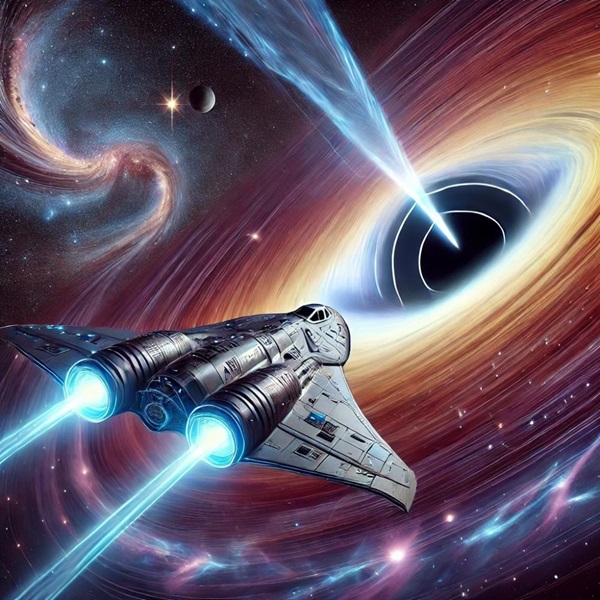
Warp Drives and Black Holes: Are We on the Brink of a Breakthrough?
Warp drives have a long history of not existing, despite their ubiquitous presence in science fiction. The concept was first introduced by writer John Campbell in a science fiction novel called Islands of Space. Today, thanks to Star Trek, the term is widely recognized, almost a generic reference for superluminal travel through hyperspace. Whether or not warp drives will ever exist is a physics problem that researchers are still trying to solve, but for now, it’s purely theoretical.
Recently, two researchers explored what would happen if a warp drive-equipped ship attempted to enter a black hole. The result is an intriguing thought experiment. While it might not lead to starship-sized warp drives, it could pave the way for smaller versions in the future.
Remo Garattini and Kirill Zatrimaylov theorized that such a drive could survive inside a so-called Schwarzschild black hole—provided the ship crosses the event horizon at a speed slower than light. Theoretically, the black hole’s gravitational field would reduce the amount of negative energy required to sustain the warp drive. If this holds true, the ship could pass through the black hole and possibly use it as a gateway to another part of the universe without being crushed. Furthermore, the mathematics behind this idea could guide the development of mini-warp drives in laboratory settings.
What’s a Warp Drive?
Could scientists build a micro- or mini-warp drive in the lab? Good question. To understand the team’s work, let’s first explore the key concepts: warp drives and black holes.
The idea behind warp drives is inspired by the fact that nothing can travel faster than light. Given the vast distances in space, reaching the nearest star would take years, even at light speed. Traveling across or between galaxies would take many lifetimes. So, if we want to become a spacefaring species, we must find a way to travel faster than light (FTL).
This is where warp drives come into play. Theoretically, they allow a spaceship to move within a bubble that can slip through space at FTL speeds. In Star Trek and other science fiction stories, starships use an energy source within a “warp core” to power warp field generators. These generators create a warp bubble in subspace, enabling the ship to travel vast distances quickly.
Do Physicists Like Warp Drives?
Warp drives are a tantalizing idea, but they come with significant challenges. For instance, generating a warp field requires an immense amount of energy—more than we can currently produce. Some physicists suggest it would take more energy than is available in the entire universe. Additionally, creating such energy would require exotic matter, something as hypothetical as “unobtanium.”
Others argue that creating a warp drive contradicts our current understanding of spacetime physics. Nevertheless, this hasn’t stopped anyone from speculating on ways to make it work. For example, in 1994, Mexican physicist Miguel Alcubierre proposed a drive that could create a bubble shifting space around an object. However, Alcubierre and others still point out various problems with building and sustaining a warp drive. One of these issues is that such a drive could isolate the ship from the rest of the universe, making it impossible to control.
About Black Holes
Black holes are most commonly understood as either stellar-mass or supermassive objects. These often have accretion disks that funnel material into the black hole. For instance, the central supermassive black hole in our Milky Way, known as Sagittarius A*, periodically consumes material, emitting a burst of radiation afterward. In other, more active galaxies, jets of material are emitted as the central black hole continuously feeds.
A black hole is a concentration of mass with gravity so strong that nothing, not even light, can escape. In their study, Garattini and Zatrimaylov used Schwarzschild black holes—simple “static” black holes that curve spacetime, have no electric charge, and do not rotate. These are ideal for mathematical exploration of the characteristics of slowly rotating objects in space.
When a Ship with Warp Drive Crosses into a Black Hole
The Schwarzschild black hole is the “perfect” black hole to use in this theoretical exploration of a warp drive crossing the event horizon. To test this scenario, Garattini and Zatrimaylov mathematically combined the equations describing the black hole with those describing the warp drive. They found that it’s possible to “embed” the warp drive in the outer region of the black hole. The warp bubble itself is much smaller than the black hole and must move toward it. The black hole’s gravity affects the energy conditions needed to create and sustain the warp drive, theoretically decreasing the amount of negative energy required. Additionally, the researchers suggest that if the warp bubble is moving slower than light, it effectively erases the black hole’s event horizon.
The research team also proposed that this situation could lead to the conversion of virtual particles into real ones in an electric field. If so, this might allow for the creation of mini-warp drives in laboratory settings.
Changing the Black Hole a Bit
Interestingly, the team also suggests that if the warp bubble is small and slow-moving relative to the black hole, it could increase the black hole’s entropy. However, they caution that if the warp drive is completely absorbed by the black hole, it may decrease the black hole’s mass and, therefore, its entropy.
Moreover, if a larger warp bubble passes through a black hole, it could produce a “screening” effect that effectively eliminates the event horizon, making it impossible to define the black hole’s entropy in the Hawking sense. If warp drives are indeed possible, these issues indicate that we still don’t fully understand them from a thermodynamic perspective.
Warp Drive Technology Remains to be Seen
While this research is valuable theoretically and might lead to the lab production of mini-warp drives, many questions remain unanswered. Perhaps in the future, as we gain a deeper understanding of quantum mechanics and both of these objects, warp technology may become feasible. If that happens, we might be able to send signals from inside a black hole carried by a warp bubble emerging from the singularity. This could allow us to capture images or recordings of what it’s like inside the event horizon—a realm currently beyond our knowledge.
There’s also a possibility that black holes could make warp drives easier to achieve by reducing the need for exotic “negative energy” source material.
Source: Warp Drives and Black Holes: Are We on the Brink of a Breakthrough?
This Earth-Sized Planet Is on a Collision Course with Destruction—Could It Happen Here?
This Earth-Sized Planet Is on a Collision Course with Destruction—Could It Happen Here?