This Earth-Sized Planet Is on a Collision Course with Destruction—Could It Happen Here?
Astronomers have recently confirmed the existence of exoplanets with extremely small orbits around their stars. But what happens when an Earth-sized exoplanet gets close enough to its star to be devoured? A recent study accepted by AAS Journals explores this question. An international team of over 50 researchers investigated an Earth-sized exoplanet with an orbital period of just 5.7 hours—classified as an “ultra-short-period” (USP) exoplanet—that could eventually experience tidal disruption, leading to its destruction by its star. This research could help us better understand these processes and challenge our current understanding of exoplanetary systems.
In a discussion with Dr. Fei Dai, an Assistant Astronomer at the University of Hawai’i and the study’s lead author, Universe Today delves into the motivations, findings, and implications of this research. Dr. Dai notes that tidal disruption could be the eventual fate of rocky planets, citing a March 2024 study published in Nature that discusses this phenomenon. “It seems like about 10 percent of sun-like stars might have engulfed their rocky planets. This system, TOI-6255, is the best-known progenitor for these planet engulfment events. The tidal disruption of rocky planets allows us to probe their interior composition and compare it with Earth.”
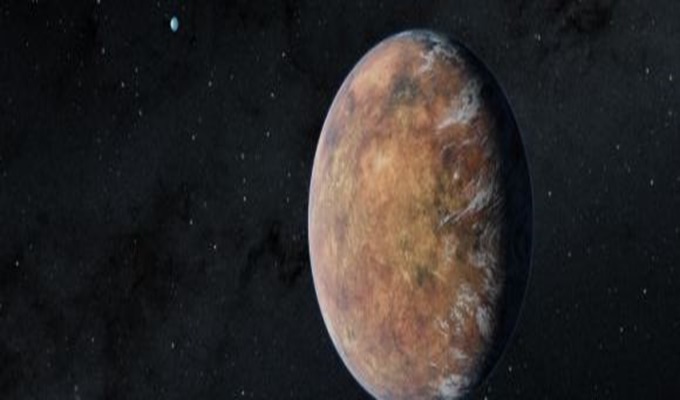
The researchers analyzed TOI-6255 b, an exoplanet with a radius about 1.08 times and a mass 1.44 times that of Earth, located just over 20.4 parsecs (65.2 light-years) away. Despite being Earth-sized, TOI-6255 b’s 5.7-hour orbit makes it far too hot for life as we know it and places it dangerously close to the Roche limit—the distance at which a smaller object can be torn apart by a larger object’s gravity. The planet is also tidally distorted, with a shape resembling a football due to the intense gravitational forces, a significant deviation from a perfect sphere. In comparison, Earth’s tidal distortion caused by the Moon is minuscule.
Dr. Dai adds, “This planet is doomed for tidal disruption in 400 million years, which is short on a cosmic scale (~13 billion years).” The researchers hope to confirm the planet’s tidal distortion using NASA’s James Webb Space Telescope through an orbital phase curve study. This could also reveal whether the planet’s surface is covered by a lava pool, as would be expected given its extreme heat.
Ultra-short-period (USP) exoplanets like TOI-6255 b are rare, with only about 100 discovered so far. These planets, with orbits of less than a day and masses less than twice that of Earth, are likely too hot for life. Similarly, “hot Jupiters”—gas giants with similarly short orbits—are also unlikely to support life. The significance of TOI-6255 b being Earth-sized, rather than Jupiter-sized, lies in its rocky composition, which offers insights into the makeup of terrestrial planets in other systems. Jupiter-sized planets, on the other hand, are mostly covered by thick hydrogen and helium atmospheres and are less likely to harbor life.
Although TOI-6255 b won’t be destroyed for another 400 million years, observing such an event could provide crucial insights into the composition of exoplanets, helping us better understand the similarities and differences between exoplanets and planets in our solar system. These unique worlds and their extremely tight orbits continue to challenge our understanding of planetary system architectures across the Milky Way Galaxy.
In our solar system, tidal disruption of planets is minimal. However, the rings of Saturn are believed to have originated from the tidal disruption of satellites. Tidal forces are highly dependent on orbital separation, with only objects in very close orbits experiencing significant tidal effects.
What new discoveries about tidal disruption on Earth-sized worlds will astronomers make in the coming years and decades? Only time will tell, and this is why we science!
Source: This Earth-Sized Planet Is on a Collision Course with Destruction—Could It Happen Here?