Venus’s ‘Missing’ Craters Found: Could This Change What We Know About the Planet?
When we think of the Moon, we often picture a barren surface covered with craters. Mars has similar pockmarks, only redder. Even Earth has a history of impacts, though most evidence has eroded over time. But what about Venus? Despite lacking Earth-like weathering, the second planet from the Sun shows surprisingly few large impact basins. However, new findings by a team of astronomers offer a fresh perspective on Venus’s mysterious surface and reveal previously hidden impact sites.
Why Venus is Unlike Earth, Despite the “Sister Planet” Label
Venus is often called Earth’s “sister planet” due to its similar size and composition, yet its surface is a hostile, alien landscape. Temperatures on Venus soar above the boiling point of water, while the thick atmosphere exerts crushing pressure, equivalent to standing 3,000 feet underwater. The planet is shrouded in sulfuric acid clouds, creating a forbidding environment that would make any notion of exploration nearly impossible.
The Hidden Craters: Why We Don’t See Them from Space
If you were standing on Venus, you might see beautifully formed impact craters. But from orbit, the dense atmosphere obscures them from view. More puzzling, Venus’s surface lacks the large impact basins we see on other rocky planets. To solve this mystery, researchers from the Planetary Science Institute turned to radar technology to penetrate Venus’s thick clouds.
The Haastte-baad Tessera: A Window into Venus’s Violent Past
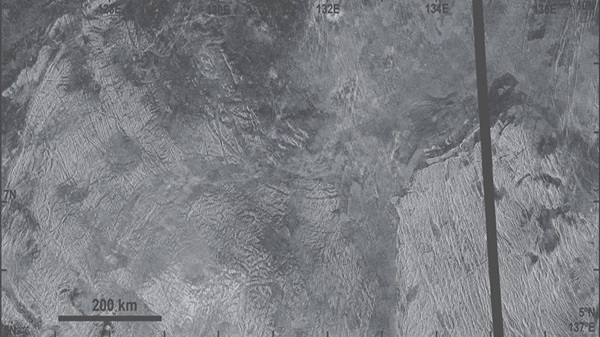
The team focused on an ancient region known as Haastte-baad Tessera, an area featuring complex, intersecting ridges known as tessera terrain. This unique pattern, resembling tiles, likely forms from a strong crust layer overlying a weaker layer, allowing for convective movement similar to boiling water. Using radar mapping, the scientists uncovered a concentric ring formation stretching over 1,400 kilometers. The researchers propose that this pattern may be the result of two closely spaced impact events, revealing the violent processes that helped shape Venus’s surface.

The Role of Venus’s Thin Crust in Creating Tessera Terrain
According to Vicki Hansen, a senior scientist at the Planetary Science Institute, the thin crust that once existed on Venus was likely only about 9 kilometers thick—compared to today’s 112-kilometer-thick lithosphere. This thin crust could have cracked when struck by a massive impactor, allowing molten lava to seep through and harden into tesserae over time.

Why Raised Plateaus Hold the Answer to Venus’s Hidden Craters
Interestingly, these tessera formations are often seen on flat, elevated plateaus where the lithosphere is thought to be thicker. Hansen explains that when magma rises to the surface and solidifies, it leaves behind a material called residuum. This solid residuum is not only denser than the surrounding mantle but also buoyant, much like an air mattress under a lava pond, which pushes the tessera terrain upward. This process suggests that Venus’s unique geology has preserved signs of ancient impacts hidden beneath its surface.
Unraveling the Mystery: Evidence of Dual Impact Events
The radar mapping of Haastte-baad Tessera suggests that two impact events may have occurred in quick succession. The first may have created the lava buildup, while the second produced the ring structure seen today. These findings offer a fascinating glimpse into Venus’s geological history, revealing a surface shaped by ancient cosmic events that have left subtle, yet telling, clues for scientists to interpret.
Source: Venus’s ‘Missing’ Craters Found: Could This Change What We Know About the Planet?
Did Time Just Get Redefined? The James Webb Space Telescope’s Shocking Discovery
Did Time Just Get Redefined? The James Webb Space Telescope’s Shocking Discovery